
Pizzeria in former bank: 300,000€ investment, 5,000€/month rent
Former 250 m² bank converted into pizzeria: 200,000€ budget, 5,000€ monthly rent, projected daily revenue of 1,000€.
Deutsch · Ursprüngliche Diskussion auf Spanisch · Veröffentlicht
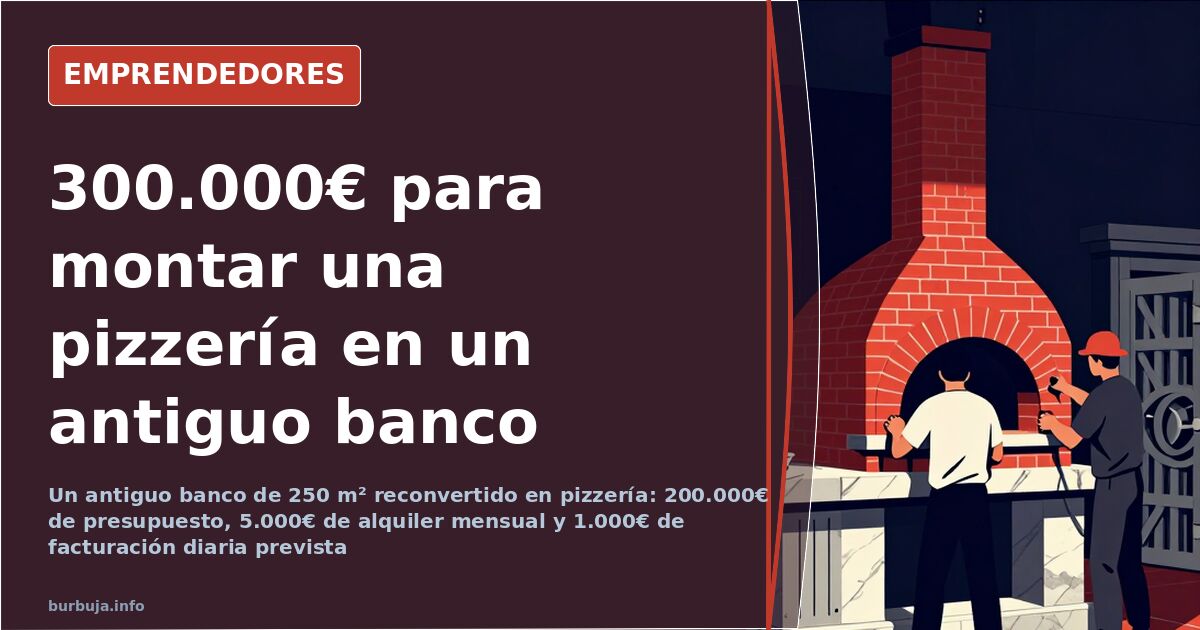
From bank to pizzeria: 250 m², €5,000 rent and €1,000 daily turnover
The starting point is a former bank branch of 250 square meters, completely gutted and renovated. The initial budget is around €200,000, although the project promoter admits it will easily reach €300,000. Monthly rent: €5,000. Projected revenue, if everything goes well: €1,000 per day from pizzas, montaditos (small sandwiches) and drinks.
The launch relies on an upfront payment of €15,000 with a two-month grace period for construction work, setting the opening date for December. It is not a standard pizzeria: it operates as a café in the morning, offering all kinds of pastries and montaditos, and as a restaurant for the rest of the day. The business is set up jointly with an entrepreneur in the sector who already runs five restaurants in the province and produces in a central warehouse supplying more than twenty points of sale.
What does it cost to keep a pizzeria open?
The figure that generates the most debate is not the investment, but the operating expenses. Those who have run small businesses are clear: between salaries, suppliers and other items, a restaurant can consume between €15,000 and €20,000 per month. With these numbers on the table, the initial investment would take about three years to amortize, provided the projected revenue is met.
And forecasts rarely come true. The warning is repeated: eating out is a discretionary expense when household budgets are tight, and the customer who fills the bar today looks for the cheapest menu tomorrow. To this is added competition. In the same area, another pizzeria with competitive prices was already operating, and it also closed.
The recurring recommendation: squeeze the landlord, negotiate exhaustively with suppliers and cut all unnecessary expenses. The margin is not in billing more, but in not spending too much.
The partner who bills millions annually
Here the project differs from the solo entrepreneur. The person driving the idea does not put up the €300,000: they are signed by a partner who generates between seven and ten million euros in annual revenue and operates four different companies doing the same thing. The business idea is their own, but the entry is framed "as a favor," based on a relationship spanning years and other shared ventures.
Some see this as the key to success, while others view it with suspicion. Starting a restaurant with an investor who already has a chain, logistics and its own oven radically changes the risk. The brand will be new, without a franchise, which offers freedom but also requires building the name from scratch.
Selling the business once it works
On the table is the medium-term exit strategy: polish it up, get it running and sell it, or keep a minimal stake and move on. Those proposing this say it bluntly: they are not interested in bearing social costs when the business is already generating good revenue.
The dilemma is old. Buying an ongoing business means paying for an established clientele. Selling after years of work leads to regret or detachment. A mentioned case: a premises bought in 2007, when it was already expensive, for which later offers were made of €600,000 more than the purchase price. Some sell chains for €40 million and continue to make successful purchases afterwards.
From wood-fired ovens to porcelain tiles containers
The conversation quickly shifts to other topics. From a pizzeria, one jumps to importing porcelain tiles from China, sea freight, 20-foot containers and auctions of seized vehicles. Specific prices appear: around €6,000 to bring a full container from Mexico, about $2,000 FOB from Brazil to Spain.
The underlying warning is the same as in hospitality: if the business depends on an undifferentiated product, the neighbor will copy it within six months and destroy the margin. Buying cheap abroad is useful for selling far from home, not for competing with the shop next door.
The result: "full capacity during peak hours"
Years later, the conclusion is an unexpected headline: the venue works. Full capacity during peak hours, albeit with nuances. The opening came when the approved credit —€200,000— had not yet arrived, a bottleneck anyone who has started a business knows well: papers signed on one side, money not arriving on the other.
With these foundations, the business should be a textbook case. And yet, those who set it up admit the result is not entirely what they expected. That is where the analysis gets stuck: between the projection of €1,000 per day, the €5,000 rent and the three-year amortization, the real margin remains a number no one can fully reconcile.
The starting point is a former bank branch of 250 square meters, completely gutted and renovated. The initial budget is around €200,000, although the project promoter admits it will easily reach €300,000. Monthly rent: €5,000. Projected revenue, if everything goes well: €1,000 per day from pizzas, montaditos (small sandwiches) and drinks.
The launch relies on an upfront payment of €15,000 with a two-month grace period for construction work, setting the opening date for December. It is not a standard pizzeria: it operates as a café in the morning, offering all kinds of pastries and montaditos, and as a restaurant for the rest of the day. The business is set up jointly with an entrepreneur in the sector who already runs five restaurants in the province and produces in a central warehouse supplying more than twenty points of sale.
What does it cost to keep a pizzeria open?
The figure that generates the most debate is not the investment, but the operating expenses. Those who have run small businesses are clear: between salaries, suppliers and other items, a restaurant can consume between €15,000 and €20,000 per month. With these numbers on the table, the initial investment would take about three years to amortize, provided the projected revenue is met.
And forecasts rarely come true. The warning is repeated: eating out is a discretionary expense when household budgets are tight, and the customer who fills the bar today looks for the cheapest menu tomorrow. To this is added competition. In the same area, another pizzeria with competitive prices was already operating, and it also closed.
The recurring recommendation: squeeze the landlord, negotiate exhaustively with suppliers and cut all unnecessary expenses. The margin is not in billing more, but in not spending too much.
The partner who bills millions annually
Here the project differs from the solo entrepreneur. The person driving the idea does not put up the €300,000: they are signed by a partner who generates between seven and ten million euros in annual revenue and operates four different companies doing the same thing. The business idea is their own, but the entry is framed "as a favor," based on a relationship spanning years and other shared ventures.
Some see this as the key to success, while others view it with suspicion. Starting a restaurant with an investor who already has a chain, logistics and its own oven radically changes the risk. The brand will be new, without a franchise, which offers freedom but also requires building the name from scratch.
Selling the business once it works
On the table is the medium-term exit strategy: polish it up, get it running and sell it, or keep a minimal stake and move on. Those proposing this say it bluntly: they are not interested in bearing social costs when the business is already generating good revenue.
The dilemma is old. Buying an ongoing business means paying for an established clientele. Selling after years of work leads to regret or detachment. A mentioned case: a premises bought in 2007, when it was already expensive, for which later offers were made of €600,000 more than the purchase price. Some sell chains for €40 million and continue to make successful purchases afterwards.
From wood-fired ovens to porcelain tiles containers
The conversation quickly shifts to other topics. From a pizzeria, one jumps to importing porcelain tiles from China, sea freight, 20-foot containers and auctions of seized vehicles. Specific prices appear: around €6,000 to bring a full container from Mexico, about $2,000 FOB from Brazil to Spain.
The underlying warning is the same as in hospitality: if the business depends on an undifferentiated product, the neighbor will copy it within six months and destroy the margin. Buying cheap abroad is useful for selling far from home, not for competing with the shop next door.
The result: "full capacity during peak hours"
Years later, the conclusion is an unexpected headline: the venue works. Full capacity during peak hours, albeit with nuances. The opening came when the approved credit —€200,000— had not yet arrived, a bottleneck anyone who has started a business knows well: papers signed on one side, money not arriving on the other.
With these foundations, the business should be a textbook case. And yet, those who set it up admit the result is not entirely what they expected. That is where the analysis gets stuck: between the projection of €1,000 per day, the €5,000 rent and the three-year amortization, the real margin remains a number no one can fully reconcile.
Auch verfügbar auf: English
Zusammenfassung einer Diskussion auf Burbuja.info - Foro de economía, actualidad y política., aus dem Spanischen übersetzt und vor der Veröffentlichung geprüft. Die ganze Diskussion lesen (364 Antworten).
Weitere Zusammenfassungen
-
Lokale Partei gründen: Kosten unter 500 Euro?
Die Gründung einer lokalen Partei in Spanien kostet oft weniger als 500 Euro, doch politischer Druck kann fatal sein. Ein Fallbeispiel aus Bilbao.
-
Galizien: Klischees und Arbeitsrealität
Das Stereotyp über das Arbeiten mit Galiziern vermischt regionale Vorurteile mit Fällen von Lohnbetrug, Kleinstbesitz und Generationenkonflikten.
-
Illegale Arbeitnehmerüberlassung: 13 Jahre, zwei Chefs
13 Jahre bei einer Firma angestellt, aber von einer anderen geführt: Illegale Arbeitnehmerüberlassung wird mit Bußgeldern bis zu 187.515 Euro geahndet.
-
IT-Blase in Spanien: Zweifelhafte Angebote und sinkende Gehälter
Der spanische IT-Sektor korrigiert sich: Junior-Gehälter ab 16.000 Euro, Angebote für 700 Euro monatlich und ein Fall, in dem KI sechs Monate Arbeit in einem Monat erledigte.
-
Decathlon verdrängt den lokalen Sportfachhandel
Decathlon bietet T-Shirts ab 5€ an, während Quechua-Stiefel schnell verschleißen. Kunden sparen beim Preis, doch der lokale Sportfachhandel leidet.
-
Erbrecht in Spanien: Nuda proprietas ohne Nutzungsrecht
In Spanien erhält der Sohn die Nuda proprietas, die Partnerin das lebenslange Nießbrauchrecht. In Galizien liegt die Pflichtteilsquote bei 25%, was den Verkauf blockiert.