
Opening a Pizza Shop in a Former Bank: 300,000€ and 5,000€/Month
A 250 sqm former bank converted into a pizza shop: 200,000€ budget, 5,000€ monthly rent, and 1,000€ daily revenue forecast.
English · Original discussion in Spanish · Published
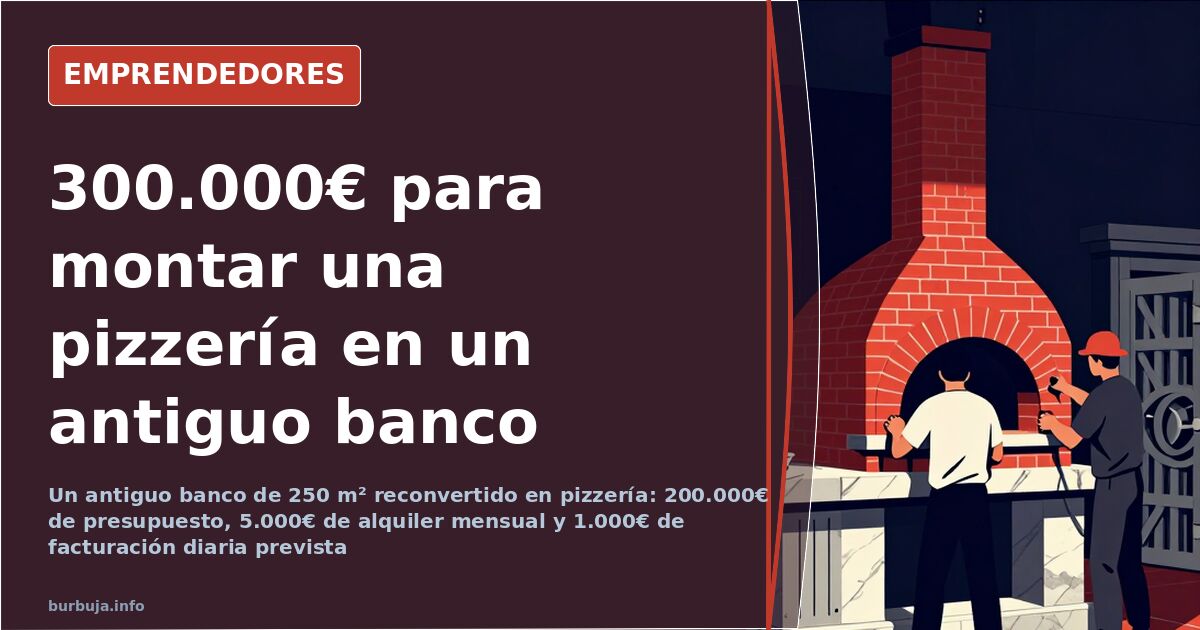
From Bank to Pizza Shop: 250 sqm, 5,000€ Rent, and 1,000€ Daily Revenue
A 250-square-meter former bank, stripped and completely renovated, serves as the starting point. The initial budget is around 200,000 euros, though the project promoter admits it will go to 300,000 euros easily. Monthly rent: 5,000 euros. Revenue forecast, if everything goes smoothly: 1,000 euros daily from pizzas, montaditos (Spanish tapas-style open sandwiches), and drinks.
The launch relies on a 15,000 euro down payment with a two-month grace period for construction, setting the opening in December. This is not a standard pizza shop: it operates as a café in the morning, serving various pastas and montaditos, and as a restaurant for the rest of the day. The business is co-owned with a sector entrepreneur who already runs five restaurants in the province and produces in a central warehouse supplying over twenty outlets.
How Much Does It Cost to Keep a Pizza Shop Open?
The figure generating the most debate is not the investment, but current expenses. Those who have run small businesses are clear: between salaries, suppliers, and other items, a restaurant can consume between 15,000 and 20,000 euros a month. With these figures on the table, the initial investment would take about three years to amortize, provided the projected revenue is met.
And forecasts rarely come true. The warning repeats: eating out is a discretionary expense when household economies tighten, and the customer who fills the counter today seeks the cheapest menu tomorrow. This is compounded by competition. Another pizza shop with competitive prices was already operating in the same area, and it also closed.
The recurring recommendation: squeeze the landlord, negotiate to exhaustion with suppliers, and cut all unnecessary expenses. The margin is not in earning more, but in not spending more.
The Partner Who Reports Millions Annually
Here the project diverges from the solo entrepreneur. The person driving the idea does not put up the 300,000 euros: a partner who reports between seven and ten million euros annually signs it and operates four different companies doing the same thing. The business idea is his own, but the entry is framed as a favor, based on years of relationship and shared ventures.
Some see this as the key to the matter, while others view it with suspicion. Starting a restaurant with an investor who already has a chain, logistics, and his own oven radically changes the risk. The brand will be new, without a franchise, granting freedom but also requiring building the name from scratch.
Selling the Business When It Works
On the table is the medium-term exit: revamp it, get it running, and sell it, or retain a minimal share and move on. The one proposing this states bluntly: he is not interested in bearing social costs when the business is already profitable.
The dilemma is old. Those who buy an operating business pay for the acquired clientele. Those who sell after years of work regret or detach themselves. A mentioned case: a premises bought in 2007, when it was already expensive, for which 600,000 euros more than the purchase price was later offered. Some sell a chain for 40 million euros and continue to succeed with what they buy next.
From Wood-Fired Ovens to Porcelain Containers
The conversation quickly shifts to something else. From a pizza shop, the discussion jumps to importing porcelain from China, sea freight, 20-foot containers, and auctions of seized vehicles. Specific prices appear: around 6,000 euros to bring a full container from Mexico, and about 2,000 dollars FOB from Brazil to Spain.
The underlying warning is the same as in hospitality: if the business depends on an undifferentiated product, the neighbor will copy it in six months and crush the margin. Buying cheap abroad is good for selling far from home, not for competing with the next-door shop.
The Result: "Totally Full During Peak Hours"
The closure, years later, is an unexpected headline: the premises is operating. Totally full during peak hours, albeit with nuances. The opening arrived when the approved credit — 200,000 euros — had not yet arrived, a bottleneck known to anyone who has started a business: papers signed on one side, money not arriving on the other.
With these premises, the business should be a textbook case. Yet the one who started it admits the result is not entirely what he expected. Here the analysis stalls: between the 1,000 euros daily projection, the 5,000 euros rent, and the three-year amortization, the real margin remains a number no one fully reconciles.
A 250-square-meter former bank, stripped and completely renovated, serves as the starting point. The initial budget is around 200,000 euros, though the project promoter admits it will go to 300,000 euros easily. Monthly rent: 5,000 euros. Revenue forecast, if everything goes smoothly: 1,000 euros daily from pizzas, montaditos (Spanish tapas-style open sandwiches), and drinks.
The launch relies on a 15,000 euro down payment with a two-month grace period for construction, setting the opening in December. This is not a standard pizza shop: it operates as a café in the morning, serving various pastas and montaditos, and as a restaurant for the rest of the day. The business is co-owned with a sector entrepreneur who already runs five restaurants in the province and produces in a central warehouse supplying over twenty outlets.
How Much Does It Cost to Keep a Pizza Shop Open?
The figure generating the most debate is not the investment, but current expenses. Those who have run small businesses are clear: between salaries, suppliers, and other items, a restaurant can consume between 15,000 and 20,000 euros a month. With these figures on the table, the initial investment would take about three years to amortize, provided the projected revenue is met.
And forecasts rarely come true. The warning repeats: eating out is a discretionary expense when household economies tighten, and the customer who fills the counter today seeks the cheapest menu tomorrow. This is compounded by competition. Another pizza shop with competitive prices was already operating in the same area, and it also closed.
The recurring recommendation: squeeze the landlord, negotiate to exhaustion with suppliers, and cut all unnecessary expenses. The margin is not in earning more, but in not spending more.
The Partner Who Reports Millions Annually
Here the project diverges from the solo entrepreneur. The person driving the idea does not put up the 300,000 euros: a partner who reports between seven and ten million euros annually signs it and operates four different companies doing the same thing. The business idea is his own, but the entry is framed as a favor, based on years of relationship and shared ventures.
Some see this as the key to the matter, while others view it with suspicion. Starting a restaurant with an investor who already has a chain, logistics, and his own oven radically changes the risk. The brand will be new, without a franchise, granting freedom but also requiring building the name from scratch.
Selling the Business When It Works
On the table is the medium-term exit: revamp it, get it running, and sell it, or retain a minimal share and move on. The one proposing this states bluntly: he is not interested in bearing social costs when the business is already profitable.
The dilemma is old. Those who buy an operating business pay for the acquired clientele. Those who sell after years of work regret or detach themselves. A mentioned case: a premises bought in 2007, when it was already expensive, for which 600,000 euros more than the purchase price was later offered. Some sell a chain for 40 million euros and continue to succeed with what they buy next.
From Wood-Fired Ovens to Porcelain Containers
The conversation quickly shifts to something else. From a pizza shop, the discussion jumps to importing porcelain from China, sea freight, 20-foot containers, and auctions of seized vehicles. Specific prices appear: around 6,000 euros to bring a full container from Mexico, and about 2,000 dollars FOB from Brazil to Spain.
The underlying warning is the same as in hospitality: if the business depends on an undifferentiated product, the neighbor will copy it in six months and crush the margin. Buying cheap abroad is good for selling far from home, not for competing with the next-door shop.
The Result: "Totally Full During Peak Hours"
The closure, years later, is an unexpected headline: the premises is operating. Totally full during peak hours, albeit with nuances. The opening arrived when the approved credit — 200,000 euros — had not yet arrived, a bottleneck known to anyone who has started a business: papers signed on one side, money not arriving on the other.
With these premises, the business should be a textbook case. Yet the one who started it admits the result is not entirely what he expected. Here the analysis stalls: between the 1,000 euros daily projection, the 5,000 euros rent, and the three-year amortization, the real margin remains a number no one fully reconciles.
Summary of a discussion on Burbuja.info - Foro de economía, actualidad y política., translated from Spanish and reviewed before publication. Read the full discussion (364 replies).
More summaries
-
Starting a business with €30,000: cuota de autónomos (self-employed contribution) vs reality
Thread calculations: cuota de autónomos (self-employed fee) €3,600/year; a 7m2 mall stall, €3,000/month.
-
Starting a local political party: less than €500?
Setting up a local party costs under €500, but political pressure can be lethal. The case of the Democratic Karma Party in Bilbao.
-
Pica Pica 24 Hours: What the Franchise Promises vs. What the Franchisee Gets
Pica Pica 24 Hours markets itself as a turnkey vending business, but in one case cleaning and neighbor complaints fell to the franchisee.
-
Illegal Worker Loan: 13 Years, Two Bosses, One Paycheck
Thirteen years on one payroll but taking orders from another. Illegal worker lending in Spain incurs fines up to 187,515 euros.
-
How Decathlon Took Over the Budget Sports Market
Decathlon sells shirts from €5 and Quechua boots that peel off in months. What the customer gains in price, neighborhood sports shops lose.
-
Bare ownership without usufruct: Inheriting a house you cannot use
A father leaves bare ownership of a home to his son and lifetime usufruct to his partner. In Galicia, the forced heirship is 25%, leaving sales blocked.