
Toothpaste under fire: dry brushing and fluoride questioned
Dry brushing, hydrogen peroxide and doubts about fluoride fuel a debate over whether toothpaste and mouthwash are an unnecessary expense
English · Original discussion in Spanish · Published
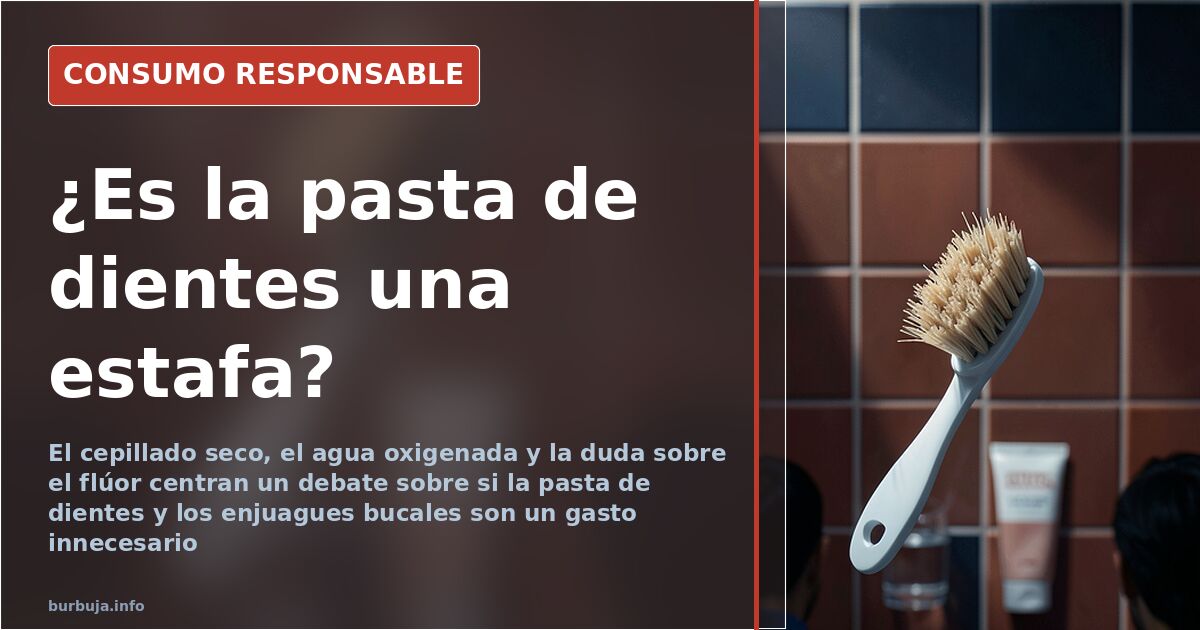
Toothpaste: the dry brushing method that puts Colgate in doubt
A dry brush, gentle strokes along the gumline, ten seconds for every three or four teeth and two minutes on the clock. That routine — without a drop of toothpaste — is enough, according to the argument that opens this discussion on responsible consumption, to keep your mouth in order. Toothpaste would be, at best, an «excuse» to brush better; mouthwash, outright daylight robbery.
The starting point is a claim attributed to a periodontist: mouthwashes boast of killing 99% of bacteria, but the ones that really attack the gums are part of that elusive remaining 1%. On top of that, according to the same source, many contain sugar and leave the tongue «in misery». The home remedy proposed: a rinse with one third 10% hydrogen peroxide and two thirds water. With the warning to check with your dentist — especially if free samples from the big brands are not plentiful in their office.
Fluoride, the first sustancia ilegal in the story
The objection comes quickly: what about the fluoride? The answer given in the conversation is less a defence of toothpaste than a doubt about its real effectiveness. In adults whose teeth are already fully formed, the absorption of fluoride from a product that is applied for a couple of minutes and then spat out is called into question. It is also pointed out that the iodised salt sold in supermarkets such as Mercadona also contains fluoride, adding an intake route almost nobody counts.
Some go further and claim that fluoride is a by-product of aluminium processing that was «recycled» into toothpaste and drinking water. It is a conspiracy theory with no proven backing, but it circulates. Against it, the majority position in the conversation is more prosaic: fluoride in moderate doses prevents cavities, which is why it was added to city water supplies for decades.
Brushing without toothpaste: better or worse for enamel?
Here the consensus breaks down. Some argue that toothpaste serves a mechanical function: when scrubbing, it increases friction and makes brushing more effective, so doing without it means scraping harder and wearing down the enamel. Others reply the opposite: toothpaste is an abrasive and, without it, a well-handled soft brush cleans just as well. The advice repeated most often is to use low-abrasion pastes if you have sensitivity and not to skimp on time.
Hydrogen peroxide reappears as a wildcard for the gums, and so does salt water. One specific account: someone says their cousin, a dentist for 35 years, recommends exactly that. Interdental cleaning, meanwhile, sneaks in as the great forgotten step: anyone who has flossed for years cannot do without it.
The freshness business and the DIY alternative
The economic argument runs through the whole conversation. The most expensive toothpaste anyone tried costs 12 euros for two 50-millilitre tubes; the budget one, three 200-millilitre tubes for the price of two. The conclusion is unanimous: the premium buys no better health, just flavour and foam. And the homemade recipes — clay, glycerine, aubergine skin ash, mint and rosemary infusion — are dismissed out of sheer laziness: too much work for a product that costs cents.
The 0.12% chlorhexidine rinse takes the crown for effectiveness against sensitivity, according to one participant, with the drawback of staining teeth. When a supermarket chain discontinued it and replaced it with 1% hexetidine, the complaint was immediate: time to pay for the pharmacy version.
In the end, the unsettling fact: most agree that what really matters is brushing, floss and time in front of the mirror. And yet, hardly anyone is willing to give up that aftertaste of freshness.
Also available in: Deutsch
Summary of a discussion on Burbuja.info - Foro de economía, actualidad y política., translated from Spanish and reviewed before publication. Read the full discussion (34 replies).
More summaries
-
Toothpaste: the 1450 ppm fluoride level almost nobody understands
Almost every toothpaste contains 1450 ppm of fluoride, regardless of price. The real debate lies in the type of fluoride, the abrasive and the additives.
-
Toothpaste as a first-aid kit: from cold sores to polishing silver
From polishing silver and CDs to the risks on burns and mucous membranes: the real uses of white toothpaste and the health warnings that advise against it
-
Made in Spain: Toothpaste and cleaning brands that resurface every Black Friday
From LACER and KEMPHOR to PERSAN and KH-7, a list of brands manufacturing in Spain grows each Black Friday, focusing on quality and local economic impact.
-
robin.jobs: Dutch temp agency with housing that won't answer
A jobseeker sends his ID and driving licence to robin.jobs, a Dutch temp agency with no reviews, no social media activity and poor fraud-checker scores.
-
Soy milk: it tastes like horchata, but the real debate is elsewhere
Soy milk doesn't taste like milk: it tastes like horchata. The real debate is about hidden sugar, phytoestrogens and a price ranging from 60 cents to 1.50 euros.
-
Turbo trainer or exercise bike: the gear that ends up as a clothes rack
Turbo trainer, exercise bike or gym: prices range from 100 to 6,000 euros, but the deciding factor is the willpower not to end up using it as a clothes rack.