
Toothpaste as a first-aid kit: from cold sores to polishing silver
From polishing silver and CDs to the risks on burns and mucous membranes: the real uses of white toothpaste and the health warnings that advise against it
English · Original discussion in Spanish · Published
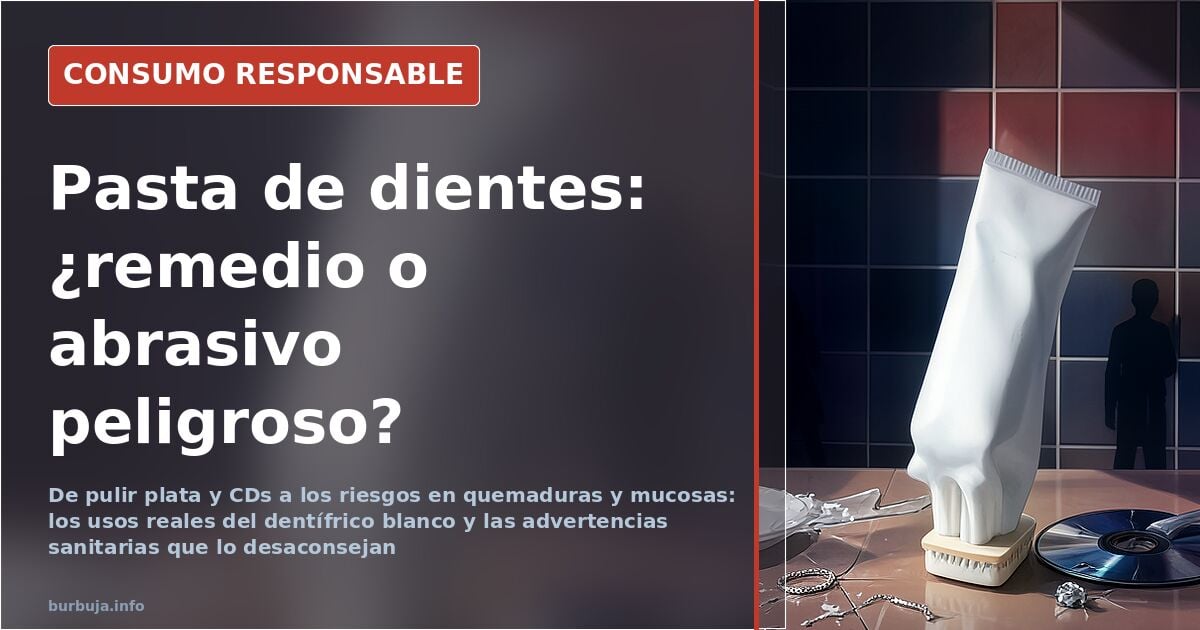
Toothpaste as a first-aid kit: uses ranging from polishing to risk
A tube of white toothpaste has been putting in overtime outside the bathroom for decades. For cold sores, hemorrhoids, burns, cleaning the silver cutlery or defogging diving goggles. The idea has been circulating for years with the same insistence as any home remedy, and the conversation it has sparked leaves a pretty useful map of where it genuinely works and where it's best to stay away.
From cold sores to hemorrhoids: where the remedy becomes a problem
The star suggestion was applying classic toothpaste to cold sores and hemorrhoids. That's where the consensus quickly falls apart. Some recall having tried it as a child for cold sores and insist that **it never worked**, with the impression that it even irritated the area more. And the most serious case is that of a fellow resident who had toothpaste applied to his genitals and **ended up in hospital**. On sensitive skin and mucous membranes, the product is an abrasive with detergents and fragrances: it's not a treatment, and anyone with such a complaint should consult a professional rather than improvise with whatever is next to the toothbrush.
Burns: the warning that debunks the myth
The second most repeated use is for household burns. It works as an immediate soothing agent on minor burns without blisters, according to several testimonials, and some recount that as a child they had a boiling coffee pot spill on their leg and were left without a mark after a layer of toothpaste. But the technical warning is emphatic: toothpaste **retains heat** and can worsen the injury, turning a second-degree burn into a third-degree one. The health recommendation is cold water and a dressing, not toothpaste. Faced with that, personal accounts cling to the result: pain relief and zero scarring. The evidence and the anecdote don't agree, and the risk lies with the damaged skin.
The abrasive that cleans silver, ceramic hobs and glass
Where there is broad agreement is in its use as a cleaning product. It works to restore the shine to **silver cutlery**, polish the ceramic hob, remove crayon marks, whiten sneaker rubber or eliminate the smell of garlic and onion from hands. Also for eyeglass lenses: spread a thin layer, rinse under the tap without touching the glass and they come out like new. And some have used it as thermal paste between a microprocessor and its heatsink, with two years of trouble-free operation, though for high-performance processors the gamble raises reasonable doubts.
Polishing CDs and the limit of miracles
Toothpaste is not gel, and that distinction bears repeating: the classic white version is the one used to polish scratched CDs, applying from the center outward. The list of supposed miracles keeps growing —up to plugging an anthill, according to one anecdote— and with it the suspicion that we're looking at the new aloe vera, that catch-all that works for everything and nothing. The practical conclusion: the tube is an excellent abrasive for hard surfaces and a bad companion for injured skin.
Toothpaste will stay in the bathroom. What's less clear is how many of its first-aid uses would survive a serious medical review.
Also available in: Deutsch
Summary of a discussion on Burbuja.info - Foro de economía, actualidad y política., translated from Spanish and reviewed before publication. Read the full discussion (44 replies).
More summaries
-
Made in Spain: Toothpaste and cleaning brands that resurface every Black Friday
From LACER and KEMPHOR to PERSAN and KH-7, a list of brands manufacturing in Spain grows each Black Friday, focusing on quality and local economic impact.
-
Baking soda, coconut oil or toothpaste: the battle over dental hygiene
One in three children has cavities. Baking soda doesn't scratch enamel. Coconut oil, fluoride and the business of the smile: the debate over whether brushing with…
-
Toothpaste: the 1450 ppm fluoride level almost nobody understands
Almost every toothpaste contains 1450 ppm of fluoride, regardless of price. The real debate lies in the type of fluoride, the abrasive and the additives.
-
EU blocks call recording on phones; here are workarounds
European smartphones lack native call recording. Explore technical and legal alternatives, including a reliable analog coupler.
-
A bat in an Airbnb leaves guests with a $25,000 bill
A couple is charged $25,000 for rabies prophylaxis after a bat encounter at an Airbnb. In Spain, the vaccine costs around 20 euros.
-
Insurer fails to send plumber for two months: the claim that never arrives
A leak, two months of waiting and an insurer that never sends a plumber. Hire one yourself, pay and claim afterwards: how to deal with your insurance company.