
Soy milk: it tastes like horchata, but the real debate is elsewhere
Soy milk doesn't taste like milk: it tastes like horchata. The real debate is about hidden sugar, phytoestrogens and a price ranging from 60 cents to 1.50 euros.
English · Original discussion in Spanish · Published
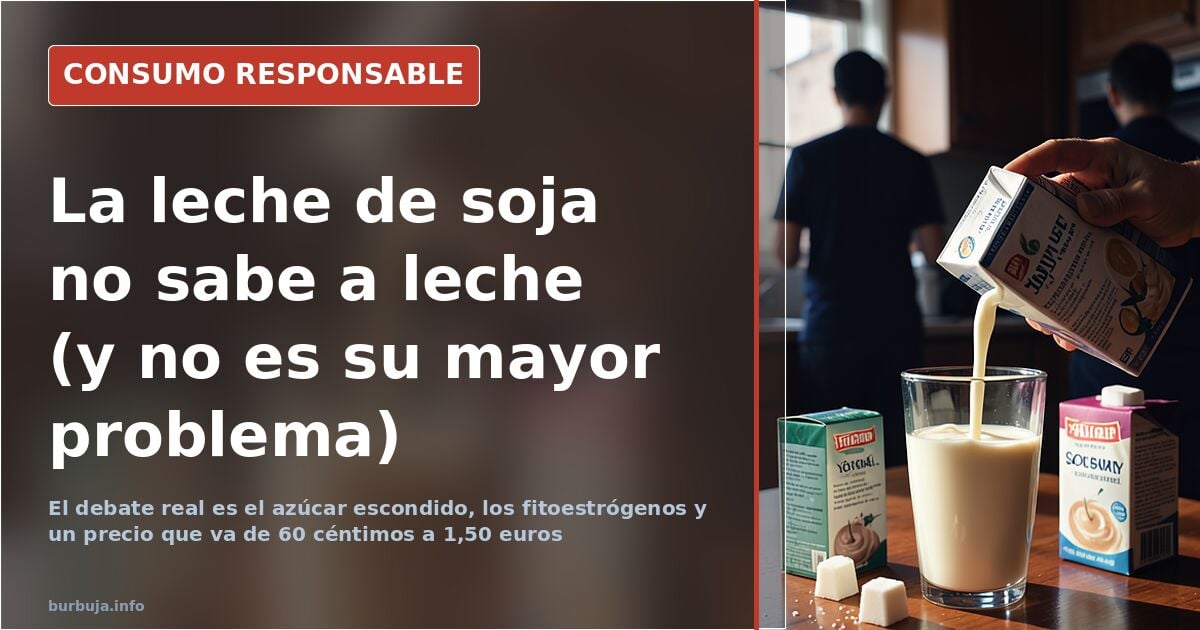
Soy milk doesn't taste like milk: it tastes like horchata
Soy milk doesn't taste like milk. It tastes like horchata, with nuances: depending on the brand and the added sugars, the resemblance narrows or breaks down entirely. That's the short answer to the question that opens the topic, and also the point where the conversation stops being about taste and starts being about something else. Because the one-litre carton hides a discussion about endocrine disruptors, phytoestrogens, hidden sugar and prices ranging from 60 cents to 1.50 euros.
The starting point is textbook: lactose intolerance, lactose-free milk doesn't convince either —it still contains lactose, just less— and the reasonable doubt of whether a plant-based drink can handle coffee, cocoa and the microwave. The practical answer that prevails is that yes, it can be heated, but the result isn't the same. Cold it works as a soft drink; hot, with cocoa or coffee, it falls short compared to cow's milk. For spreading on toast or pouring over cereal, it does the job.
What does soy milk taste like compared to cow's milk?
The consensus is broad: it's nothing like it. The most repeated description is a kind of horchata, with notable variations between the sweetened version, the one with fructose, the vanilla one and the plain one. The chocolate one, however, takes the crown among those looking for a sweet drink: some pay **1.50 euros a litre** for a specific brand while others go for store brands at **one euro**, accepting that it tastes somewhat worse.
Unsweetened soy milk is the cheapest and the easiest to find, but also the one furthest from a milky taste. Those who buy it blindly expecting milk are in for a disappointment; those who buy it knowing what it is, come back for more.
The warning that keeps coming up: phytoestrogens and endocrine disruptors
Here the tone rises. Part of the discussion argues that soy is a **first-rate endocrine disruptor** and that its regular consumption in men is linked to lower libido, while in women it is associated with polycystic ovary syndrome. These are claims that circulate insistently and should be treated with caution: they are not a diagnosis nor a proven causal relationship, and any dietary decision should involve a healthcare professional.
The alternative gaining trinc is oat milk. It is defended as the healthiest, the mildest in flavour and the most forgiving with instant chocolate. Rice milk appears as the second option, even milder, though with a fruta for being watery due to the cereal's starch. Almond milk divides opinion: some like it, others find it too intense. Hemp and spelt milk slip into the conversation as minority discoveries.
The invisible sugar and the label nobody reads
The economic and nutritional arguments quickly intersect. Some point out that oat milk contains **more sugar than cow's milk**, while others respond that oats, with their beta-glucans, regulate glucose levels and are recommended for diabetics. The discussion is settled by reading the label: good plant-based drinks contain **around 15%** cereal and the rest is water, while others add sugars to taste better.
The homemade solution emerges as the most cost-effective: buying oat flakes and making the drink at home works out to many litres per kilo, with a touch of cocoa, cinnamon and honey. The full calculation, with prices per kilo and yield per litre, shows a difference that surprises anyone who has only looked at the supermarket shelf.
From 60 cents a litre to 1.50 euros
Price is the silent battleground. At one end, offers of **four units at 60 cents** each at discount chains; at the other, brands that don't drop below **1.50 euros**, justified by being GMO-free. In between, the store brand at one euro as a compromise option.
The question hanging in the air is whether it's worth skimping on something consumed daily. The prevailing answer is that it depends on the sensitivity of each palate and each wallet, but that the premium is rarely justified by taste alone.
With all this, soy seems doomed to be the cheap gateway while oat milk is the final destination. If the trend holds, the plant-based drinks aisle will end up looking less like a dairy alternative and more like a shelf of liquid cereals. Although, when it comes to food, it's best not to bet too heavily.
Also available in: Deutsch
Summary of a discussion on Burbuja.info - Foro de economía, actualidad y política., translated from Spanish and reviewed before publication. Read the full discussion (60 replies).
More summaries
-
Milk under scrutiny: lactose, A1 casein and industry
A forum user blames dairy for anxiety and pain; others argue milk only harms intolerant people. Debate is open.
-
Adult Milk Consumption: Lactose and A2 Protein Debate
Lactose tolerance is a minority genetic mutation. The debate over A2 milk, UHT processing, and calcium sources continues in Spain.
-
Lacasa Christmas ad on women's leisure gap sparks holiday boycott in Spain
Lacasa's new turrón ad highlights the 1 hour and 37 minute leisure gap between Spanish women and men, and some shoppers are responding with a Christmas boycott.
-
iPhone 5: two million pre-orders in 24 hours at a real cost of 900 euros
The iPhone 5 drew two million pre-orders in 24 hours, with an estimated unlocked price of 600 euros and monthly plans pushing the real cost to 1,380 euros over eighteen months.
-
How to find window air leaks: the incense stick and candle trick
Incense and a candle reveal whether air is coming in through the window, but the real leak is often in the roller shutter box, a foam-free installation or the metal frame.
-
Guerrilla gardening: grafts, copper and tomatoes that won't wilt
Fusarium has no cure and copper doesn't always help: the home vegetable garden is torn between resistant grafts, preventive chemicals and beneficial insects.