
Spending Just Enough: The Battle for Consumption in Spain
A coffee and two toast cost six euros; a cinema ticket, eight. Anger over VAT, electricity, and income tax hikes is curbing consumption in Spain.
English · Original discussion in Spanish · Published
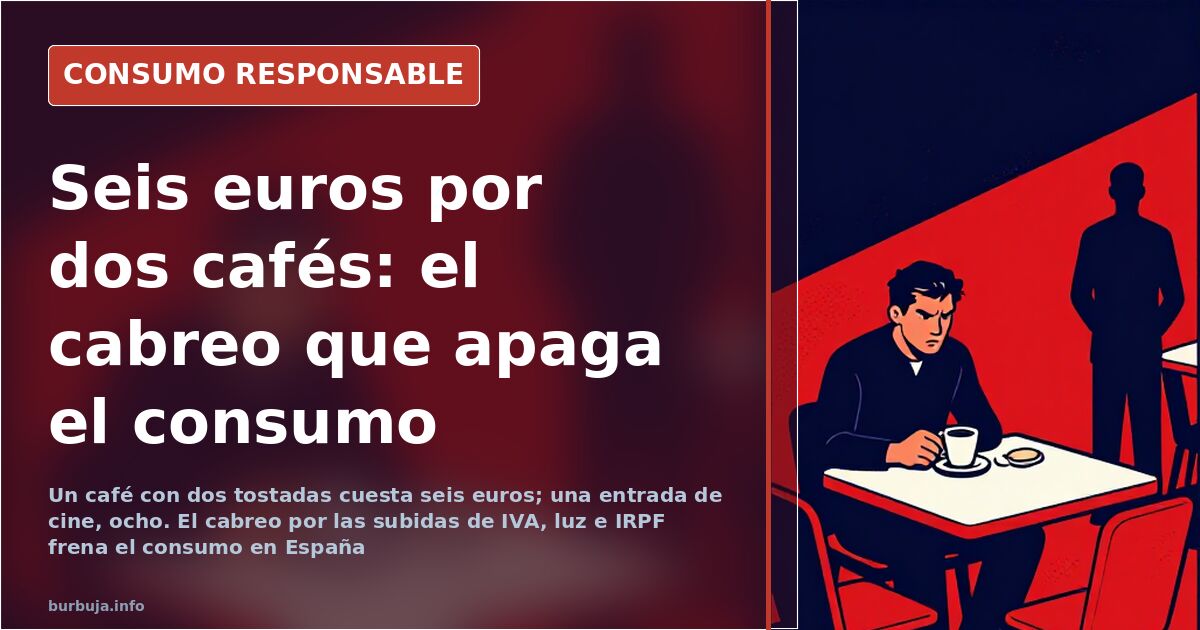
Not an Extra Coffee: The Silent Resistance to Consumption
A coffee with milk and two mini toasts. Six euros. A thousand of the old pesetas for something that cost half a few years ago. That receipt, repeated in thousands of bars, explains the mood of a segment of Spanish consumers better than any report: spend only what's necessary and, if possible, nothing more.
The anger has a slogan. "My ing mother is going to consume" has become the war cry of those who believe that tax and price increases are not offset by salary raises. It's not a prediction. It's a pocket threat. And behind it lurks an uncomfortable question: how much of that slowdown is conviction and how much is simply a lack of money?
VAT, Electricity, and Income Tax: The Hikes That Broke the Camel's Back
The list is familiar: increases in VAT, electricity, income tax, and transport. Four blows to disposable income that, added together, reduce purchasing power without any salary increases. The most repeated argument is as simple as it is difficult to refute: if I save less and pay more, I consume less. There's no greater mystery.
Against this, there's the opposing reproach, from those who argue that giving up spending is shooting yourself in the foot. If everyone tightens their belts, local businesses are the first to suffer, and with them the jobs that sustain consumption. The problem, others retort, is that that corner baker has also had their taxes increased.
From the Bar Receipt to Lidl's Cornmeal: The Grocery Basket
Here the numbers become concrete. A cinema ticket for 8 euros. Two coffees with milk and two mini toasts for 6 euros. And, at the other extreme, the subsistence basket: Lidl cornmeal for 0.49 euros for 285 grams and pasta for 0.72 euros per kilo. The pattern repeats: people buy the essentials, and the rest goes into savings.
There are also small grievances that ignite tempers. 3D glasses at a cinema, free when booking online, are charged at the box office without informing the customer. These are details, but they fuel the feeling that someone always ends up paying the bill for others.
Amazon and the VAT That Doesn't Reach the Treasury
Since 2013, a good part of what is bought online goes through Amazon, which invoices with the Luxembourg VAT, 17%, compared to Spain's 21%. European regulations set thresholds for cross-border sales—35,000 or 100,000 euros depending on the country—above which large companies should apply the VAT of the destination country. Who checks this?
There are two opposing views. Some celebrate that their money doesn't end up in the coffers that later bail out banks. Others see it as shooting yourself in the foot: if VAT is collected abroad, someone will have to cover that hole with more taxes on the usual suspects.
Consumption at a Minimum: Cars Like in 1989
The sector's figures paint a picture of more than just anger. Car sales are equivalent to those of 1989, with 10 million more inhabitants. Consumption of durable goods has fallen by 70% compared to 2006; services, by 30%; goods lasting less than three years, by another 30%. In some cases, people are buying like in the 1960s.
And if this is the logical consumption, the consequence should be stated plainly: it's time to live with patched clothes, elbow patches on jackets, and resoled shoes. No one has said it out loud.
From Anger to Post-Consumption
For a segment of consumers, the protest has ceased to be temporary and has become a way of life. Some declare themselves in a post-consumerist phase: they neither need nor want almost anything sold in a shopping mall, and much of what they consume circulates outside the usual channels. Frugality, others argue, is not poverty but the path to financial independence: most people who accumulate more than a million euros net did so by working, investing, and not spending.
What remains is the undisputed fact. While popular consumption dwindles, luxury grows: for every Ferrari sold, 20 Seats are not sold. The money doesn't disappear. It changes hands and leaves the usual circuit.
A coffee with milk and two mini toasts. Six euros. A thousand of the old pesetas for something that cost half a few years ago. That receipt, repeated in thousands of bars, explains the mood of a segment of Spanish consumers better than any report: spend only what's necessary and, if possible, nothing more.
The anger has a slogan. "My ing mother is going to consume" has become the war cry of those who believe that tax and price increases are not offset by salary raises. It's not a prediction. It's a pocket threat. And behind it lurks an uncomfortable question: how much of that slowdown is conviction and how much is simply a lack of money?
VAT, Electricity, and Income Tax: The Hikes That Broke the Camel's Back
The list is familiar: increases in VAT, electricity, income tax, and transport. Four blows to disposable income that, added together, reduce purchasing power without any salary increases. The most repeated argument is as simple as it is difficult to refute: if I save less and pay more, I consume less. There's no greater mystery.
Against this, there's the opposing reproach, from those who argue that giving up spending is shooting yourself in the foot. If everyone tightens their belts, local businesses are the first to suffer, and with them the jobs that sustain consumption. The problem, others retort, is that that corner baker has also had their taxes increased.
From the Bar Receipt to Lidl's Cornmeal: The Grocery Basket
Here the numbers become concrete. A cinema ticket for 8 euros. Two coffees with milk and two mini toasts for 6 euros. And, at the other extreme, the subsistence basket: Lidl cornmeal for 0.49 euros for 285 grams and pasta for 0.72 euros per kilo. The pattern repeats: people buy the essentials, and the rest goes into savings.
There are also small grievances that ignite tempers. 3D glasses at a cinema, free when booking online, are charged at the box office without informing the customer. These are details, but they fuel the feeling that someone always ends up paying the bill for others.
Amazon and the VAT That Doesn't Reach the Treasury
Since 2013, a good part of what is bought online goes through Amazon, which invoices with the Luxembourg VAT, 17%, compared to Spain's 21%. European regulations set thresholds for cross-border sales—35,000 or 100,000 euros depending on the country—above which large companies should apply the VAT of the destination country. Who checks this?
There are two opposing views. Some celebrate that their money doesn't end up in the coffers that later bail out banks. Others see it as shooting yourself in the foot: if VAT is collected abroad, someone will have to cover that hole with more taxes on the usual suspects.
Consumption at a Minimum: Cars Like in 1989
The sector's figures paint a picture of more than just anger. Car sales are equivalent to those of 1989, with 10 million more inhabitants. Consumption of durable goods has fallen by 70% compared to 2006; services, by 30%; goods lasting less than three years, by another 30%. In some cases, people are buying like in the 1960s.
And if this is the logical consumption, the consequence should be stated plainly: it's time to live with patched clothes, elbow patches on jackets, and resoled shoes. No one has said it out loud.
From Anger to Post-Consumption
For a segment of consumers, the protest has ceased to be temporary and has become a way of life. Some declare themselves in a post-consumerist phase: they neither need nor want almost anything sold in a shopping mall, and much of what they consume circulates outside the usual channels. Frugality, others argue, is not poverty but the path to financial independence: most people who accumulate more than a million euros net did so by working, investing, and not spending.
What remains is the undisputed fact. While popular consumption dwindles, luxury grows: for every Ferrari sold, 20 Seats are not sold. The money doesn't disappear. It changes hands and leaves the usual circuit.
Summary of a discussion on Burbuja.info - Foro de economía, actualidad y política., translated from Spanish and reviewed before publication. Read the full discussion (339 replies).
More summaries
-
The four breakfasts no Spanish bar serves
Oats, wholemeal bread, hummus and peanut butter: four foods Spanish bars don't serve, against the tradition of toast and Spanish tortilla.
-
Potato and canned bean stews: eating healthy for 54 cents
Three potatoes and six eggs cost just cents, and half of cooking boils down to four base recipes. Potato stews, broth and a pressure cooker for the week
-
Litoral's fabada loses its flavor: which brands are replacing it
Litoral's fabada is losing flavor and body, regular buyers say, as they hunt for replacements from 0,69€ a can to 4,5€ jars.
-
Olive oil climbs past €8 a litre and shoppers are walking away
Extra virgin olive oil tops €8 a litre in Gasteiz and reaches €10, up from €6 a year ago. More and more shoppers are taking it off their lists
-
A Land Rover and 20.000 euros in repairs in just four years
Mireia has spent about 20.000 euros on repairs to her Land Rover, with only 173.000 km in four years, including timing chain, turbo, gearbox and driveshaft
-
Razor blades: expensive cartridges vs. cheap double-edge
A 100-pack of double-edge blades costs €9–12 and gives five shaves per blade; the expensive cartridge is done after five uses.