
A Land Rover and 20.000 euros in repairs in just four years
Mireia has spent about 20.000 euros on repairs to her Land Rover, with only 173.000 km in four years, including timing chain, turbo, gearbox and driveshaft
English · Original discussion in Spanish · Published
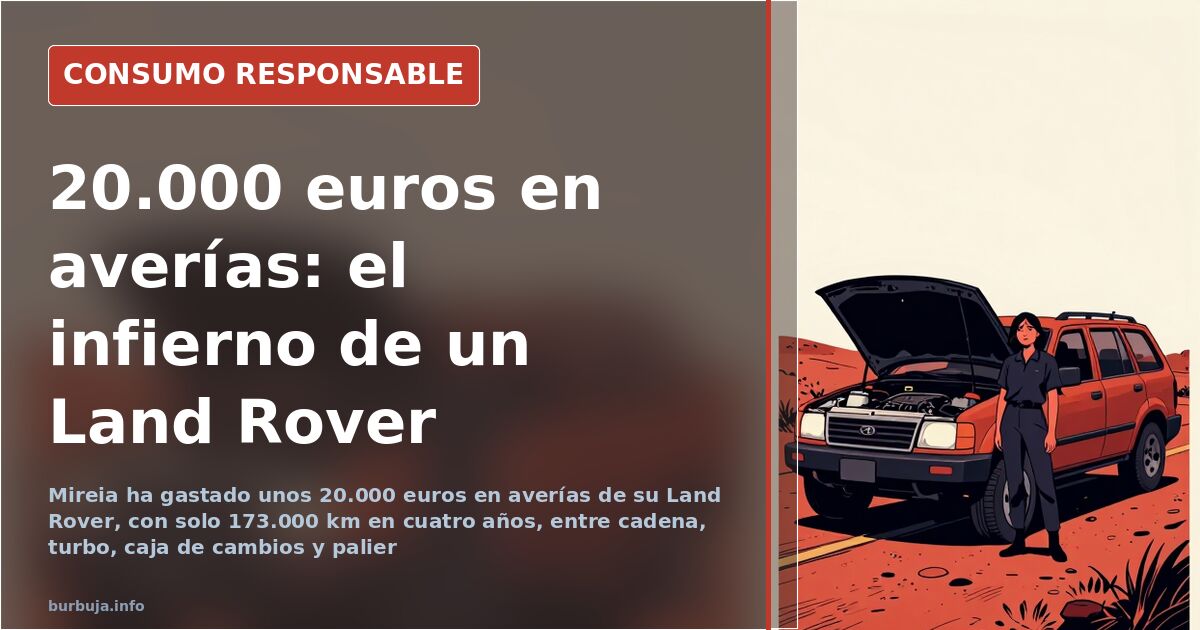
Mireia's Land Rover: 20.000 euros in repairs and 173.000 km
How many trips to the garage does it take to admit the problem isn't the mechanic? Mireia had owned her Land Rover for four years when a TikTok video turned her into the symbol of something the brand would not have found amusing: a high-end car with 20.000 euros in repairs and barely 173.000 kilometres. The figure, repeated on social media, sums up an invoice that the owner claims to have kept in her hand.
The story, according to her own statements, is a succession of serious repairs, all above four figures. The first year, just out of the dealership, the car already started to fail. And from there, downhill.
The timing chain, the turbo and a 9.000-euro gearbox
The litany begins with the timing chain, whose break cost her around 3.000 euros. Shortly after, the turbo —a complete replacement of parts and labour— raised the bill to around 6.000 euros. In total, according to her account, the vehicle has visited the official garage five times for repairs exceeding four figures.
The final blow came with the gearbox, repaired for around 9.000 euros. And just after leaving the garage, the car started making strange noises. The brand told her to bring it in and the diagnosis pointed to the driveshaft, a transmission part that cost around 1.000 euros. To compensate for the ordeal, the official garage gave her a coffee thermos. Her summary: "They don't help you, they don't tell you anything and they don't take responsibility for anything."
Is Land Rover the least reliable brand on the market?
Here the individual case intersects with a broader suspicion. Some argue, based on insurance company statistics, that Land Rover is one of the brands that visits the garage most often; the list of the least problematic includes Lexus, Toyota, Nissan and BMW. Others point out that it's a historical problem: the British car industry dragged a fruta for fragility for decades, and the purchase by an Indian manufacturer did not change the narrative.
Against that weighs the opposite argument: the brand's classic off-roaders, those from the Santana factory, lasted for decades with 1980 registration plates pulling a trailer with 500 kilos of firewood. The problem, they say, is not the brand, but the current product: huge cars, full of electronics and designed more for the photo than for off-road.
[TWEET]173000[/TWEET]
The 173.000 kilometres and the uncomfortable question of maintenance
There is one fact that reshuffles the whole debate: the mileage. With 173.000 km in four years, the car has been driven a lot, and some of the messages ask about the service history —oil changes, filters, inspections— that the owner would have done. The suspicion, never confirmed, is that neglected maintenance accelerates wear and explains breakdowns like the driveshaft one.
Against this plays the timeline: the first serious failure, the timing chain, appears in the first year, when the car had barely been used. That questions the argument of wear and tear from use. If something breaks just out of the dealership, the problem is not the driver's. And if there really was a warranty, why didn't it cover it? The question, raised by several, still has no clear answer.
From the Santana that pulled firewood to the Instagram Range Rover
The conversation quickly drifts towards the social use of the car. An off-roader of this range is associated with posing: cars that look gorgeous in photos and rarely get muddy. The most circulated argument is one of economic common sense: with 20.000 euros, another more modest car would have covered purchase, petrol and repairs for years. The implicit conclusion is uncomfortable for the high-end buyer: the entry price is paid once, repairs at new-car prices are paid forever.
The thermos as a statement of intent
In the end, the detail that has circulated the most is not any of the thousands of euros spent, but the garage's gift. A coffee thermos for a customer who left there the value of a new compact car. If that's not an institutional response, it looks a lot like one.
How many trips to the garage does it take to admit the problem isn't the mechanic? Mireia had owned her Land Rover for four years when a TikTok video turned her into the symbol of something the brand would not have found amusing: a high-end car with 20.000 euros in repairs and barely 173.000 kilometres. The figure, repeated on social media, sums up an invoice that the owner claims to have kept in her hand.
The story, according to her own statements, is a succession of serious repairs, all above four figures. The first year, just out of the dealership, the car already started to fail. And from there, downhill.
The timing chain, the turbo and a 9.000-euro gearbox
The litany begins with the timing chain, whose break cost her around 3.000 euros. Shortly after, the turbo —a complete replacement of parts and labour— raised the bill to around 6.000 euros. In total, according to her account, the vehicle has visited the official garage five times for repairs exceeding four figures.
The final blow came with the gearbox, repaired for around 9.000 euros. And just after leaving the garage, the car started making strange noises. The brand told her to bring it in and the diagnosis pointed to the driveshaft, a transmission part that cost around 1.000 euros. To compensate for the ordeal, the official garage gave her a coffee thermos. Her summary: "They don't help you, they don't tell you anything and they don't take responsibility for anything."
Is Land Rover the least reliable brand on the market?
Here the individual case intersects with a broader suspicion. Some argue, based on insurance company statistics, that Land Rover is one of the brands that visits the garage most often; the list of the least problematic includes Lexus, Toyota, Nissan and BMW. Others point out that it's a historical problem: the British car industry dragged a fruta for fragility for decades, and the purchase by an Indian manufacturer did not change the narrative.
Against that weighs the opposite argument: the brand's classic off-roaders, those from the Santana factory, lasted for decades with 1980 registration plates pulling a trailer with 500 kilos of firewood. The problem, they say, is not the brand, but the current product: huge cars, full of electronics and designed more for the photo than for off-road.
[TWEET]173000[/TWEET]
The 173.000 kilometres and the uncomfortable question of maintenance
There is one fact that reshuffles the whole debate: the mileage. With 173.000 km in four years, the car has been driven a lot, and some of the messages ask about the service history —oil changes, filters, inspections— that the owner would have done. The suspicion, never confirmed, is that neglected maintenance accelerates wear and explains breakdowns like the driveshaft one.
Against this plays the timeline: the first serious failure, the timing chain, appears in the first year, when the car had barely been used. That questions the argument of wear and tear from use. If something breaks just out of the dealership, the problem is not the driver's. And if there really was a warranty, why didn't it cover it? The question, raised by several, still has no clear answer.
From the Santana that pulled firewood to the Instagram Range Rover
The conversation quickly drifts towards the social use of the car. An off-roader of this range is associated with posing: cars that look gorgeous in photos and rarely get muddy. The most circulated argument is one of economic common sense: with 20.000 euros, another more modest car would have covered purchase, petrol and repairs for years. The implicit conclusion is uncomfortable for the high-end buyer: the entry price is paid once, repairs at new-car prices are paid forever.
The thermos as a statement of intent
In the end, the detail that has circulated the most is not any of the thousands of euros spent, but the garage's gift. A coffee thermos for a customer who left there the value of a new compact car. If that's not an institutional response, it looks a lot like one.
Summary of a discussion on Burbuja.info - Foro de economía, actualidad y política., translated from Spanish and reviewed before publication. Read the full discussion (150 replies).
More summaries
-
Toyota, Honda, or Lexus: Which Japanese Brand Lasts 400,000 km?
A study of 395 million vehicles measures durability, clashing with parts availability and the real condition of Japanese used cars.
-
Dacia Logan and Citroën C-Elysée diesel km0: when they're worth it and when they're not
The Dacia Logan and Citroën C-Elysée km0 cost 11,500 euros. Owners disagree: one has topped 80,000 km; another wouldn't buy one again.
-
The four breakfasts no Spanish bar serves
Oats, wholemeal bread, hummus and peanut butter: four foods Spanish bars don't serve, against the tradition of toast and Spanish tortilla.
-
Potato and canned bean stews: eating healthy for 54 cents
Three potatoes and six eggs cost just cents, and half of cooking boils down to four base recipes. Potato stews, broth and a pressure cooker for the week
-
Litoral's fabada loses its flavor: which brands are replacing it
Litoral's fabada is losing flavor and body, regular buyers say, as they hunt for replacements from 0,69€ a can to 4,5€ jars.
-
Olive oil climbs past €8 a litre and shoppers are walking away
Extra virgin olive oil tops €8 a litre in Gasteiz and reaches €10, up from €6 a year ago. More and more shoppers are taking it off their lists