
Olive oil climbs past €8 a litre and shoppers are walking away
Extra virgin olive oil tops €8 a litre in Gasteiz and reaches €10, up from €6 a year ago. More and more shoppers are taking it off their lists
English · Original discussion in Spanish · Published
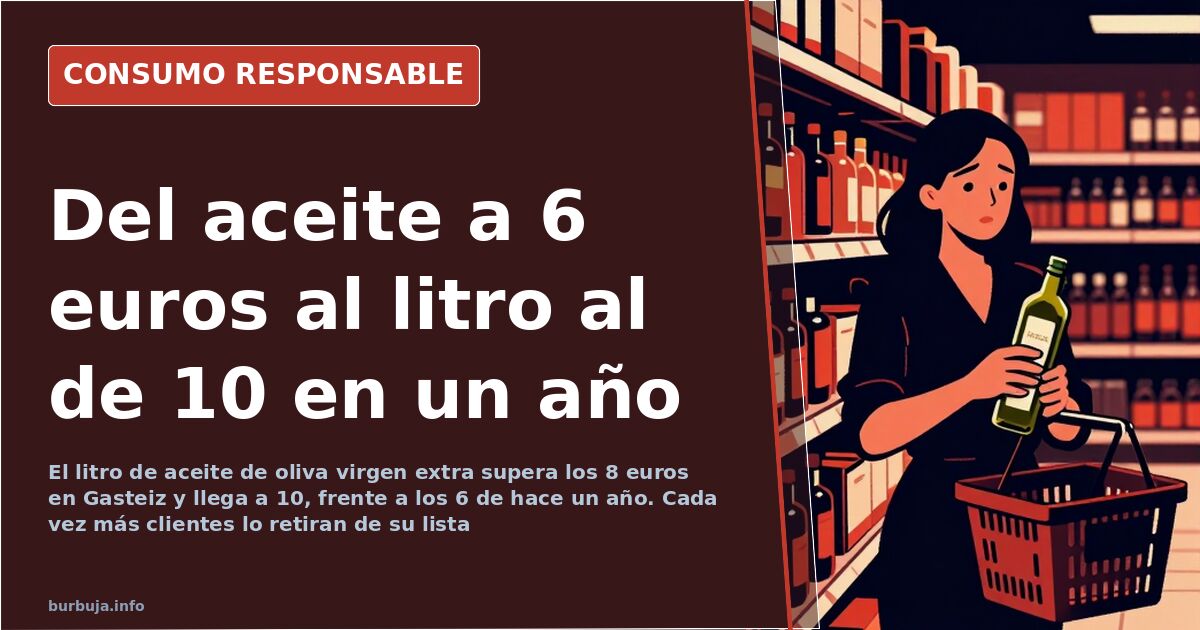
Olive oil at €8: the shopping basket says enough
A litre of extra virgin olive oil has stopped being a quiet staple and become the product that makes shoppers raise an eyebrow at the till. On shelves in Gasteiz it tops €8, in several stores it comes close to €9 and on some aisles it has been seen at €10. A year ago, in November 2022, that same litre was close to €6 in the capital of Álava. The rise has pushed some buyers to take it off their list, and the phenomenon is no longer anecdotal: some have switched frying fat and others have learned to dress salads without oil.
How much olive oil costs in the supermarket
Monitoring carried out in several supermarkets in Vitoria leaves an uncomfortable range. The average price of extra virgin tops eight euros per litre and in some cases stops just short of nine. In a hypermarket, extra virgin has been seen at €10 a litre, with a sign on the shelf limiting purchases to six litres per customer. The limit itself is the best summary of the mood: some see rationing where others see a simple measure to stop anyone clearing out the stock.
The scene is repeated in every shop. A 74-year-old retiree from Gasteiz explained that she refuses to buy it until it comes down and called the price abuse and a rip-off, with explanations about drought or war cutting no ice. It is not an isolated case: the anger runs from surprise to resignation, and from there to the decision not to pay at the till.
From the producer's bottle to the shelf: the real range
The gap between buying in bulk and buying bottled is the part of the story least told. Against the eight or nine euros per litre in the supermarket, there are examples of five-litre bottles at €25 bought directly from a nearby producer, which leaves the litre well below the shelf price. At the other extreme, in Lisbon €9 for 0.75 litres has been seen and at a wholesale market €9.25 per litre of extra virgin has been paid.
That is where one of the most repeated trends comes from: crossing the border. Portugal appears in several accounts as the country where the same product costs less, and the conclusion drawn is as simple as it is uncomfortable: if the same thing costs less on the other side, the harvest does not explain the whole price here. The entry-level range is also mentioned: next to the €8.5 bottle, there is another olive oil at €6.5 made, according to its label, from leftovers.
The drought that does not quite explain the price
The official argument has a date. In September 2023 OCU (Spain's consumers' organisation) attributed the price surge to a poor harvest, with 50% drops in production, and added an uncomfortable detail: shelves were selling oil from the previous campaign, which had been bought on the wholesale market at a much more affordable price. In other words, old product at a new price.
The consumer organisation itself has complained that extra virgin is paid in Spain far above what it costs in neighbouring countries. Those who maintain that production has shrunk recall that when supply is short, the price rises; those who look at the bottle and the label reply that the poor harvest did not reach the last litre bottled. Comparison with other food products reinforces the suspicion: some observe trays of meat lasting until their expiry date and being withdrawn rather than discounted, which suggests that supply is being managed, not merely made more expensive.
Sunflower, lard and oil-free salads: the replacements
Consumers have not stood still. The list of substitutes grows: sunflower for frying, butter and margarine for spreading, pork fat for cooking, steaming for almost everything and pomace oil for those who want to keep the flavour. For salads, oil-free formulas circulate based on soy sauce, mustard, vinegar and a touch of heat: those who have tried them say they no longer miss the classic dressing.
There are also those playing with an advantage. Some buyers stocked up when a litre was moving between €2 and €3 and now have supplies for years. The rest improvise, compare and, above all, leave the product on the shelf. The most repeated precedent is that of Canary Islands bananas: people stopped buying them when prices soared and they returned to the trolley when the price normalised.
Does stopping buying bring the price down?
Here the consensus breaks. Some argue that the only way to bring production and distribution to heel is for sales to fall, and boast that they have not bought a single bottle since the escalation began. Others recall that in Spain stopping consumption has never brought down housing prices or raised wages, so the standoff may remain just a gesture. Available data point to a 15% drop in consumption, a figure some read as a floor and others as a ceiling.
The most likely short-term scenario is not a collapse. If the next campaign improves, gradual relief on the shelves can be expected, although no one guarantees that the fall will reach the buyer's pocket in full or that the cheap range will return to 2022 prices. Meanwhile, sunflower oil will continue to gain ground in the frying pan, and extra virgin will remain, salads permitting, on the shelf of things bought when you have to.
A litre of extra virgin olive oil has stopped being a quiet staple and become the product that makes shoppers raise an eyebrow at the till. On shelves in Gasteiz it tops €8, in several stores it comes close to €9 and on some aisles it has been seen at €10. A year ago, in November 2022, that same litre was close to €6 in the capital of Álava. The rise has pushed some buyers to take it off their list, and the phenomenon is no longer anecdotal: some have switched frying fat and others have learned to dress salads without oil.
How much olive oil costs in the supermarket
Monitoring carried out in several supermarkets in Vitoria leaves an uncomfortable range. The average price of extra virgin tops eight euros per litre and in some cases stops just short of nine. In a hypermarket, extra virgin has been seen at €10 a litre, with a sign on the shelf limiting purchases to six litres per customer. The limit itself is the best summary of the mood: some see rationing where others see a simple measure to stop anyone clearing out the stock.
The scene is repeated in every shop. A 74-year-old retiree from Gasteiz explained that she refuses to buy it until it comes down and called the price abuse and a rip-off, with explanations about drought or war cutting no ice. It is not an isolated case: the anger runs from surprise to resignation, and from there to the decision not to pay at the till.
From the producer's bottle to the shelf: the real range
The gap between buying in bulk and buying bottled is the part of the story least told. Against the eight or nine euros per litre in the supermarket, there are examples of five-litre bottles at €25 bought directly from a nearby producer, which leaves the litre well below the shelf price. At the other extreme, in Lisbon €9 for 0.75 litres has been seen and at a wholesale market €9.25 per litre of extra virgin has been paid.
That is where one of the most repeated trends comes from: crossing the border. Portugal appears in several accounts as the country where the same product costs less, and the conclusion drawn is as simple as it is uncomfortable: if the same thing costs less on the other side, the harvest does not explain the whole price here. The entry-level range is also mentioned: next to the €8.5 bottle, there is another olive oil at €6.5 made, according to its label, from leftovers.
The drought that does not quite explain the price
The official argument has a date. In September 2023 OCU (Spain's consumers' organisation) attributed the price surge to a poor harvest, with 50% drops in production, and added an uncomfortable detail: shelves were selling oil from the previous campaign, which had been bought on the wholesale market at a much more affordable price. In other words, old product at a new price.
The consumer organisation itself has complained that extra virgin is paid in Spain far above what it costs in neighbouring countries. Those who maintain that production has shrunk recall that when supply is short, the price rises; those who look at the bottle and the label reply that the poor harvest did not reach the last litre bottled. Comparison with other food products reinforces the suspicion: some observe trays of meat lasting until their expiry date and being withdrawn rather than discounted, which suggests that supply is being managed, not merely made more expensive.
Sunflower, lard and oil-free salads: the replacements
Consumers have not stood still. The list of substitutes grows: sunflower for frying, butter and margarine for spreading, pork fat for cooking, steaming for almost everything and pomace oil for those who want to keep the flavour. For salads, oil-free formulas circulate based on soy sauce, mustard, vinegar and a touch of heat: those who have tried them say they no longer miss the classic dressing.
There are also those playing with an advantage. Some buyers stocked up when a litre was moving between €2 and €3 and now have supplies for years. The rest improvise, compare and, above all, leave the product on the shelf. The most repeated precedent is that of Canary Islands bananas: people stopped buying them when prices soared and they returned to the trolley when the price normalised.
Does stopping buying bring the price down?
Here the consensus breaks. Some argue that the only way to bring production and distribution to heel is for sales to fall, and boast that they have not bought a single bottle since the escalation began. Others recall that in Spain stopping consumption has never brought down housing prices or raised wages, so the standoff may remain just a gesture. Available data point to a 15% drop in consumption, a figure some read as a floor and others as a ceiling.
The most likely short-term scenario is not a collapse. If the next campaign improves, gradual relief on the shelves can be expected, although no one guarantees that the fall will reach the buyer's pocket in full or that the cheap range will return to 2022 prices. Meanwhile, sunflower oil will continue to gain ground in the frying pan, and extra virgin will remain, salads permitting, on the shelf of things bought when you have to.
Summary of a discussion on Burbuja.info - Foro de economía, actualidad y política., translated from Spanish and reviewed before publication. Read the full discussion (204 replies).
More summaries
-
The €3.61 Fee Killing AliExpress Purchases
The €3.61 per-category tariff has inflated AliExpress purchases by up to 80%. Consumers are stopping buys, and revenue is falling. Does it actually protect...
-
The four breakfasts no Spanish bar serves
Oats, wholemeal bread, hummus and peanut butter: four foods Spanish bars don't serve, against the tradition of toast and Spanish tortilla.
-
Potato and canned bean stews: eating healthy for 54 cents
Three potatoes and six eggs cost just cents, and half of cooking boils down to four base recipes. Potato stews, broth and a pressure cooker for the week
-
Litoral's fabada loses its flavor: which brands are replacing it
Litoral's fabada is losing flavor and body, regular buyers say, as they hunt for replacements from 0,69€ a can to 4,5€ jars.
-
A Land Rover and 20.000 euros in repairs in just four years
Mireia has spent about 20.000 euros on repairs to her Land Rover, with only 173.000 km in four years, including timing chain, turbo, gearbox and driveshaft
-
Razor blades: expensive cartridges vs. cheap double-edge
A 100-pack of double-edge blades costs €9–12 and gives five shaves per blade; the expensive cartridge is done after five uses.