
Spain's Dragó calls DiverXO menu 'bullshit'
Sánchez Dragó labels the DiverXO tasting menu as nonsense, reigniting the debate between haute cuisine and everyday value.
English · Original discussion in Spanish · Published
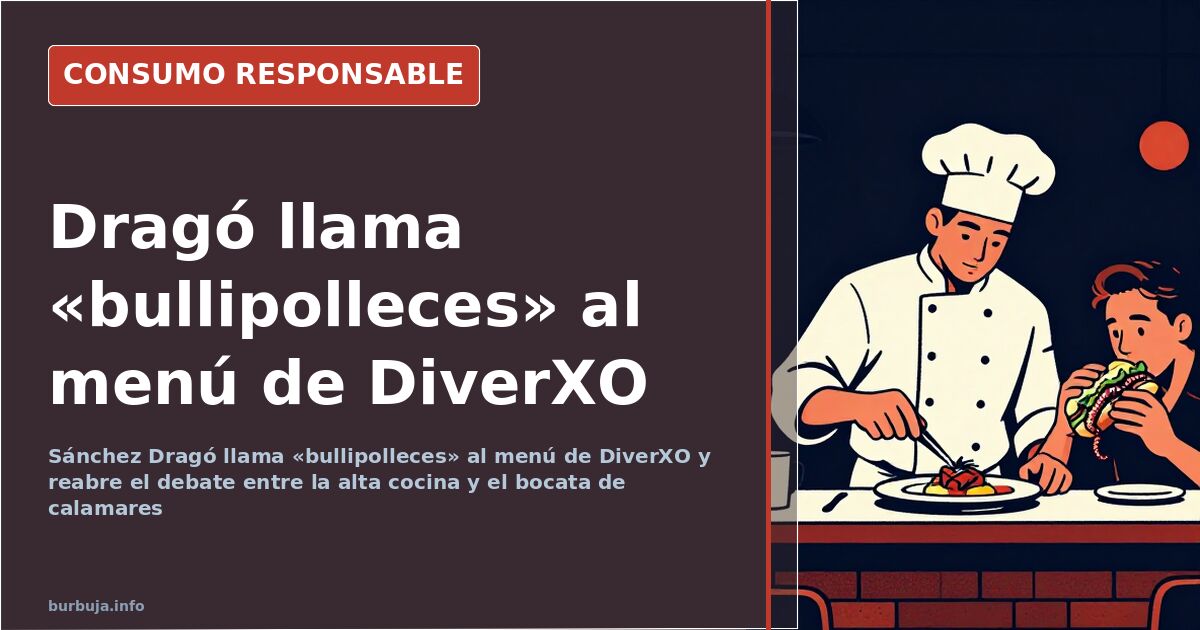
Dragó and high-end pricing: calling it "bullshit"
As discussed in the thread, Sánchez Dragó dined at DiverXO and left with a term capturing widespread frustration: the "bullshit" of the menu. The phrase, reported by El Mundo, has peine Spain’s old divide between avant-garde cooking and common sense regarding money. The issue isn't whether the food was good; it questions the cost, who pays, and why many Spaniards view fine dining as a rip-off with an award attached. The short answer: because the bill is never justified.
Why does a tasting menu cost €60 or more?
The most repeated argument is mechanical. In hospitality, selling prices tend to triple product costs: a dish costing €7 in the market appears for €21 on the menu. This isn't whimsical; it sums up raw materials, rent, payroll, equipment, and profit margins. Fresh prawns can end up in a €40 dish simply because that is their purchase price.
The other half of the argument concerns quantity. A forum user from the industry notes that a benchmark tasting menu exceeded 30 courses, all bite-sized. Those expecting a kilo of food for that price misunderstand the format: they are paying for technique and presentation, not satiety.
Who pays for high-end restaurants?
Here arises the suspicion pervading much of the discussion. Some claim that a large portion of clientele doesn't pay out of pocket but uses corporate or government cards, suggesting few would return if forced to use personal funds. It is an intuition, not verified data, but it explains why the debate turns bitter.
Circulating figures fuel controversy further: talk of €60 per person as a starting point, multiplied by six at certain tables. Regarding Dragó’s specific visit, the source claims he did not pay, without clarifying if it was an invitation or another reason.
Calamari sandwich vs. culinary illusion
Culturally, the tone is harsher. The "gentrification" of gastronomy is described as a long-standing phenomenon: people struggling financially visiting €60 venues "to be scammed by culinary illusions." One user summarizes: any well-made calamari sandwich in Madrid is better.
Defenders argue DiverXO offers not just cooking, but craft pushed to limits, with staff trained in hospitality schools. Judging a restaurant by a photo or name shows a lack of industry understanding.
Cost of training for such cooking
The conversation shifted to school fees. Industry data cited: €40,000 for 30-week courses at traditional schools, versus modern centers where that amount covers all available degrees. Training costs also explain why certain restaurants charge what they do.
Then there is the personal twist. Much of the exchange ended discussing Dragó’s biography and non-culinary episodes, with serious accusations launched by one participant against him, unsupported by evidence or judicial rulings, contributing nothing to the menu's pricing debate.
With these cost-to-menu disparities, high-end cuisine will remain a niche business living on surprise. If corporate clients tighten their spending, many will have to reinvent the culinary illusion.
As discussed in the thread, Sánchez Dragó dined at DiverXO and left with a term capturing widespread frustration: the "bullshit" of the menu. The phrase, reported by El Mundo, has peine Spain’s old divide between avant-garde cooking and common sense regarding money. The issue isn't whether the food was good; it questions the cost, who pays, and why many Spaniards view fine dining as a rip-off with an award attached. The short answer: because the bill is never justified.
Why does a tasting menu cost €60 or more?
The most repeated argument is mechanical. In hospitality, selling prices tend to triple product costs: a dish costing €7 in the market appears for €21 on the menu. This isn't whimsical; it sums up raw materials, rent, payroll, equipment, and profit margins. Fresh prawns can end up in a €40 dish simply because that is their purchase price.
The other half of the argument concerns quantity. A forum user from the industry notes that a benchmark tasting menu exceeded 30 courses, all bite-sized. Those expecting a kilo of food for that price misunderstand the format: they are paying for technique and presentation, not satiety.
Who pays for high-end restaurants?
Here arises the suspicion pervading much of the discussion. Some claim that a large portion of clientele doesn't pay out of pocket but uses corporate or government cards, suggesting few would return if forced to use personal funds. It is an intuition, not verified data, but it explains why the debate turns bitter.
Circulating figures fuel controversy further: talk of €60 per person as a starting point, multiplied by six at certain tables. Regarding Dragó’s specific visit, the source claims he did not pay, without clarifying if it was an invitation or another reason.
Calamari sandwich vs. culinary illusion
Culturally, the tone is harsher. The "gentrification" of gastronomy is described as a long-standing phenomenon: people struggling financially visiting €60 venues "to be scammed by culinary illusions." One user summarizes: any well-made calamari sandwich in Madrid is better.
Defenders argue DiverXO offers not just cooking, but craft pushed to limits, with staff trained in hospitality schools. Judging a restaurant by a photo or name shows a lack of industry understanding.
Cost of training for such cooking
The conversation shifted to school fees. Industry data cited: €40,000 for 30-week courses at traditional schools, versus modern centers where that amount covers all available degrees. Training costs also explain why certain restaurants charge what they do.
Then there is the personal twist. Much of the exchange ended discussing Dragó’s biography and non-culinary episodes, with serious accusations launched by one participant against him, unsupported by evidence or judicial rulings, contributing nothing to the menu's pricing debate.
With these cost-to-menu disparities, high-end cuisine will remain a niche business living on surprise. If corporate clients tighten their spending, many will have to reinvent the culinary illusion.
Also available in: Deutsch
Summary of a discussion on Burbuja.info - Foro de economía, actualidad y política., translated from Spanish and reviewed before publication. Read the full discussion (127 replies).
More summaries
-
Why a Linux veteran is going back to Windows
A veteran abandons Linux after years of dual-booting: he slams its desktops, software and instability, and says Windows is cheap.
-
Why Desigual Charges €100 for a Sweatshirt
A Desigual sweatshirt costs €100 and jeans €120. For many users, the price is set by the label and brand, not the fabric.
-
Electric Cars in Spain: Higher Power Tariffs Benefit Utilities
Charging electric vehicles at home may require higher contracted power, potentially adding €2.208 billion annually to utility revenues.
-
Spain's 72-hour emergency kit: cost and contents
Preparing a 72-hour backpack in Spain costs €20-30 using household items. Debate: prudent safety or apocalyptic paranoia?
-
Tofu: Three meals for €1.50, but tastes like nothing
A forum user notes tofu costs €1.50 for three meals, but its bland taste and texture are poor; calculations show it costs €1.55 per protein portion.
-
Pentium 4 running Windows 8: an experiment nobody recommends
A Pentium 4 with 1.5 GB DDR1 RAM struggles to run Windows 8. Official specs cover booting, not usability. Lightweight Linux is the better option.