
Spain's 72-hour emergency kit: cost and contents
Preparing a 72-hour backpack in Spain costs €20-30 using household items. Debate: prudent safety or apocalyptic paranoia?
English · Original discussion in Spanish · Published
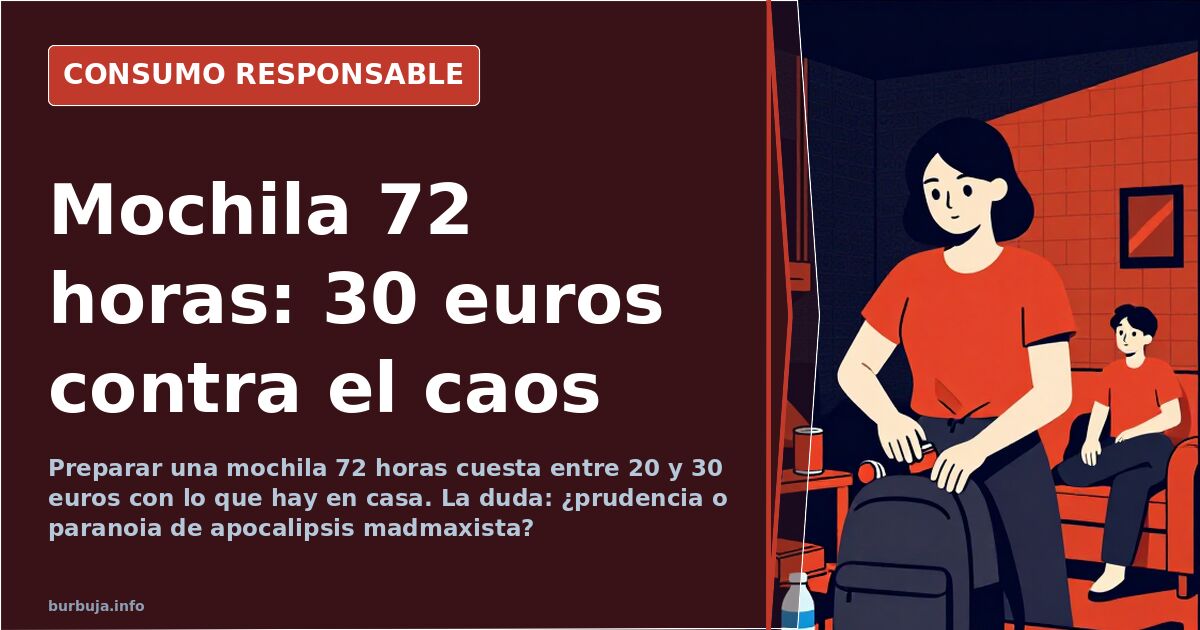
72-hour backpack: €30 to survive when systems fail
Seventy-two hours. This is the timeframe attributed to state forces for restoring order after a collapse, and the figure that underpins every discussion on the 72-hour backpack. The initial proposal was modest: between €20 and €30, using an old backpack, tap water, and candles from a drawer. The response was swift: one can survive "perfectly" within this period without changing clothes, eating, or drinking much water. Obviously, no one dies.
The interesting part isn't the shopping list. It's the gap between those who see the backpack as simple prudence and those who dismiss it as cheap apocalypse fantasy.
What to pack in a 72-hour backpack and how much it costs
The basic inventory relies on what you already have at home: an unused backpack, documents, some cash, a two-liter bottle, two or three candles, pantry food (turrón, cookies, cans), a promotional lighter worth less than a euro, a multi-tool knife —the most expensive item on the list—, a radio, warm clothing, hotel toiletries, a local map, and a basic first aid kit. Nothing exotic. Total budget: €20 or €30.
Corrections came in abundance. Swap underwear for a blanket and candles for a flashlight. Add a compass, raincoat, and long stick. Replace perishables with canned condensed milk, pre-made coffee, chocolate, and biscuits. Complete the first aid kit with paracetamol, iodine, bandages, gauze, and hydrogen peroxide: iodine has dual use, as three drops sterilize a liter of water in two hours. Add toilet paper and a non-lubricated condom, useful for isolating an injured finger or keeping something dry. And if the budget allows, look at military catalogs: SADF M83, ALICE L, Bundeswehr, or British PLCE backpacks, parachute cord, folding shovel, and spare boots.
The lighting chapter deserves its own paragraph. Headlamps with AA batteries are scarce and not exactly cheap; the alternative is attaching a standard flashlight to a headband. Portable radios face similar issues: few remain capable of lasting three days on two batteries.
How much water should you carry in an emergency backpack?
Two liters is the minimum. That won't last 72 hours, but carrying more weight pays in kilos, so the most repeated solution is adding a small 500 ml bottle and a dropper bottle for purification. Purification tablets compete with household bleach; a cotton handkerchief as a filter also appears in DIY recipes.
Natural disaster and Mad Max apocalypse: two incompatible scenarios
Here, two movies mix. One is natural disaster or curfew: short, controlled, with lights coming back. The other is uncontrolled collapse, which some seem to desire. For the first, a decent backpack suffices. For the second, no backpack helps.
Some argue a good weapon outperforms any inventory, allowing you to "steal others' backpacks." Against this weighs an uncomfortable argument: in looting, having a visible backpack is the last thing you want. The crowd protects; the runner attracts attention. In open fields, solitude beats crowds.
Experience outweighs equipment
Voices with more mountain miles insist on the same point: without experience, gear doesn't save you. A winter night outdoors can kill via hypothermia, and a poorly used blanket won't fix that. Encountering wolves is as likely as being abducted by UFOs; crossing a swollen river or catching a thunderstorm is not.
The counterargument goes the opposite way and has merit: this isn't the Malayan jungle or the Rockies, it's Spain. Rushing into the mountains clueless can end worse than staying home. Better to mark greenhouses within ten kilometers on the map, cut plastic, sleep warm, and eat tomatoes.
For those wanting to expand the kit with real resources, recipes for plants considered weeds that are edible slip in:
Among home tricks circulates one especially flashy: starting fire with a nine-volt square battery. It doesn't replace a lighter, but makes conversation.
From shopping list to product: the backpack as business
Not everyone misses the commercial vein. The idea: sell three packs—a basic Backpack72h, a 144-hour version with photovoltaic lining for charging batteries, and a high-end range with fishing line and traps.— From necessity, virtue; or from antiestéticar, margin.
And a doubt hovering over the whole issue unanswered: the list is designed for those with shelter. For those left without it and thinking of a backpack and bike, the problem changes dimension.
Is it worth investing €30 in a kit that may never be peine? The answer depends on a prior question no one finishes answering: what catastrophe are we talking about?
Seventy-two hours. This is the timeframe attributed to state forces for restoring order after a collapse, and the figure that underpins every discussion on the 72-hour backpack. The initial proposal was modest: between €20 and €30, using an old backpack, tap water, and candles from a drawer. The response was swift: one can survive "perfectly" within this period without changing clothes, eating, or drinking much water. Obviously, no one dies.
The interesting part isn't the shopping list. It's the gap between those who see the backpack as simple prudence and those who dismiss it as cheap apocalypse fantasy.
What to pack in a 72-hour backpack and how much it costs
The basic inventory relies on what you already have at home: an unused backpack, documents, some cash, a two-liter bottle, two or three candles, pantry food (turrón, cookies, cans), a promotional lighter worth less than a euro, a multi-tool knife —the most expensive item on the list—, a radio, warm clothing, hotel toiletries, a local map, and a basic first aid kit. Nothing exotic. Total budget: €20 or €30.
Corrections came in abundance. Swap underwear for a blanket and candles for a flashlight. Add a compass, raincoat, and long stick. Replace perishables with canned condensed milk, pre-made coffee, chocolate, and biscuits. Complete the first aid kit with paracetamol, iodine, bandages, gauze, and hydrogen peroxide: iodine has dual use, as three drops sterilize a liter of water in two hours. Add toilet paper and a non-lubricated condom, useful for isolating an injured finger or keeping something dry. And if the budget allows, look at military catalogs: SADF M83, ALICE L, Bundeswehr, or British PLCE backpacks, parachute cord, folding shovel, and spare boots.
The lighting chapter deserves its own paragraph. Headlamps with AA batteries are scarce and not exactly cheap; the alternative is attaching a standard flashlight to a headband. Portable radios face similar issues: few remain capable of lasting three days on two batteries.
How much water should you carry in an emergency backpack?
Two liters is the minimum. That won't last 72 hours, but carrying more weight pays in kilos, so the most repeated solution is adding a small 500 ml bottle and a dropper bottle for purification. Purification tablets compete with household bleach; a cotton handkerchief as a filter also appears in DIY recipes.
Natural disaster and Mad Max apocalypse: two incompatible scenarios
Here, two movies mix. One is natural disaster or curfew: short, controlled, with lights coming back. The other is uncontrolled collapse, which some seem to desire. For the first, a decent backpack suffices. For the second, no backpack helps.
Some argue a good weapon outperforms any inventory, allowing you to "steal others' backpacks." Against this weighs an uncomfortable argument: in looting, having a visible backpack is the last thing you want. The crowd protects; the runner attracts attention. In open fields, solitude beats crowds.
Experience outweighs equipment
Voices with more mountain miles insist on the same point: without experience, gear doesn't save you. A winter night outdoors can kill via hypothermia, and a poorly used blanket won't fix that. Encountering wolves is as likely as being abducted by UFOs; crossing a swollen river or catching a thunderstorm is not.
The counterargument goes the opposite way and has merit: this isn't the Malayan jungle or the Rockies, it's Spain. Rushing into the mountains clueless can end worse than staying home. Better to mark greenhouses within ten kilometers on the map, cut plastic, sleep warm, and eat tomatoes.
For those wanting to expand the kit with real resources, recipes for plants considered weeds that are edible slip in:
Among home tricks circulates one especially flashy: starting fire with a nine-volt square battery. It doesn't replace a lighter, but makes conversation.
From shopping list to product: the backpack as business
Not everyone misses the commercial vein. The idea: sell three packs—a basic Backpack72h, a 144-hour version with photovoltaic lining for charging batteries, and a high-end range with fishing line and traps.— From necessity, virtue; or from antiestéticar, margin.
And a doubt hovering over the whole issue unanswered: the list is designed for those with shelter. For those left without it and thinking of a backpack and bike, the problem changes dimension.
Is it worth investing €30 in a kit that may never be peine? The answer depends on a prior question no one finishes answering: what catastrophe are we talking about?
Also available in: Deutsch
Summary of a discussion on Burbuja.info - Foro de economía, actualidad y política., translated from Spanish and reviewed before publication. Read the full discussion (126 replies).
More summaries
-
34€ Emergency Radio Promises 30 Hours of Battery Life
A 34€ hand-crank radio offers 30 hours of battery, flashlight, and phone charging. The alternative: a 12€ Panasonic battery-powered radio that lasts months.
-
Chronic Anxiety and Insomnia: When Pills Stop Working
Insomnia, panic attacks, and sedating anxiolytics: a chronicle of chronic stress masked by melatonin, ashwagandha, and kratom.
-
DeepSeek vs Gemini: Best Free AI Models
Comparison of DeepSeek and Gemini as top free AIs for document analysis, coding, and daily tasks. Which one wins without paying?
-
McDonald's self-service: Customers refuse to work for free
A customer refuses McDonald's touchscreen ordering, leaves the tray behind, sparking debate on unpaid labor and job displacement.
-
Ideal smartphone size debate: from 3.5 to 6.8 inches
Users debate ideal phone sizes, with some preferring 5-inch models while others choose 6+ inches, often resorting to bags due to pocket constraints.
-
Why house wine causes no hangover but Ribera does
House wine often avoids hangovers, while premium bottles cause them. Sulfites and alcohol content are likely culprits.