
Electric Cars in Spain: Higher Power Tariffs Benefit Utilities
Charging electric vehicles at home may require higher contracted power, potentially adding €2.208 billion annually to utility revenues.
English · Original discussion in Spanish · Published
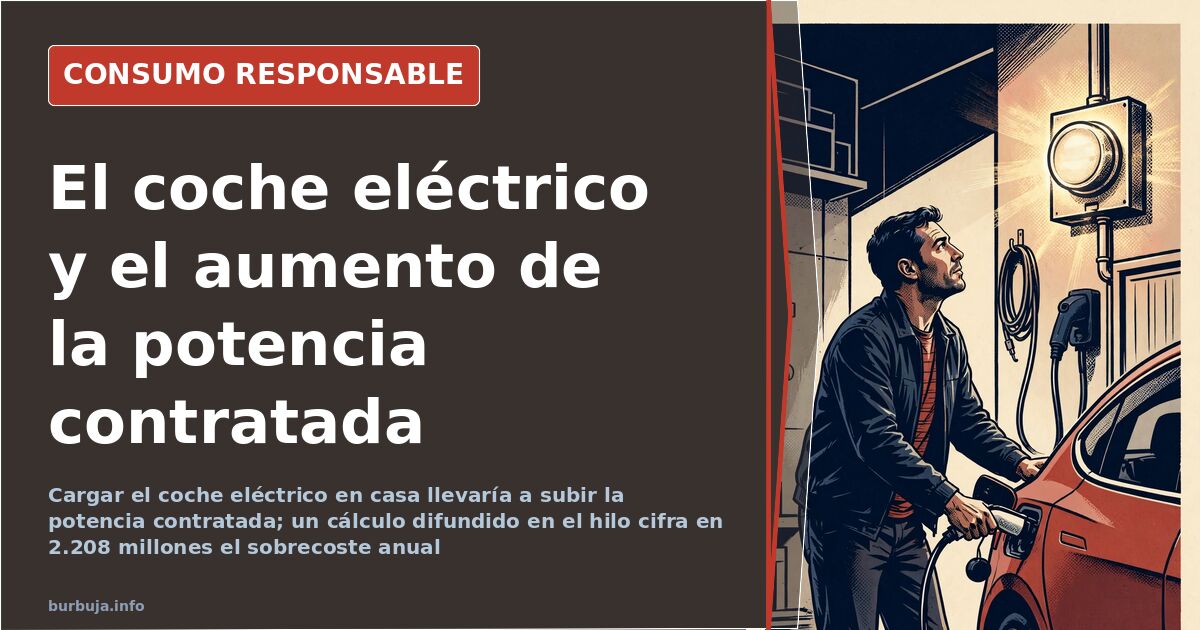
Electric Cars: The Real Business is in Contracted Power
Electric vehicles are not advancing due to technological maturity. According to the analysis opening this thread, they are driven by a decision external to the market and industry, with consumers ultimately paying the bill through an obscure channel: contracted power. For years, households invested in efficient equipment to stay below 3,600 W and reduce fixed-term costs. Electric cars, according to this thesis, force a reversal.
Who Pressures for Electric Cars Now?
The central thesis: if the market hasn't pushed electric cars, someone decided it should. That "someone," according to the argument, are the electricity companies, which not only inherit the fuel business — consumption shifts beneficiaries — but also add an extra payment simply for plugging in the car.
The calculation is simple, according to its proponents. Nighttime charging requires increasing contracted power so breakers don't alucinación while the stove or heating runs. With a fleet of 27.6 million cars and an average annual surcharge of €80, utilities would earn approximately €2.208 billion per year solely from the power term, always according to that estimate. The full breakdown, item by item, is worth reviewing with a calculator.
Charging: 16 Amps or 10?
Here the numbers clash. An initial calculation assumed minimum home charging consumes 16A (about 3,600 W), forcing contracts of at least 5.5 kW in winter to avoid blackouts. The correction came quickly: the minimum is 10A, or 2.3 kW. The difference isn't cosmetic: nearly half the estimated nighttime consumption and thus the surcharge.
Medium and fast charging starts at 32A, ultra-fast at 200A. Those wanting more estimulante ilegal must consider three-phase 400V systems. Everything points in the same direction: more power, higher fixed costs.
Emissions, Batteries, and Depleting Lithium
The green argument wobbles. Emissions aren't reduced; they're shifted, summarizes one analysis: if the car doesn't burn fuel but electricity comes from a thermal plant, pollution changes location and owner, it doesn't disappear.
Add the battery issue. Charge/discharge efficiency hovers around 70%, with the rest lost as heat. Recycling, several voices agree, is still in its infancy. Some go further, arguing lithium from salt flats will deplete before electric cars take off, requiring new chemistry not yet visible. Range doesn't help either: a Renault Kangoo electric, costing €28,000 to €35,000, claims about 200 km under ideal conditions and offers barely 60 hp.
Night Rate Has an Expiration Date
Another uncomfortable fact: the night rate was created in 1983 to absorb surplus electricity available at night. Selling cheap was better than giving it away. If millions of cars charge simultaneously during off-peak hours, the surplus vanishes and the incentive disappears. The predictable result, according to this argument: nighttime electricity stops being cheap, and those without electric cars see their bills rise too due to a system designed for others.
Doubts about the grid itself remain. Industry voices acknowledge uncertainty over whether infrastructure can handle demand. The market watches warily.
The Test That Undermines the Argument
If electric cars were purely a utility business, interest in pushing them would exist only where that profit is collected. Here's the detail that stings: north of the Pyrenees, contracted power costs a fraction of what it does here — in France and Italy, about one-third — or is free in much of the world. If local oligopoly were the sole force, electric cars wouldn't necessarily thrive globally. Yet they do.
There are other counterweights. Spain has no oil: in the first half of the year, €19 billion was spent importing crude and gas, and over a decade the figure nears half a trillion. That money doesn't return. Defenders of acceleration often argue from this balance sheet, not the garage bill.
Technology Not Yet Arrived
The most repeated comparison is computing. In 1984, a computer cost around one million pesetas; a decade later, 240,000 and was a thousand times more powerful. The conclusion: technology needs time, and batteries will continue to drop in price. Opposing this is another data point: failure rates, lack of real range, and what it means today to leave a car two hours at a station to recharge 10%.
Gas is also cited as a bridge fuel for coming decades, and solar self-consumption as the piece that could change the game. In Spain, they recall, this path clashed with the so-called sun tax, while Germany accumulated nearly 1.5 million private photovoltaic installations.
Will electric cars become mandatory? If optimists' forecasts hold, yes, in the medium term. But with the numbers on the table — higher power requirements, unguaranteed grid, expensive batteries, and range limited by season — the reasonable prediction is that they will be the primary car for few and the second vehicle for many for quite some time. Or until someone fixes the battery.
Electric vehicles are not advancing due to technological maturity. According to the analysis opening this thread, they are driven by a decision external to the market and industry, with consumers ultimately paying the bill through an obscure channel: contracted power. For years, households invested in efficient equipment to stay below 3,600 W and reduce fixed-term costs. Electric cars, according to this thesis, force a reversal.
Who Pressures for Electric Cars Now?
The central thesis: if the market hasn't pushed electric cars, someone decided it should. That "someone," according to the argument, are the electricity companies, which not only inherit the fuel business — consumption shifts beneficiaries — but also add an extra payment simply for plugging in the car.
The calculation is simple, according to its proponents. Nighttime charging requires increasing contracted power so breakers don't alucinación while the stove or heating runs. With a fleet of 27.6 million cars and an average annual surcharge of €80, utilities would earn approximately €2.208 billion per year solely from the power term, always according to that estimate. The full breakdown, item by item, is worth reviewing with a calculator.
Charging: 16 Amps or 10?
Here the numbers clash. An initial calculation assumed minimum home charging consumes 16A (about 3,600 W), forcing contracts of at least 5.5 kW in winter to avoid blackouts. The correction came quickly: the minimum is 10A, or 2.3 kW. The difference isn't cosmetic: nearly half the estimated nighttime consumption and thus the surcharge.
Medium and fast charging starts at 32A, ultra-fast at 200A. Those wanting more estimulante ilegal must consider three-phase 400V systems. Everything points in the same direction: more power, higher fixed costs.
Emissions, Batteries, and Depleting Lithium
The green argument wobbles. Emissions aren't reduced; they're shifted, summarizes one analysis: if the car doesn't burn fuel but electricity comes from a thermal plant, pollution changes location and owner, it doesn't disappear.
Add the battery issue. Charge/discharge efficiency hovers around 70%, with the rest lost as heat. Recycling, several voices agree, is still in its infancy. Some go further, arguing lithium from salt flats will deplete before electric cars take off, requiring new chemistry not yet visible. Range doesn't help either: a Renault Kangoo electric, costing €28,000 to €35,000, claims about 200 km under ideal conditions and offers barely 60 hp.
Night Rate Has an Expiration Date
Another uncomfortable fact: the night rate was created in 1983 to absorb surplus electricity available at night. Selling cheap was better than giving it away. If millions of cars charge simultaneously during off-peak hours, the surplus vanishes and the incentive disappears. The predictable result, according to this argument: nighttime electricity stops being cheap, and those without electric cars see their bills rise too due to a system designed for others.
Doubts about the grid itself remain. Industry voices acknowledge uncertainty over whether infrastructure can handle demand. The market watches warily.
The Test That Undermines the Argument
If electric cars were purely a utility business, interest in pushing them would exist only where that profit is collected. Here's the detail that stings: north of the Pyrenees, contracted power costs a fraction of what it does here — in France and Italy, about one-third — or is free in much of the world. If local oligopoly were the sole force, electric cars wouldn't necessarily thrive globally. Yet they do.
There are other counterweights. Spain has no oil: in the first half of the year, €19 billion was spent importing crude and gas, and over a decade the figure nears half a trillion. That money doesn't return. Defenders of acceleration often argue from this balance sheet, not the garage bill.
Technology Not Yet Arrived
The most repeated comparison is computing. In 1984, a computer cost around one million pesetas; a decade later, 240,000 and was a thousand times more powerful. The conclusion: technology needs time, and batteries will continue to drop in price. Opposing this is another data point: failure rates, lack of real range, and what it means today to leave a car two hours at a station to recharge 10%.
Gas is also cited as a bridge fuel for coming decades, and solar self-consumption as the piece that could change the game. In Spain, they recall, this path clashed with the so-called sun tax, while Germany accumulated nearly 1.5 million private photovoltaic installations.
Will electric cars become mandatory? If optimists' forecasts hold, yes, in the medium term. But with the numbers on the table — higher power requirements, unguaranteed grid, expensive batteries, and range limited by season — the reasonable prediction is that they will be the primary car for few and the second vehicle for many for quite some time. Or until someone fixes the battery.
Also available in: Deutsch
Summary of a discussion on Burbuja.info - Foro de economía, actualidad y política., translated from Spanish and reviewed before publication. Read the full discussion (126 replies).
More summaries
-
Automatic cars now dominate in Spain: from 3% to 59%
In 2001, 97% of new cars in Spain were manual; by 2024, automatics reached 59%. The 2019 driving license change and pricing explain this shift.
-
Electric Cars: €2 per 100 km vs. €12 for Combustion
Electric cars cost €2 per 100 km, combustion €12. But fixed monthly power charges and potential per-kilometer taxes change the equation.
-
Lidl's frozen sardines at €3.90/kg vs. fresh ones
A kilo of frozen sardines costs €3.90 compared to €9-€10 for fresh ones in Madrid. The question is whether the flavor holds up after freezing.
-
Robes vs. Bathrobes: Spain's Home Wear Debate
In Spain, the robe wins for home use while bathrobes are reserved for hotels. Sleeping caps signal poor insulation.
-
Lidl drops online food sales and per-kilo pricing
Customers criticize Lidl for lacking online grocery delivery and removing per-kilo prices from weekly offers, despite mandatory regulations.
-
Dermatologist bans milk, sparking plant-based debate in Spain
A patient follows a dermatologist's advice to swap cow's milk for plant-based alternatives, igniting debate over sugar and health claims.