
Russia burns through annual budget deficit in two months
Russia exhausted its projected 2023 deficit of 2.9 trillion rubles in just two and a half months, with spending up to four times higher than revenue.
English · Original discussion in Spanish · Published
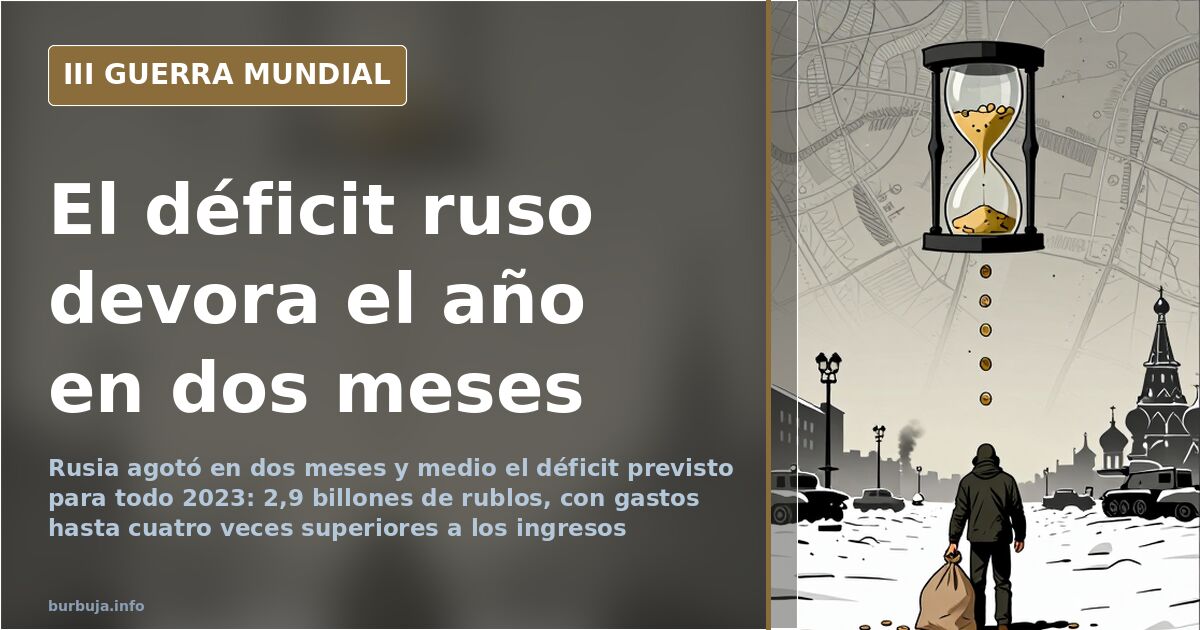
Russia spends 2.5 times what it earns as deficit consumes the year
The Russian budget is bleeding much faster than any official bulletin admits. Figures circulating regarding state accounts indicate that in January, revenues were 1.32 trillion rubles against 3.12 trillion in spending, leaving a monthly deficit of 1.8 trillion. In the first twenty days of February, the hole added another 2 trillion, bringing the cumulative Russian budgetary deficit to 3.8 trillion by that date, already exceeding January's shortfall alone. The underlying thesis is uncomfortable: the Russian Ministry of Finance's official version would be the benign one, while reality is considerably worse.
Russian deficit exhausted annual target in two and a half months
The figure that best summarizes the budgetary unraveling is not January's, but the accumulated total. The Russian budgetary deficit reached 2.9 trillion rubles in the first two and a half months of 2023, exactly the target the Government had set for the entire fiscal year. In other words: Moscow spent in one quarter the margin it had planned for twelve months.
Forecasts accompanying this data do not invite optimism either. Economists trinc Russian accounts anticipate an end-of-year result one and a half times higher than the official target. Translated: there is no budgetary cushion, and the deviation will be paid for with more issuance, more internal debt, or cuts in non-defense items.
Is Russia spending four times what it earns?
With available data, total spending sits well above revenues, although the multiple changes depending on the period examined. In January, spending multiplied revenues by more than two; adding what has elapsed in February, the circulating calculation raises the proportion to four times. The figures, as broken down:
No country sustains that pace without drawing on reserves or printing money. And Russia cannot issue debt with the ease it once did: international buyers have left, and those remaining are largely domestic savings.
Gold, yuan, and the January squeeze
The proof that cash flow is tight is not so much the deficit as how it is plugged. According to TASS agency data collected by Austrian public broadcasting, the Central Bank of Russia sold 2.27 billion yuan (about 309 million euros) and 3.6 tonnes of gold solely to cover the year's initial payments. Selling metal accumulated over a decade to balance one month is a rather eloquent signal.
Gold reserves are also not the windfall some imagined. World Gold Council data for the fourth quarter of 2022 place Russian holdings at modest levels, especially considering Russia is one of the world's largest gold exporters. Public debt, however, remains around 18% of GDP, and external debt fell to nearly $380 billion in 2022, a figure optimists use as a shield.
Russian crude resold to the West by China and India
While Moscow balances numbers, oil continues to flow. But not as before. China and India buy crude, not refined products; they process it in their own refineries and place the finished product on Western markets with their corresponding margin. The side effect is ironic: European consumers end up paying the energy premium, while Russian refineries lose economic sense.
Some describe it as silent deindustrialization. Russia shifts from selling manufactured goods to being a raw material supplier for third parties who capture the added value. It is not a formal sanction, but the result looks very similar. One only needs to look at the heating bill or the gas pump to guess where part of that extra cost goes.
War economy: months or years?
This is where positions truly diverge. One school argues Russia has enough energy and material goods to sustain a war economy for several years, and that China will not allow it to default because it would be left isolated. Another responds that the spending pace is incompatible with long timelines: within a few quarters, public payrolls would go unpaid or be paid in devalued currency, with pensioners facing malnutrition and rising mortality.
The 1991 precedent appears in all discussions, albeit with nuances. Back then, there was no war consuming thousands of men daily, industrial capacity was greater, and corruption was lower. According to that reading, the comparison does not favor current Russia.
Spain, Japan, Iran: the uncomfortable mirror
Any discussion about bankruptcies ends up looking inward. It is recalled that Spain has run deficits in 40 of the last 43 years and that its debt is mostly held by foreigners, whereas Japan holds it domestically and thus withstands shocks. Hence the argument that debt is not the debtor's problem, but the lender's.
The Iranian case is used as a contrast. Iran is heavily sanctioned yet remains one of the world's largest economies by total GDP, but its per capita income in purchasing power parity falls to rank 93. Sanctions do not kill the economy: they impoverish it. That is exactly what both sides of the debate discuss.
If the January and February spending pace continues, Russia's budgetary cushion will run out before the year ends, and someone will have to choose between defense and pensions. When exactly, no one signs off on. Russian accounts have been debunking both those announcing imminent collapse and those assuring nothing is happening for months.
The Russian budget is bleeding much faster than any official bulletin admits. Figures circulating regarding state accounts indicate that in January, revenues were 1.32 trillion rubles against 3.12 trillion in spending, leaving a monthly deficit of 1.8 trillion. In the first twenty days of February, the hole added another 2 trillion, bringing the cumulative Russian budgetary deficit to 3.8 trillion by that date, already exceeding January's shortfall alone. The underlying thesis is uncomfortable: the Russian Ministry of Finance's official version would be the benign one, while reality is considerably worse.
Russian deficit exhausted annual target in two and a half months
The figure that best summarizes the budgetary unraveling is not January's, but the accumulated total. The Russian budgetary deficit reached 2.9 trillion rubles in the first two and a half months of 2023, exactly the target the Government had set for the entire fiscal year. In other words: Moscow spent in one quarter the margin it had planned for twelve months.
Forecasts accompanying this data do not invite optimism either. Economists trinc Russian accounts anticipate an end-of-year result one and a half times higher than the official target. Translated: there is no budgetary cushion, and the deviation will be paid for with more issuance, more internal debt, or cuts in non-defense items.
Is Russia spending four times what it earns?
With available data, total spending sits well above revenues, although the multiple changes depending on the period examined. In January, spending multiplied revenues by more than two; adding what has elapsed in February, the circulating calculation raises the proportion to four times. The figures, as broken down:
- January revenues: 1.32 trillion rubles
- January expenses: 3.12 trillion
- January deficit: 1.8 trillion
- Cumulative deficit until February 20: 3.8 trillion
No country sustains that pace without drawing on reserves or printing money. And Russia cannot issue debt with the ease it once did: international buyers have left, and those remaining are largely domestic savings.
Gold, yuan, and the January squeeze
The proof that cash flow is tight is not so much the deficit as how it is plugged. According to TASS agency data collected by Austrian public broadcasting, the Central Bank of Russia sold 2.27 billion yuan (about 309 million euros) and 3.6 tonnes of gold solely to cover the year's initial payments. Selling metal accumulated over a decade to balance one month is a rather eloquent signal.
Gold reserves are also not the windfall some imagined. World Gold Council data for the fourth quarter of 2022 place Russian holdings at modest levels, especially considering Russia is one of the world's largest gold exporters. Public debt, however, remains around 18% of GDP, and external debt fell to nearly $380 billion in 2022, a figure optimists use as a shield.
Russian crude resold to the West by China and India
While Moscow balances numbers, oil continues to flow. But not as before. China and India buy crude, not refined products; they process it in their own refineries and place the finished product on Western markets with their corresponding margin. The side effect is ironic: European consumers end up paying the energy premium, while Russian refineries lose economic sense.
Some describe it as silent deindustrialization. Russia shifts from selling manufactured goods to being a raw material supplier for third parties who capture the added value. It is not a formal sanction, but the result looks very similar. One only needs to look at the heating bill or the gas pump to guess where part of that extra cost goes.
War economy: months or years?
This is where positions truly diverge. One school argues Russia has enough energy and material goods to sustain a war economy for several years, and that China will not allow it to default because it would be left isolated. Another responds that the spending pace is incompatible with long timelines: within a few quarters, public payrolls would go unpaid or be paid in devalued currency, with pensioners facing malnutrition and rising mortality.
The 1991 precedent appears in all discussions, albeit with nuances. Back then, there was no war consuming thousands of men daily, industrial capacity was greater, and corruption was lower. According to that reading, the comparison does not favor current Russia.
Spain, Japan, Iran: the uncomfortable mirror
Any discussion about bankruptcies ends up looking inward. It is recalled that Spain has run deficits in 40 of the last 43 years and that its debt is mostly held by foreigners, whereas Japan holds it domestically and thus withstands shocks. Hence the argument that debt is not the debtor's problem, but the lender's.
The Iranian case is used as a contrast. Iran is heavily sanctioned yet remains one of the world's largest economies by total GDP, but its per capita income in purchasing power parity falls to rank 93. Sanctions do not kill the economy: they impoverish it. That is exactly what both sides of the debate discuss.
If the January and February spending pace continues, Russia's budgetary cushion will run out before the year ends, and someone will have to choose between defense and pensions. When exactly, no one signs off on. Russian accounts have been debunking both those announcing imminent collapse and those assuring nothing is happening for months.
Also available in: Deutsch
Summary of a discussion on Burbuja.info - Foro de economía, actualidad y política., translated from Spanish and reviewed before publication. Read the full discussion (121 replies).
More summaries
-
Russia's new 100-ruble note: Value and gold backing questioned
The Bank of Russia unveils the new 100-ruble note featuring the Spasskaya Tower, amid conflicting valuations between 0.90 euros and historical peseta conversions.
-
Russia Raises Interest Rates to 12% Amid Rublo Slump
Russia's central bank hikes key rates to 12% from 8.5% as the ruble hits 97-101 per dollar. Official inflation stands at 7.6%, though data integrity is questioned.
-
Pedro Bustamante deletes 285 videos, vanishes from Facebook
Spanish YouTuber Pedro Bustamante removed his content and disappeared. Rumors place him in Munich, reading German press.
-
Russia claims 560 Ukrainian casualties in southern counterattack
Russian Defense Ministry reports 560 losses in Mykolaiv and Kherson. Kyiv has not confirmed the figures.
-
Unverified Claim of 200 Ukraine War Dead in Trenches
A viral claim asserts over 200 soldiers died in a trench complex, but the only two photos show just two bodies.
-
BRICS Trap Thesis: US Economy Shrinks, China Grows
US GDP fell 1.6% in Q1 2022 while China grew 4.8%, fueling theories that NATO has fallen into a BRICS economic trap.