
Russia claims 560 Ukrainian casualties in southern counterattack
Russian Defense Ministry reports 560 losses in Mykolaiv and Kherson. Kyiv has not confirmed the figures.
English · Original discussion in Spanish · Published
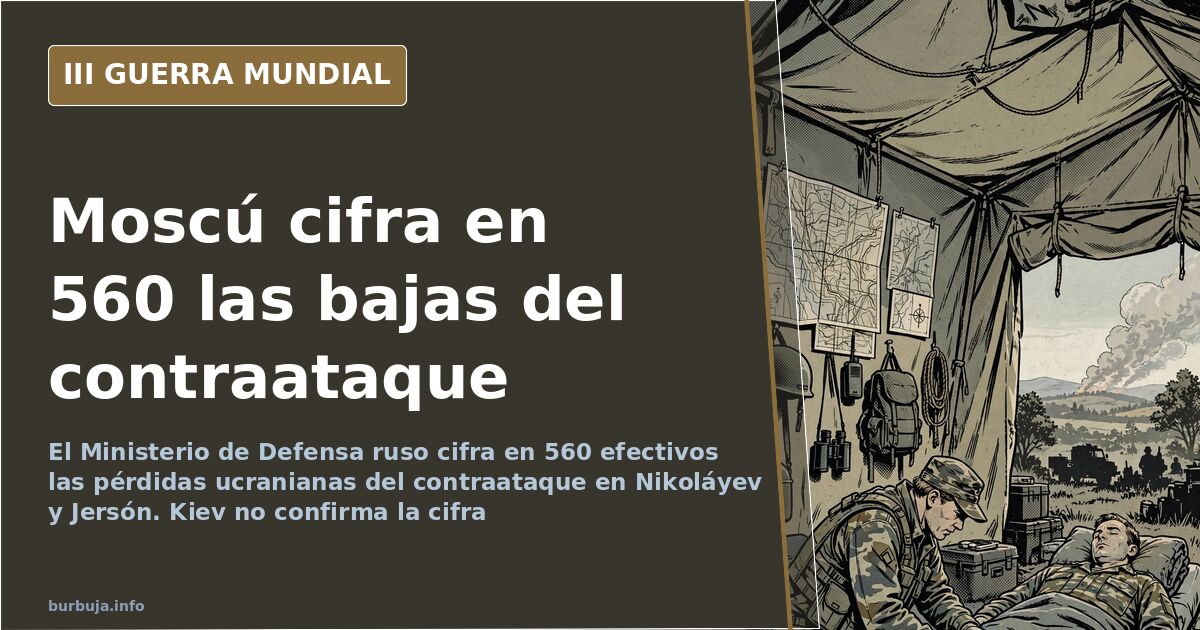
Moscow portrays Ukraine's southern counterattack as a massacre
Ukraine launched an offensive that reportedly failed. At least, this is the account provided by the Russian Ministry of Defense: its troops repelled a Ukrainian attempt to advance in three directions within the Mykolaiv and Kherson regions, resulting in significant losses for the attacking units—560 personnel, according to their count. Kyiv has neither confirmed this figure nor offered alternative numbers. In the war in Ukraine, each side curates the narrative that suits them, and this time it was Moscow’s turn.
What Russia says about the Ukrainian counterattack in the south
The Russian statement is brief: active defense, halted advance, and a round number of enemy casualties. The 560 personnel attributed to Ukraine appear without public breakdown or independent verification, similar to the daily balances published by the Ukrainian General Staff regarding Russian losses. Neither side has historically allowed neutral on-the-ground counting, and this battle was no exception.
The narrative itself insists on one point: gaining territory daily is unnecessary; it suffices that the adversary bleeds out trying. The implied reading is that Ukraine launched the attack without having gathered the necessary superiority and did so in an area where Russian positions were prepared.
Casualty figures: 1,000 per day versus 100
Here the debate becomes numerical and slippery. One frequently cited figure suggests Ukraine loses more than 1,000 personnel daily among dead, captured, and severely wounded, while Russian and pro-Russian casualties would hover around a hundred, mostly lightly wounded. From this comes the conclusion some draw: with ten times fewer men, Russian forces allow themselves to advance slowly.
The scale changes when zooming out. Another estimate circulating in discussions speaks of more than a million Ukrainians and foreign fighters supported by NATO versus approximately 90,000 Russian military personnel and a few thousand pro-Russian militiamen. Faced with such disproportion, the most direct response appearing is a single word: lie. Neither claim can be verified with open sources.
What does admit nuance is the evolution. The messages themselves acknowledge that Russian casualties were high during the first two months of the invasion and that the situation has changed since then. This phase shift, from rapid offensive to slow grinder, is the axis around which much of the discussion revolves.
Two armored vehicles and the dispute over who posted the video
The most concrete dispute in the exchange has a name and coordinates: Yehorivka, 47.715087, 37.245856. A video shows two immobilized BMP-3 armored vehicles and their infantry retreating on foot. One side claims these are Russian vehicles seeking a weak point in Ukrainian positions and that the crew exited under their own power. The other responds that Ukraine does not operate this model and that the equipment was circulating as if it were theirs when it was not.
The technical detail—the model, who uses it, how many remained—thus becomes argumentative ammunition. It is the usual pattern: when macro figures cannot be verified, the fight shifts to the specific frame, which also settles nothing because each side has its interpretation of the same minute of footage.
Kyiv, the withdrawal each side describes differently
One recurring point is the Russian withdrawal from the outskirts of Kyiv. From one perspective, it is emphasized that Russian forces left by their own decision, presenting it as a gesture of goodwill linked to peace negotiations then on the table, and that Ukraine turned attacks against already-retreating columns into its own victory. The opposing faction tells it exactly the reverse: as a Russian military failure.
The episode serves as a litmus test for everything else. According to that version, the most celebrated Ukrainian advances would have occurred in localities where Russians never established themselves, or from which they left without fighting, and where Moscow ordered resistance, lines barely moved a few hundred meters.
Artillery, HIMARS, and a war of attrition
The looming question is how long each economy behind the front can endure. A recurrent argument is that Russia barely employs aviation and supports all effort with artillery and ballistic missiles, "those they had enough for three days," irony included. The comparative cost of a cubic meter of Russian artillery ammunition versus the Western equivalent is used as proof that attrition is asymmetric.
On the opposite side, references to HIMARS systems and the constant flow of Western weaponry support the idea that Kyiv does not run out of striking capacity. The conclusion shared by almost all crossing analyses is uncomfortable: there are no shortcuts.
Who pays the bill for the war
A current of opinion within the exchange points directly at Washington and Brussels: it argues that Western military support turns Ukraine into an instrument of a larger dispute and that Europe will end up paying for reconstruction. Another responds that without that support, the country would no longer exist as an independent state. It is a political discussion, not military, and neither side will close it with a video of two armored vehicles.
With these elements, what is predictable is that the front will continue to move at a snail's pace and that casualty figures will remain the battlefield where lying occurs most. If anything has become clear in this phase, it is that neither side is in a hurry to publish a count that harms them.
Ukraine launched an offensive that reportedly failed. At least, this is the account provided by the Russian Ministry of Defense: its troops repelled a Ukrainian attempt to advance in three directions within the Mykolaiv and Kherson regions, resulting in significant losses for the attacking units—560 personnel, according to their count. Kyiv has neither confirmed this figure nor offered alternative numbers. In the war in Ukraine, each side curates the narrative that suits them, and this time it was Moscow’s turn.
What Russia says about the Ukrainian counterattack in the south
The Russian statement is brief: active defense, halted advance, and a round number of enemy casualties. The 560 personnel attributed to Ukraine appear without public breakdown or independent verification, similar to the daily balances published by the Ukrainian General Staff regarding Russian losses. Neither side has historically allowed neutral on-the-ground counting, and this battle was no exception.
The narrative itself insists on one point: gaining territory daily is unnecessary; it suffices that the adversary bleeds out trying. The implied reading is that Ukraine launched the attack without having gathered the necessary superiority and did so in an area where Russian positions were prepared.
Casualty figures: 1,000 per day versus 100
Here the debate becomes numerical and slippery. One frequently cited figure suggests Ukraine loses more than 1,000 personnel daily among dead, captured, and severely wounded, while Russian and pro-Russian casualties would hover around a hundred, mostly lightly wounded. From this comes the conclusion some draw: with ten times fewer men, Russian forces allow themselves to advance slowly.
The scale changes when zooming out. Another estimate circulating in discussions speaks of more than a million Ukrainians and foreign fighters supported by NATO versus approximately 90,000 Russian military personnel and a few thousand pro-Russian militiamen. Faced with such disproportion, the most direct response appearing is a single word: lie. Neither claim can be verified with open sources.
What does admit nuance is the evolution. The messages themselves acknowledge that Russian casualties were high during the first two months of the invasion and that the situation has changed since then. This phase shift, from rapid offensive to slow grinder, is the axis around which much of the discussion revolves.
Two armored vehicles and the dispute over who posted the video
The most concrete dispute in the exchange has a name and coordinates: Yehorivka, 47.715087, 37.245856. A video shows two immobilized BMP-3 armored vehicles and their infantry retreating on foot. One side claims these are Russian vehicles seeking a weak point in Ukrainian positions and that the crew exited under their own power. The other responds that Ukraine does not operate this model and that the equipment was circulating as if it were theirs when it was not.
The technical detail—the model, who uses it, how many remained—thus becomes argumentative ammunition. It is the usual pattern: when macro figures cannot be verified, the fight shifts to the specific frame, which also settles nothing because each side has its interpretation of the same minute of footage.
Kyiv, the withdrawal each side describes differently
One recurring point is the Russian withdrawal from the outskirts of Kyiv. From one perspective, it is emphasized that Russian forces left by their own decision, presenting it as a gesture of goodwill linked to peace negotiations then on the table, and that Ukraine turned attacks against already-retreating columns into its own victory. The opposing faction tells it exactly the reverse: as a Russian military failure.
The episode serves as a litmus test for everything else. According to that version, the most celebrated Ukrainian advances would have occurred in localities where Russians never established themselves, or from which they left without fighting, and where Moscow ordered resistance, lines barely moved a few hundred meters.
Artillery, HIMARS, and a war of attrition
The looming question is how long each economy behind the front can endure. A recurrent argument is that Russia barely employs aviation and supports all effort with artillery and ballistic missiles, "those they had enough for three days," irony included. The comparative cost of a cubic meter of Russian artillery ammunition versus the Western equivalent is used as proof that attrition is asymmetric.
On the opposite side, references to HIMARS systems and the constant flow of Western weaponry support the idea that Kyiv does not run out of striking capacity. The conclusion shared by almost all crossing analyses is uncomfortable: there are no shortcuts.
Who pays the bill for the war
A current of opinion within the exchange points directly at Washington and Brussels: it argues that Western military support turns Ukraine into an instrument of a larger dispute and that Europe will end up paying for reconstruction. Another responds that without that support, the country would no longer exist as an independent state. It is a political discussion, not military, and neither side will close it with a video of two armored vehicles.
With these elements, what is predictable is that the front will continue to move at a snail's pace and that casualty figures will remain the battlefield where lying occurs most. If anything has become clear in this phase, it is that neither side is in a hurry to publish a count that harms them.
Also available in: Deutsch
Summary of a discussion on Burbuja.info - Foro de economía, actualidad y política., translated from Spanish and reviewed before publication. Read the full discussion (121 replies).
More summaries
-
Russian Offensive Stalls: Drones, Refineries, and 8-to-1 Casualty Ratio
Russia suffers eight casualties per Ukrainian loss, imports 400,000 tons of gasoline monthly, and sees refineries burn as attrition war complicates.
-
Ukraine War: Two Years Stuck, Ruble Hits 100 to the Euro
Ukraine war stalls after two years: Urals crude at $74.50 vs. Brent at $81.62, ruble at 100/euro. Focus shifts to endurance.
-
Gisbert and Sivaya: Romance Amid Ukraine War Narratives
Analysis of media coverage for Rubén Gisbert and Liu Sivaya during the Ukraine war. Is this digital propaganda or reality?
-
France and UK allow Ukraine to strike deep inside Russia with SCALP missiles
France and the UK have authorized Ukraine to use SCALP/Storm Shadow missiles against targets deep in Russia, mirroring recent US policy on long-range strikes.
-
Winner's Morality: The Comfort of Being on the Safe Side
The original poster admits feeling secure despite siding with 'the bad guys.' This highlights how safety often outweighs moral scruples in geopolitical conflicts.
-
Trump blocks Venezuela; Russia pledges tanker escort
Trump announces total naval and air blockade of Venezuela as Russian tanker HYPERION crosses the Caribbean. A forum user claims Moscow will protect vessels.