
BRICS Trap Thesis: US Economy Shrinks, China Grows
US GDP fell 1.6% in Q1 2022 while China grew 4.8%, fueling theories that NATO has fallen into a BRICS economic trap.
English · Original discussion in Spanish · Published
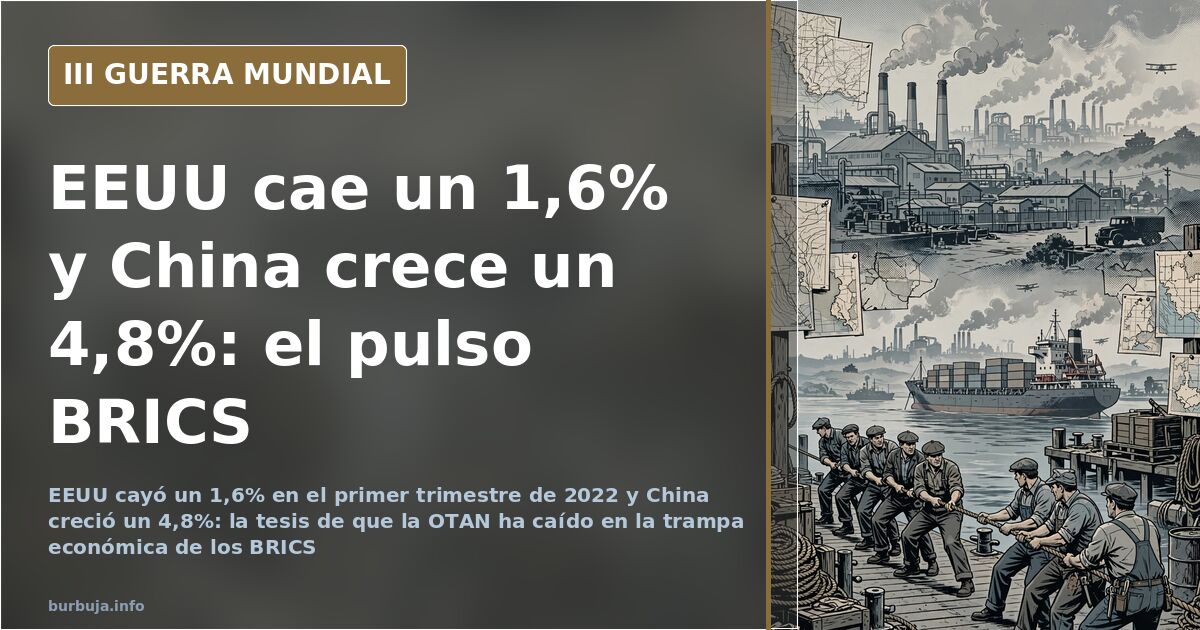
BRICS Win Economic War as US Slumps
Can a nation once thought to have an economy the size of Italy’s hold all of NATO at bay? A growing thesis argues that the West hasn’t lost a conventional war but has been pushed into a war of attrition designed by Moscow and its new partners. The scoreboard is stark: the US economy contracted by 1.6 % in the first quarter of 2022, while China’s grew by 4.8 %. This entire framework rests on those two figures.
The Indictment: Western Material Destroyed in Weeks
The first argument is material. It claims Germany sent Ukraine 40 % of its long-range artillery and the US 10 % of its M777 howitzers, only for Russia to turn them into scrap within a month. The conclusion is uncomfortable: Moscow destroys in weeks what Berlin and Washington take years to manufacture. Added to this is the episode of captured French Caesar cannons moved to a Russian factory to study their secrets, viewed as a hard-to-recover technological loss.
The other front is intelligence. Rumors circulate that Chinese hackers obtained blueprints and details of US F-35 and F-22 fighters, with improved copies already flying. If accurate—and one must tread carefully here—the cost of the war would no longer be measured in ammunition, but in decades of lost technological advantage.
Debt, Recession, and the Suffocating 120 %
The second pillar is financial. The US carries debt equal to 120 % of its GDP, and Spain faces a similar burden. Adding new infrastructure at such high levels of indebtedness seems impossible, with forecasts suggesting a crisis comparable to 2008, but starting from much more fragile ground. The friction point is who can better withstand this load.
Here enters the comparison that breaks the conventional narrative. In China, average savings hover around 25 %, and nearly 90 % of citizens own their homes—87 % in urban areas and 96 % in rural ones, according to cited housing studies. Add to this lower tax burdens than in the US. With that cushion, Beijing’s maneuvering room is greater than Western press assumes.
Who Joins BRICS and Why Does It Matter?
The bloc’s picture changes fast. Iran and Argentina have reportedly taken the step, with Egypt, Indonesia, and others close behind. India and Brazil, theoretical allies of Washington, are distancing themselves. Meanwhile, Western energy consumption shifts toward Asia: China and India absorb what Europe stops buying. Energy, it is argued, migrates across continents with no apparent ability to stop it.
On the military front, the drip-feed of Chinese announcements is highlighted: a third aircraft carrier and, a month prior, a helicopter carrier, frigate, and next-generation submarine unveiled the same day. The reading is that rearmament waits for no negotiation.
Cracks in the Narrative: Kyiv Didn’t Fall in Four Days
Not everything fits, and objections bite. Pilingui announced Kyiv would fall in four days, yet four months later, nothing of the sort had peine. Zelensky did not surrender. On the Russian side, attrition forced recruiters to seek men over 40 in villages, signaling casualty counts aren’t as sold.
Against this, the counterargument is that these setbacks don’t alter the underlying outcome: NATO remains bogged down, its citizens heading toward recession, and emerging economies growing. A doubt lingers: did the Atlantic alliance fall unaware, or, as another school holds, did it know exactly what was coming and accept the sacrifice?
Who Decides Then: Governments or Someone Above?
A third reading denies the trap and points to intent: neither the EU nor NATO made mistakes; they sought exactly this long war, one that isn’t won but sustained. Under this hypothesis, Zelensky would receive the signal when due, leading to a Bosnia-style settlement with autonomous territories and intermediate formulas. Suspicion extends to summits and large corporations which, per this version, set the agenda for current governments. None of this comes with proof in available materials.
Meanwhile, geopolitics’ compound interest keeps running: energy shifts from Europe to Asia, alliances reorder, and each quarter of conflict narrows the margin for those playing with 120 % debt.
With this picture, the board seems clear: pieces move, the score rises and falls each quarter, and no player is willing to show their hand.
Can a nation once thought to have an economy the size of Italy’s hold all of NATO at bay? A growing thesis argues that the West hasn’t lost a conventional war but has been pushed into a war of attrition designed by Moscow and its new partners. The scoreboard is stark: the US economy contracted by 1.6 % in the first quarter of 2022, while China’s grew by 4.8 %. This entire framework rests on those two figures.
The Indictment: Western Material Destroyed in Weeks
The first argument is material. It claims Germany sent Ukraine 40 % of its long-range artillery and the US 10 % of its M777 howitzers, only for Russia to turn them into scrap within a month. The conclusion is uncomfortable: Moscow destroys in weeks what Berlin and Washington take years to manufacture. Added to this is the episode of captured French Caesar cannons moved to a Russian factory to study their secrets, viewed as a hard-to-recover technological loss.
The other front is intelligence. Rumors circulate that Chinese hackers obtained blueprints and details of US F-35 and F-22 fighters, with improved copies already flying. If accurate—and one must tread carefully here—the cost of the war would no longer be measured in ammunition, but in decades of lost technological advantage.
Debt, Recession, and the Suffocating 120 %
The second pillar is financial. The US carries debt equal to 120 % of its GDP, and Spain faces a similar burden. Adding new infrastructure at such high levels of indebtedness seems impossible, with forecasts suggesting a crisis comparable to 2008, but starting from much more fragile ground. The friction point is who can better withstand this load.
Here enters the comparison that breaks the conventional narrative. In China, average savings hover around 25 %, and nearly 90 % of citizens own their homes—87 % in urban areas and 96 % in rural ones, according to cited housing studies. Add to this lower tax burdens than in the US. With that cushion, Beijing’s maneuvering room is greater than Western press assumes.
Who Joins BRICS and Why Does It Matter?
The bloc’s picture changes fast. Iran and Argentina have reportedly taken the step, with Egypt, Indonesia, and others close behind. India and Brazil, theoretical allies of Washington, are distancing themselves. Meanwhile, Western energy consumption shifts toward Asia: China and India absorb what Europe stops buying. Energy, it is argued, migrates across continents with no apparent ability to stop it.
On the military front, the drip-feed of Chinese announcements is highlighted: a third aircraft carrier and, a month prior, a helicopter carrier, frigate, and next-generation submarine unveiled the same day. The reading is that rearmament waits for no negotiation.
Cracks in the Narrative: Kyiv Didn’t Fall in Four Days
Not everything fits, and objections bite. Pilingui announced Kyiv would fall in four days, yet four months later, nothing of the sort had peine. Zelensky did not surrender. On the Russian side, attrition forced recruiters to seek men over 40 in villages, signaling casualty counts aren’t as sold.
Against this, the counterargument is that these setbacks don’t alter the underlying outcome: NATO remains bogged down, its citizens heading toward recession, and emerging economies growing. A doubt lingers: did the Atlantic alliance fall unaware, or, as another school holds, did it know exactly what was coming and accept the sacrifice?
Who Decides Then: Governments or Someone Above?
A third reading denies the trap and points to intent: neither the EU nor NATO made mistakes; they sought exactly this long war, one that isn’t won but sustained. Under this hypothesis, Zelensky would receive the signal when due, leading to a Bosnia-style settlement with autonomous territories and intermediate formulas. Suspicion extends to summits and large corporations which, per this version, set the agenda for current governments. None of this comes with proof in available materials.
Meanwhile, geopolitics’ compound interest keeps running: energy shifts from Europe to Asia, alliances reorder, and each quarter of conflict narrows the margin for those playing with 120 % debt.
With this picture, the board seems clear: pieces move, the score rises and falls each quarter, and no player is willing to show their hand.
Also available in: Deutsch
Summary of a discussion on Burbuja.info - Foro de economía, actualidad y política., translated from Spanish and reviewed before publication. Read the full discussion (121 replies).
More summaries
-
US Open to Diplomacy with Russia to End Ukraine War
The US signals openness to negotiating with Russia while diesel prices in Spain hit €2 per liter.
-
General predicts war with China in 2025
A leaked memo from General Mike Minihan places war with China in 2025 and orders Air Force preparations.
-
Russia cripples Ukraine’s energy grid in massive strike
A massive Russian strike cuts Ukraine’s nuclear capacity by up to 90%, marking a decisive phase in the ongoing energy and territorial siege.
-
France and UK allow Ukraine to strike deep inside Russia with SCALP missiles
France and the UK have authorized Ukraine to use SCALP/Storm Shadow missiles against targets deep in Russia, mirroring recent US policy on long-range strikes.
-
Winner's Morality: The Comfort of Being on the Safe Side
The original poster admits feeling secure despite siding with 'the bad guys.' This highlights how safety often outweighs moral scruples in geopolitical conflicts.
-
Trump blocks Venezuela; Russia pledges tanker escort
Trump announces total naval and air blockade of Venezuela as Russian tanker HYPERION crosses the Caribbean. A forum user claims Moscow will protect vessels.