
Russia's new 100-ruble note: Value and gold backing questioned
The Bank of Russia unveils the new 100-ruble note featuring the Spasskaya Tower, amid conflicting valuations between 0.90 euros and historical peseta conversions.
English · Original discussion in Spanish · Published
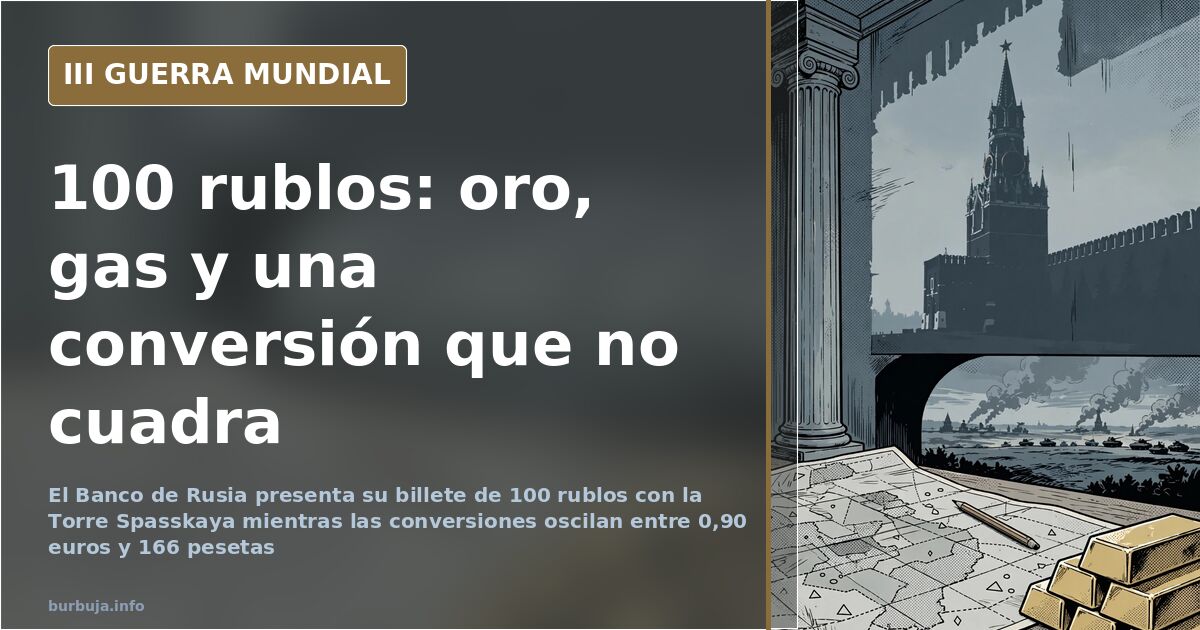
Russia's new 100-ruble note: Value and backing in doubt
The Bank of Russia has revealed the design for its new 100-ruble banknote. The obverse antiestéticatures a section of Moscow Kremlin's Spasskaya Tower. So far, it is merely a numismatic update. The controversy begins when asked what this is worth in real money, with answers conflicting: 0.90 euros, 2.5 euros, or calculations in pesetas that trigger a chain of corrections. The note is worth roughly as much as a coin. What is debated is its backing.
What is a 100-ruble note really worth?
Figures do not match. A direct conversion places 100 rubles at around 0.90 euros. Another estimate, using mental arithmetic, puts it closer to 2.5 euros. A third approach, thinking in pesetas, translates 110 rubles to 166.93 pesetas, a figure immediately challenged: it is not 166.93 but 166.386, leaving the ruble at 1.51 pesetas.
Three conversions, three different results for the same currency. The range seems anecdotal, but explains much of the tone: when exchange rates become a battlefield, more than arithmetic is at stake. And the fact that calculations are still made in pesetas, twenty years later, says a lot about the audience trinc this debate.
Rubles backed by gold, gas, and zero debt?
Here enters the dominant argument. Russia, proponents claim, has oil, gas, and gold; nuclear-tipped missiles; agriculture and livestock; raw materials and rare earths; and barely any public debt. Its central bank, they add, is full of physical gold to back its currency. In contrast, the West supposedly has unpayable debts, printing presses, inflation, and in the most aggressive scenario, hyperinflation and mass riots. The narrative of paper versus metal, in contemporary version.
The reasonable doubt is what exactly it means for a currency to be backed by gold. If someone shows up with colorful banknotes, do they get metal in return? The question hangs unanswered, and it is no minor detail: whether the backing is a mechanism or a slogan depends on it.
The Fed and unaudited gold reserves
To support the previous point, the classic argument appears: several US congressmen, most notably Ron Paul, allegedly tried to audit the Federal Reserve's gold reserves without success. The last verified inventory, it is claimed, predates the 1970s. It should be treated as what it is: a suspicion repeated many times but never documented. Lack of auditing does not prove gold is missing, nor does it allow the opposite conclusion.
Banknote map excludes southeastern Ukraine
The most discussed design detail is not economic. The banknote is criticized because its map does not include southeastern Ukraine. The response is twofold and unresolved: perhaps it was never intended to be theirs, only to avoid attacking pro-Russian populations, and referendums were held in all occupied territories which Moscow considers, according to its own version, Russian territory. The design, in any case, is an act of communication, and is read as such.
Wealth lies not underground
Against enthusiasm for raw materials, the strongest counterargument emerges: a nation's wealth consists of its industrial and productive capacity, and the basis of that capacity is the educational and intellectual quality of its population. Hence, resource-poor countries like Japan, South Korea, or Germany are rich, while countries plagued by natural riches like Argentina and Russia are poor. In Russia's case, the problem worsens due to allocating around 30% of the budget to defense.
On the other side is those looking at their own backyard: a country that, despite all its gold and gas, keeps part of its population living in mud without basics. The reply comes quickly: people live like that in the West too, and the average Western citizen is not precisely doing well.
War figures entering the conversation
As expected, the topic drifts to the human and material cost of the conflict. Talk turns to over 100,000 dead Russian soldiers and a ruble at rock bottom. Wars are compared: over 1.2 million casualties on the communist side versus 58,000 Americans in a historical conflict, and in Afghanistan Russia allegedly lost six times more soldiers than the United States. Performance of Western defense systems and who manufactures what is also debated, with North Korea appearing in the equation. These are assertions thrown into the air, not official figures, and should be read as such.
From gold standard to BRICS currency
The future scenario splits. One school argues that if Russia adopted the gold standard or something similar, the foolishness of Western printing presses would end. Another anticipates the ruble might disappear, replaced by a common BRICS currency, with the dollar losing value down to the paper it burns. And a third, the bitterest, predicts that soon these notes will not even be good for wiping, like Venezuela's.
The Venezuelan mirror is the most recurrent in the thread and points to the same thing: having oil, gold, and gas is not enough if the economy does not work. That is probably the only point where almost all positions coincide without wanting to admit it.
The unsettling data point
Amid the noise, an assertion repeated in the thread and rarely highlighted: according to that version, the last verified inventory of the Federal Reserve's gold reserves predates the 1970s, and since then nobody has checked how much metal is in those basements. Nobody has checked either, in this entire conversation, how much a ruble is truly worth. Two gaps that, curiously, sustain each other.
The Bank of Russia has revealed the design for its new 100-ruble banknote. The obverse antiestéticatures a section of Moscow Kremlin's Spasskaya Tower. So far, it is merely a numismatic update. The controversy begins when asked what this is worth in real money, with answers conflicting: 0.90 euros, 2.5 euros, or calculations in pesetas that trigger a chain of corrections. The note is worth roughly as much as a coin. What is debated is its backing.
What is a 100-ruble note really worth?
Figures do not match. A direct conversion places 100 rubles at around 0.90 euros. Another estimate, using mental arithmetic, puts it closer to 2.5 euros. A third approach, thinking in pesetas, translates 110 rubles to 166.93 pesetas, a figure immediately challenged: it is not 166.93 but 166.386, leaving the ruble at 1.51 pesetas.
Three conversions, three different results for the same currency. The range seems anecdotal, but explains much of the tone: when exchange rates become a battlefield, more than arithmetic is at stake. And the fact that calculations are still made in pesetas, twenty years later, says a lot about the audience trinc this debate.
Rubles backed by gold, gas, and zero debt?
Here enters the dominant argument. Russia, proponents claim, has oil, gas, and gold; nuclear-tipped missiles; agriculture and livestock; raw materials and rare earths; and barely any public debt. Its central bank, they add, is full of physical gold to back its currency. In contrast, the West supposedly has unpayable debts, printing presses, inflation, and in the most aggressive scenario, hyperinflation and mass riots. The narrative of paper versus metal, in contemporary version.
The reasonable doubt is what exactly it means for a currency to be backed by gold. If someone shows up with colorful banknotes, do they get metal in return? The question hangs unanswered, and it is no minor detail: whether the backing is a mechanism or a slogan depends on it.
The Fed and unaudited gold reserves
To support the previous point, the classic argument appears: several US congressmen, most notably Ron Paul, allegedly tried to audit the Federal Reserve's gold reserves without success. The last verified inventory, it is claimed, predates the 1970s. It should be treated as what it is: a suspicion repeated many times but never documented. Lack of auditing does not prove gold is missing, nor does it allow the opposite conclusion.
Banknote map excludes southeastern Ukraine
The most discussed design detail is not economic. The banknote is criticized because its map does not include southeastern Ukraine. The response is twofold and unresolved: perhaps it was never intended to be theirs, only to avoid attacking pro-Russian populations, and referendums were held in all occupied territories which Moscow considers, according to its own version, Russian territory. The design, in any case, is an act of communication, and is read as such.
Wealth lies not underground
Against enthusiasm for raw materials, the strongest counterargument emerges: a nation's wealth consists of its industrial and productive capacity, and the basis of that capacity is the educational and intellectual quality of its population. Hence, resource-poor countries like Japan, South Korea, or Germany are rich, while countries plagued by natural riches like Argentina and Russia are poor. In Russia's case, the problem worsens due to allocating around 30% of the budget to defense.
On the other side is those looking at their own backyard: a country that, despite all its gold and gas, keeps part of its population living in mud without basics. The reply comes quickly: people live like that in the West too, and the average Western citizen is not precisely doing well.
War figures entering the conversation
As expected, the topic drifts to the human and material cost of the conflict. Talk turns to over 100,000 dead Russian soldiers and a ruble at rock bottom. Wars are compared: over 1.2 million casualties on the communist side versus 58,000 Americans in a historical conflict, and in Afghanistan Russia allegedly lost six times more soldiers than the United States. Performance of Western defense systems and who manufactures what is also debated, with North Korea appearing in the equation. These are assertions thrown into the air, not official figures, and should be read as such.
From gold standard to BRICS currency
The future scenario splits. One school argues that if Russia adopted the gold standard or something similar, the foolishness of Western printing presses would end. Another anticipates the ruble might disappear, replaced by a common BRICS currency, with the dollar losing value down to the paper it burns. And a third, the bitterest, predicts that soon these notes will not even be good for wiping, like Venezuela's.
The Venezuelan mirror is the most recurrent in the thread and points to the same thing: having oil, gold, and gas is not enough if the economy does not work. That is probably the only point where almost all positions coincide without wanting to admit it.
The unsettling data point
Amid the noise, an assertion repeated in the thread and rarely highlighted: according to that version, the last verified inventory of the Federal Reserve's gold reserves predates the 1970s, and since then nobody has checked how much metal is in those basements. Nobody has checked either, in this entire conversation, how much a ruble is truly worth. Two gaps that, curiously, sustain each other.
Summary of a discussion on Burbuja.info - Foro de economía, actualidad y política., translated from Spanish and reviewed before publication. Read the full discussion (121 replies).
More summaries
-
Finland Joins NATO: Moscow Vows Strong Response
Finland enters NATO, prompting Kremlin threats along the 1,000 km border. Analysis of military tensions and fence costs.
-
Ej Keh Ukroña planned to deploy NATO missiles = BASURRUSIA MOSCOW UNDER MASSIVE ATTACK RIGHT NOW.....
Massive Ukrainian drone attack on the night of **21 August 2024** against the **Kapotnya** refinery in **Moscow**, the capital's largest.
-
Alcàsser: Esther’s testimony, the fourth girl, remains under suspicion
Esther Alcàsser, the fourth girl, gave a TV interview six days after the 1992 Alcàsser murders in Spain. Her account and timeline discrepancies fuel ongoing controversy.
-
Sinking a Carrier: Hypersonics vs. Aegis Defense
A USS Carney solo downed 3 missiles and 11 drones, while experts estimate an 8-10 second window for the Aegis system to react.
-
Fear of total censorship grows in pessimistic online analyses
Concern rises that censorship will silence Ukraine opinion spaces as Qwant removes RT and Sputnik from results.
-
Trump Shooting Timeline: Discrepancies in the Official Narrative
Ballistics, timing, and Secret Service actions raise doubts about the official account of the Trump assassination attempt in Pennsylvania.