
Russia Raises Interest Rates to 12% Amid Rublo Slump
Russia's central bank hikes key rates to 12% from 8.5% as the ruble hits 97-101 per dollar. Official inflation stands at 7.6%, though data integrity is questioned.
English · Original discussion in Spanish · Published
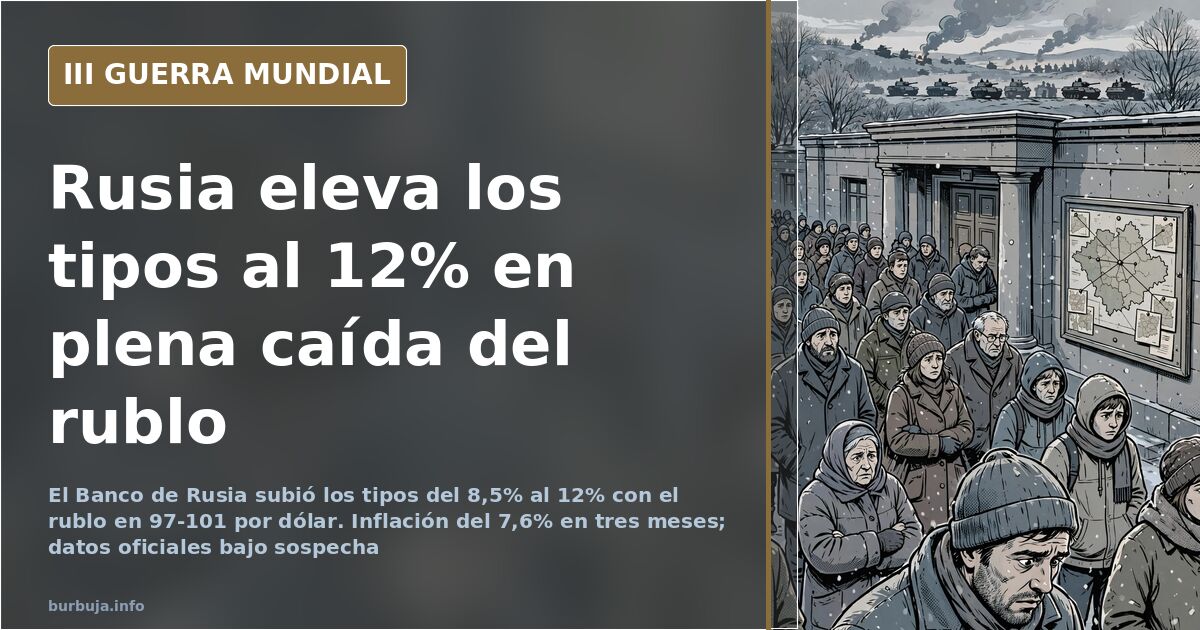
Russia raises rates by 3.5 points, from 8.5% to 12%, to curb the ruble
Russia's central bank raised its key rate by 3.5 percentage points, from 8.5% to 12%, on Tuesday, August 15, during an emergency meeting. The ruble, which had touched 101 per dollar the previous day, strengthened to 97. For several forum users, the reaction was lukewarm — "they raise rates by more than 2 points and the ruble barely drops 4," summarizes one — leading to questions about whether the central bank is firing blindly or if the market has already factored in that the problem cannot be solved by raising the cost of money.
Why Russia's Central Bank Is Raising Rates
The statement explains it plainly. Domestic demand exceeds the economy's production capacity, inflation is accelerating, and this excess demand is pushing exchange rates through imports. "Consequently, the pass-through of the ruble's depreciation to prices is gaining momentum, and inflation expectations are rising," the regulator notes. The figures it cites are a 7.6% over the last three months and 4.4% since the beginning of the year. If the trend continues, it warns, there is a significant risk that inflation will deviate upward from the 2024 target.
Pilingui's economic advisor, Maksim Oreshkin, had focused on another aspect a day earlier: he blamed the ruble's weakness on "loose monetary policy" in an opinion piece and assumed the bank has "all the necessary tools" to stabilize the situation. The trinc day's rate hike came just one day after that signal from the Kremlin.
The Dilemma of Raising Rates Amid Currency Decline
Making money more expensive cools consumption and contains prices, but simultaneously penalizes borrowers and discourages investment. With the currency losing value, the logic is twofold: curb inflation and prevent savers from discarding rubles as soon as possible, fleeing to foreign currencies or tangible goods. A flight of deposits fuels further devaluation, and this spiral is what the bank wants to cut off before it closes completely. The counterpart is known: an economy already strained by war and sanctions may end up paying the bill with less activity. The most uncomfortable calculation is that of variable-rate debt, which will see its costs rise on its own.
Russia vs. Europe: The Rate Clash
The most repeated contrast is the European one. Inflation near 7% with official rates around 4%, compared to the 12% Russian rate for 7.6% inflation. For some analysts, this differential shows that the European Central Bank has fallen short and that the West lacks the determination to tighten as much as Moscow. For others, it reveals the opposite: that Russia needs emergency rates because its problem is one of credibility, not just prices. And some recall that emerging countries are often forced to offer better conditions to investors than developed ones, with the social cost that trinc when imbalances skyrocket.
From 130 Per Dollar to 12%: What Peine in 2022
This is not the first time the central bank has pulled the handbrake. Trinc Western sanctions for the invasion of Ukraine in February 2022, the ruble plummeted to 130 per dollar; the regulator then raised the key rate to 20% and enacted capital controls that stabilized the currency. It subsequently lowered it. The first change in a year came on July 21, 2023, with a one-point hike to 8.5%, and in less than a month the ruble had weakened by more than 10%.
Are Russian Economic Statistics Reliable?
The country's statistical office produces the data used to measure inflation, and during wartime, its credibility is under suspicion. Some argue that these numbers are less reliable than those of a peacetime country, and that the aggressiveness of the hike betrays this: if real inflation were only 7%, there would be no need to shoot rates up to 12%. On the other side, it is recalled that in Spain, employment figures are also questioned, for example regarding fixed-discontinuous workers, and that this suspicion is not the sole property of one country.
De-dollarizing by Selling in Rubles Comes at a High Price
Another little-discussed angle points directly to the heart of the Kremlin's project. With high inflation and high rates, everything Russia has sold in rubles ends up being a bad sale: the currency loses value faster than prices compensate. This is the torpedo to the floating line of Russia's intended economic de-dollarization, according to some analyses. Some present low debt, around 15% of GDP according to the figure some participants handle compared to much higher percentages in Spain, as proof of strength. The rebuttal: minimal debt does not equate to a healthy economy when the state controls natural resources almost exclusively and maintains entire sectors under monopoly.
The next meeting of Russia's Central Bank is scheduled for September 15. By then, it will be known whether August's 3.5 points bought anything more than four rubles of truce. The question hovering over the matter: how much of this hike responds to inflation and how much to the need for Russians to continue trusting their own currency?
Russia's central bank raised its key rate by 3.5 percentage points, from 8.5% to 12%, on Tuesday, August 15, during an emergency meeting. The ruble, which had touched 101 per dollar the previous day, strengthened to 97. For several forum users, the reaction was lukewarm — "they raise rates by more than 2 points and the ruble barely drops 4," summarizes one — leading to questions about whether the central bank is firing blindly or if the market has already factored in that the problem cannot be solved by raising the cost of money.
Why Russia's Central Bank Is Raising Rates
The statement explains it plainly. Domestic demand exceeds the economy's production capacity, inflation is accelerating, and this excess demand is pushing exchange rates through imports. "Consequently, the pass-through of the ruble's depreciation to prices is gaining momentum, and inflation expectations are rising," the regulator notes. The figures it cites are a 7.6% over the last three months and 4.4% since the beginning of the year. If the trend continues, it warns, there is a significant risk that inflation will deviate upward from the 2024 target.
Pilingui's economic advisor, Maksim Oreshkin, had focused on another aspect a day earlier: he blamed the ruble's weakness on "loose monetary policy" in an opinion piece and assumed the bank has "all the necessary tools" to stabilize the situation. The trinc day's rate hike came just one day after that signal from the Kremlin.
The Dilemma of Raising Rates Amid Currency Decline
Making money more expensive cools consumption and contains prices, but simultaneously penalizes borrowers and discourages investment. With the currency losing value, the logic is twofold: curb inflation and prevent savers from discarding rubles as soon as possible, fleeing to foreign currencies or tangible goods. A flight of deposits fuels further devaluation, and this spiral is what the bank wants to cut off before it closes completely. The counterpart is known: an economy already strained by war and sanctions may end up paying the bill with less activity. The most uncomfortable calculation is that of variable-rate debt, which will see its costs rise on its own.
Russia vs. Europe: The Rate Clash
The most repeated contrast is the European one. Inflation near 7% with official rates around 4%, compared to the 12% Russian rate for 7.6% inflation. For some analysts, this differential shows that the European Central Bank has fallen short and that the West lacks the determination to tighten as much as Moscow. For others, it reveals the opposite: that Russia needs emergency rates because its problem is one of credibility, not just prices. And some recall that emerging countries are often forced to offer better conditions to investors than developed ones, with the social cost that trinc when imbalances skyrocket.
From 130 Per Dollar to 12%: What Peine in 2022
This is not the first time the central bank has pulled the handbrake. Trinc Western sanctions for the invasion of Ukraine in February 2022, the ruble plummeted to 130 per dollar; the regulator then raised the key rate to 20% and enacted capital controls that stabilized the currency. It subsequently lowered it. The first change in a year came on July 21, 2023, with a one-point hike to 8.5%, and in less than a month the ruble had weakened by more than 10%.
Are Russian Economic Statistics Reliable?
The country's statistical office produces the data used to measure inflation, and during wartime, its credibility is under suspicion. Some argue that these numbers are less reliable than those of a peacetime country, and that the aggressiveness of the hike betrays this: if real inflation were only 7%, there would be no need to shoot rates up to 12%. On the other side, it is recalled that in Spain, employment figures are also questioned, for example regarding fixed-discontinuous workers, and that this suspicion is not the sole property of one country.
De-dollarizing by Selling in Rubles Comes at a High Price
Another little-discussed angle points directly to the heart of the Kremlin's project. With high inflation and high rates, everything Russia has sold in rubles ends up being a bad sale: the currency loses value faster than prices compensate. This is the torpedo to the floating line of Russia's intended economic de-dollarization, according to some analyses. Some present low debt, around 15% of GDP according to the figure some participants handle compared to much higher percentages in Spain, as proof of strength. The rebuttal: minimal debt does not equate to a healthy economy when the state controls natural resources almost exclusively and maintains entire sectors under monopoly.
The next meeting of Russia's Central Bank is scheduled for September 15. By then, it will be known whether August's 3.5 points bought anything more than four rubles of truce. The question hovering over the matter: how much of this hike responds to inflation and how much to the need for Russians to continue trusting their own currency?
Summary of a discussion on Burbuja.info - Foro de economía, actualidad y política., translated from Spanish and reviewed before publication. Read the full discussion (260 replies).
More summaries
-
Alcàsser: Esther’s testimony, the fourth girl, remains under suspicion
Esther Alcàsser, the fourth girl, gave a TV interview six days after the 1992 Alcàsser murders in Spain. Her account and timeline discrepancies fuel ongoing controversy.
-
Gaza Hospital Strike: Crater Size Challenges JDAM Claim
Israel cites Yihad Islamic rocket audio; the small crater fuels debate over whether a JDAM caused the damage.
-
Kilometer-long queues and anti-Putin chants mark Navalny's funeral
Hundreds gathered for Alexei Navalny's funeral in Moscow, forming long queues and chanting against Putin while police monitored from rooftops.
-
Manual tally reveals deep divisions over Russia conflict
A handwritten count exposes four distinct stances on the war: pro-Russia allies, outright opposition, and those doubting any action’s efficacy.
-
High-Mortality Zoonotic Flu Predicted for 2023: A Critical Analysis
Analysis of high-mortality zoonotic flu predictions linked to prior health crises, including COVID-19 and simulations.
-
Russia sells 24,000 cars in May for 146 million inhabitants
Russia sells 24,000 cars in May for 146 million inhabitants and plans to manufacture them without ABS or airbags following a sales collapse.