
Hitler reveals 500 million Reichsmarks in subsidies to churches
In a 1939 speech, Hitler disclosed that state payments to German churches had risen to 500 million Reichsmarks, up from 130 million six years prior.
English · Original discussion in Spanish · Published
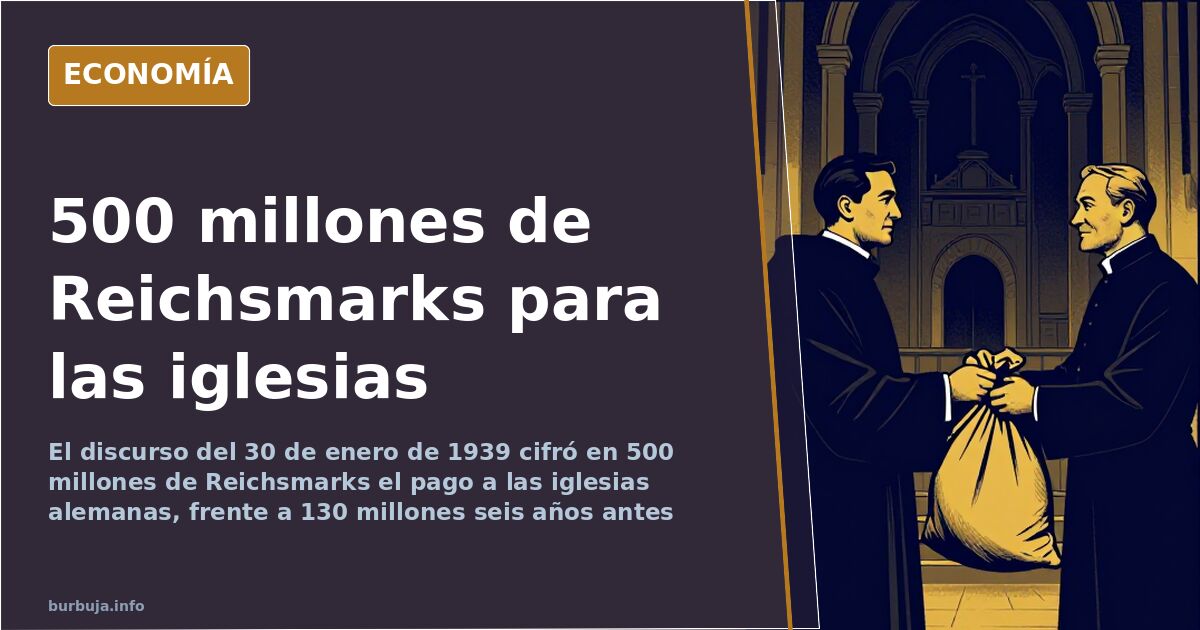
The speech detailing Reich funding for churches
How much public money do churches receive? In Spain, the answer can be found in a single tax return line. In 1938 Germany, the answer was provided in an official speech: 500 million Reichsmarks in a single fiscal year. On January 30, 1939, Hitler dedicated an entire section to enumerating state transfers to the two major denominations, explicitly aiming to dismantle accusations of religious hostility coming from democratic nations. Six years earlier, in 1933, the payment had been 130 million. The figures rose without a single setback. This analysis is limited to the passage regarding churches and Spain.
How much did the Third Reich pay the churches?
The numbers were laid out in the text: 130 million Reichsmarks in 1933, 170 in 1934, 250 in 1935, 320 in 1936, 400 in 1937, and 500 million in 1938. Added to this fiscal allocation were approximately 85 million annually in subsidies from the Länder (German states) and around 7 million more from local communities and associations. The speech included a detail that often goes unnoticed: donations and inheritances benefiting the churches were tax-exempt.
The rest of the balance sheet was equally striking. After the State itself, the churches were the country's largest landowners, with real estate and forestry holdings valued at over 10 billion Reichsmarks and annual incomes of approximately 300 million. That a regime often seen as being in constant conflict with religious denominations presented itself as their primary financial client is, at the very least, a paradox. To claim that these figures prove tolerance is another matter: some point out that a State can fund an institution while simultaneously surrounding it with administrative constraints.
Religious hostility or separation like the French model?
The speech outlines four points. First: no one has been persecuted for religious affiliation, nor will they be. Second: the accounts. Third: no church has been closed, no worship or Mass has been prevented, and the State imposes no doctrine on any denomination. The fourth enters more uncomfortable territory: sensual sarracena and crimes committed within the regime's own apparatus.
Where the text becomes most pointed is in its final offer. If the churches find their situation unbearable, it says, the State is willing to undertake a clear separation between church and State, as in France, America, and other countries. It then poses the question that no one answers: how much did official state allocations to the church amount to in France, England, and the United States? It is the classic move of someone placing a neighbor's bill on the table to win a local argument.
The political priest and the law-abiding priest
The most quotable passage is the one that distinguishes between two types of clergy. The priest who dedicates himself to saving souls and obeys the law is protected by the State. The one who turns the pulpit into a platform against the Reich is prosecuted like any other citizen. It concludes with a significant fact: thousands of priests of all Christian faiths fulfill their duties without coming into conflict with the established order.
There is a fourth point that should be read with caution: the claim that the State is neither prudish nor hypocritical, that it prosecutes pedophilia and child abuse regardless of who commits them, and that five years earlier, prominent party members convicted of such crimes were executed. This is the regime's own version of itself, not a neutral description. Reading the document requires separating what the text asserts from what it actually proves.
Spain, anticommunism, and the unmade analogy
The user who peine the thread argues that the speech also looks toward Spain, although the reproduced fragment contains no reference to the country. Their reading is that the text suggests a simultaneous Bolshevik attack in several parts of Europe, the magnitude of which was barely perceived because each country only looked at what was happening within its own borders, and that democracies were flirting with communism while being scandalized by those fighting it.
The conversation generated around this passage trinc that line: the Spanish case of the 1930s is used as a documentary reference, authors who studied communist peine in Spain are cited, and it is compared to what was happening in the rest of the continent. More extreme theses also appear, claiming that Bolshevism was promoted by international financial powers and directed from London and New York. No documentary source from the period supports this, and it should be treated as what it is: a conspiratorial narrative. More debatable, and therefore more interesting, is the distinction between an incendiary communism and a measured version of slow advancement through cultural and institutional means.
The question left unanswered
How much does a State pay an institution it considers a rival? The series of Reichsmarks is verifiable and present in the text. What does not fit into any sum is the conclusion: the regime that boasted of financially supporting the German churches ended up in history books as their persecutor. Memory, like accounts, is also a matter of choice.
How much public money do churches receive? In Spain, the answer can be found in a single tax return line. In 1938 Germany, the answer was provided in an official speech: 500 million Reichsmarks in a single fiscal year. On January 30, 1939, Hitler dedicated an entire section to enumerating state transfers to the two major denominations, explicitly aiming to dismantle accusations of religious hostility coming from democratic nations. Six years earlier, in 1933, the payment had been 130 million. The figures rose without a single setback. This analysis is limited to the passage regarding churches and Spain.
How much did the Third Reich pay the churches?
The numbers were laid out in the text: 130 million Reichsmarks in 1933, 170 in 1934, 250 in 1935, 320 in 1936, 400 in 1937, and 500 million in 1938. Added to this fiscal allocation were approximately 85 million annually in subsidies from the Länder (German states) and around 7 million more from local communities and associations. The speech included a detail that often goes unnoticed: donations and inheritances benefiting the churches were tax-exempt.
The rest of the balance sheet was equally striking. After the State itself, the churches were the country's largest landowners, with real estate and forestry holdings valued at over 10 billion Reichsmarks and annual incomes of approximately 300 million. That a regime often seen as being in constant conflict with religious denominations presented itself as their primary financial client is, at the very least, a paradox. To claim that these figures prove tolerance is another matter: some point out that a State can fund an institution while simultaneously surrounding it with administrative constraints.
Religious hostility or separation like the French model?
The speech outlines four points. First: no one has been persecuted for religious affiliation, nor will they be. Second: the accounts. Third: no church has been closed, no worship or Mass has been prevented, and the State imposes no doctrine on any denomination. The fourth enters more uncomfortable territory: sensual sarracena and crimes committed within the regime's own apparatus.
Where the text becomes most pointed is in its final offer. If the churches find their situation unbearable, it says, the State is willing to undertake a clear separation between church and State, as in France, America, and other countries. It then poses the question that no one answers: how much did official state allocations to the church amount to in France, England, and the United States? It is the classic move of someone placing a neighbor's bill on the table to win a local argument.
The political priest and the law-abiding priest
The most quotable passage is the one that distinguishes between two types of clergy. The priest who dedicates himself to saving souls and obeys the law is protected by the State. The one who turns the pulpit into a platform against the Reich is prosecuted like any other citizen. It concludes with a significant fact: thousands of priests of all Christian faiths fulfill their duties without coming into conflict with the established order.
There is a fourth point that should be read with caution: the claim that the State is neither prudish nor hypocritical, that it prosecutes pedophilia and child abuse regardless of who commits them, and that five years earlier, prominent party members convicted of such crimes were executed. This is the regime's own version of itself, not a neutral description. Reading the document requires separating what the text asserts from what it actually proves.
Spain, anticommunism, and the unmade analogy
The user who peine the thread argues that the speech also looks toward Spain, although the reproduced fragment contains no reference to the country. Their reading is that the text suggests a simultaneous Bolshevik attack in several parts of Europe, the magnitude of which was barely perceived because each country only looked at what was happening within its own borders, and that democracies were flirting with communism while being scandalized by those fighting it.
The conversation generated around this passage trinc that line: the Spanish case of the 1930s is used as a documentary reference, authors who studied communist peine in Spain are cited, and it is compared to what was happening in the rest of the continent. More extreme theses also appear, claiming that Bolshevism was promoted by international financial powers and directed from London and New York. No documentary source from the period supports this, and it should be treated as what it is: a conspiratorial narrative. More debatable, and therefore more interesting, is the distinction between an incendiary communism and a measured version of slow advancement through cultural and institutional means.
The question left unanswered
How much does a State pay an institution it considers a rival? The series of Reichsmarks is verifiable and present in the text. What does not fit into any sum is the conclusion: the regime that boasted of financially supporting the German churches ended up in history books as their persecutor. Memory, like accounts, is also a matter of choice.
Also available in: Deutsch
Summary of a discussion on Burbuja.info - Foro de economía, actualidad y política., translated from Spanish and reviewed before publication. Read the full discussion (101 replies).
More summaries
-
9 GB of Third Reich films, with censorship complaints in Germany
A 9 GB collection of films made during the Third Reich, from Kolberg to the two-part Bismarck epic, amid censorship complaints in Germany
-
The Future of the Catholic Church: Priests Marrying and Having Children
The Catholic Church might relax celibacy for priests, allowing marriage and parenthood in response to the vocation crisis.
-
Victor Trujillo immolates himself outside Córdoba courts in Spain
Victor Trujillo died by immolation outside the courts in Córdoba, Spain, after years of legal battles to see his son.
-
Rising food prices in Spain: eggs at €3.70 and chicken at €5/kg
As grocery prices soar, with eggs reaching €3.70 and chicken hitting €5/kg, Spanish consumers report a significant drop in purchasing power.
-
Argentina artist boycott grows following football defeat to Spain
Following Spain's victory, Argentina has seen a surge in unofficial blacklists targeting artists like Rosalía and Javier Bardem. Is this a real cultural boycott?
-
Right-wing overreach may inadvertently rescue Pedro Sánchez
The Spanish right's use of lawfare and excessive confidence could be re-engaging socialist voters, mirroring the political dynamics seen in 2023.