
Rising food prices in Spain: eggs at €3.70 and chicken at €5/kg
As grocery prices soar, with eggs reaching €3.70 and chicken hitting €5/kg, Spanish consumers report a significant drop in purchasing power.
English · Original discussion in Spanish · Published
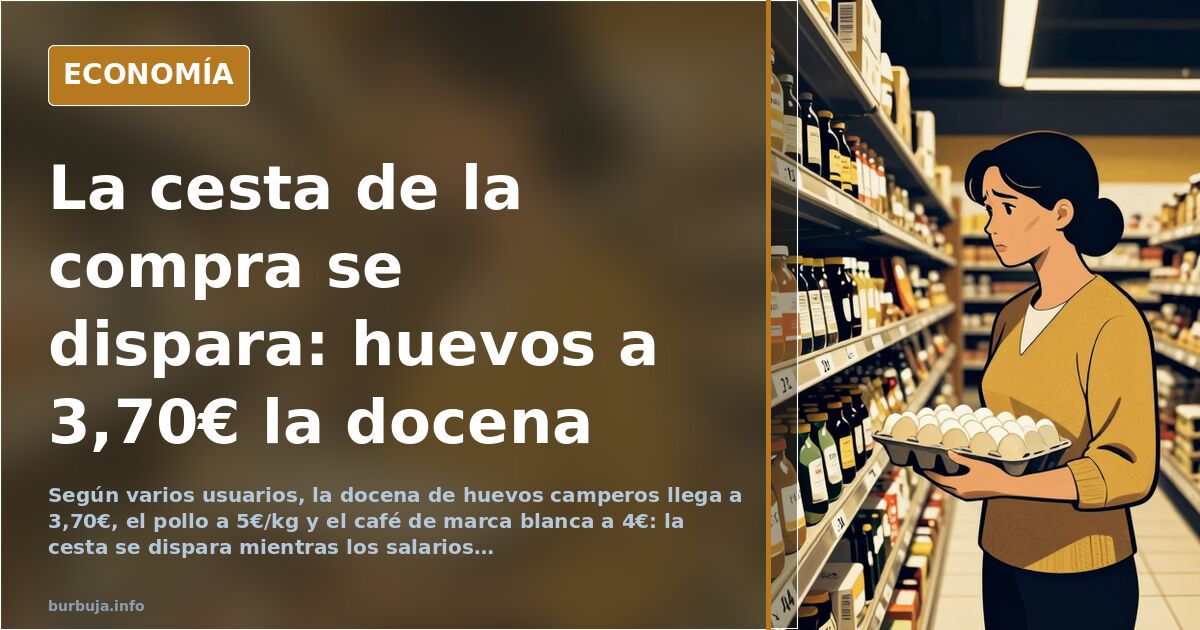
Rising food prices in Spain: eggs at €3.70 and chicken at €5/kg
The grocery basket has become the ultimate thermometer for household economics, and it is showing signs of fever. While official indicators insist that inflation is moderating, the prices people see in supermarkets are trinc a different path: according to several forum users, a dozen free-range eggs now costs €3.70 in some chains, chicken is nearing €5 per kilo, beef is reaching €40 per kilo, and store-brand coffee—which cost less than €1.50 per 250g two years ago—is approaching €4. The gap between macro data and the actual receipt is the heart of this debate.
Egg and meat prices: figures that fall short
The first reality check comes with eggs. A dozen free-range eggs is already at €3.70 in some chains, and XL formats have been seen at €4.20 or even €4.40 per dozen, according to some participants. This is not an isolated case: store-brand coffee, which in 2015 could be bought for €0.99 per 250g pack, has climbed to €4, while commercial brands move between €5 and €6 for the same amount, according to examples provided in the thread. Chicken at €5 per kilo and beef at €40 per kilo complete a basket that can no longer be compared to what it was three years ago.
Some argue these figures are an exaggeration or depend on the specific shop. However, concrete examples are piling up: a sign on a restaurant table advertises four frozen croquettes with a piece of bacon for €12.45. Inflation, some say, is under control; the bill, however, keeps rising.
Stagnant wages and falling purchasing power
The problem is not just that prices are rising, but that wages are not keeping pace. Purchasing power—the indicator that measures how far a salary goes—has been stagnant for years and is now retreating, according to one participant. Wages are not shrinking in nominal terms, but they are contracting in real terms: people are buying less with the same amount of money. This is the core of the discontent.
The forecast of lower wages is no longer just an intuition: it has appeared in media outlets such as Diario de Sevilla and El Independiente, which report the loss of purchasing power among workers, as linked by a user. Meanwhile, public debate focuses on GDP, employment, or debt—variables that, while important, do not reflect the daily reality of those doing the shopping. The gap between the official narrative and domestic experience is widening.
Social unrest and conflicting explanations
Reactions to this situation paint a picture of frustration and distrust. One part of the analysis suggests that the war in Ukraine and the energy crisis explain rising food costs. Another current points to structural factors: immigration, increased public spending, monetary policy, or market dynamics. These stances clash and, in many cases, become radicalized.
Some argue that politicians, civil servants, and pensioners with maximum pensions live detached from this problem, while the rest bear the collateral damage. Others point out that the situation is not exclusive to Spain: in France, Belgium, the Netherlands, Germany, Switzerland, the UK, Ireland, the US, Italy, or Romania, there is also inflation, even if the media focus remains on the Spanish Government. International comparisons dismantle the idea that everything is the fault of a specific political decision.
What can be done? Proposed measures and skepticism
Proposals to alleviate the situation range from raising the minimum wage (SMI) and increasing public spending to reducing taxes or intervening in prices. None convince everyone. One analytical sector warns that printing more money or raising the SMI without control could fuel inflation, while another believes that without shock measures, the loss of purchasing power will become unsustainable.
Skepticism is the dominant note. It is noted that no political party proposes credible ways to improve purchasing power, and that political debate gets lost in identity disputes while the grocery basket continues to get more expensive. The feeling that solutions are not arriving is, perhaps, the common denominator of all stances.
With these differences, the pressure on households will only increase. The most prudent prediction is that the gap between official data and the supermarket receipt will remain the main focus of discontent, though no one knows for certain when or how it will close.
The grocery basket has become the ultimate thermometer for household economics, and it is showing signs of fever. While official indicators insist that inflation is moderating, the prices people see in supermarkets are trinc a different path: according to several forum users, a dozen free-range eggs now costs €3.70 in some chains, chicken is nearing €5 per kilo, beef is reaching €40 per kilo, and store-brand coffee—which cost less than €1.50 per 250g two years ago—is approaching €4. The gap between macro data and the actual receipt is the heart of this debate.
Egg and meat prices: figures that fall short
The first reality check comes with eggs. A dozen free-range eggs is already at €3.70 in some chains, and XL formats have been seen at €4.20 or even €4.40 per dozen, according to some participants. This is not an isolated case: store-brand coffee, which in 2015 could be bought for €0.99 per 250g pack, has climbed to €4, while commercial brands move between €5 and €6 for the same amount, according to examples provided in the thread. Chicken at €5 per kilo and beef at €40 per kilo complete a basket that can no longer be compared to what it was three years ago.
Some argue these figures are an exaggeration or depend on the specific shop. However, concrete examples are piling up: a sign on a restaurant table advertises four frozen croquettes with a piece of bacon for €12.45. Inflation, some say, is under control; the bill, however, keeps rising.
Stagnant wages and falling purchasing power
The problem is not just that prices are rising, but that wages are not keeping pace. Purchasing power—the indicator that measures how far a salary goes—has been stagnant for years and is now retreating, according to one participant. Wages are not shrinking in nominal terms, but they are contracting in real terms: people are buying less with the same amount of money. This is the core of the discontent.
The forecast of lower wages is no longer just an intuition: it has appeared in media outlets such as Diario de Sevilla and El Independiente, which report the loss of purchasing power among workers, as linked by a user. Meanwhile, public debate focuses on GDP, employment, or debt—variables that, while important, do not reflect the daily reality of those doing the shopping. The gap between the official narrative and domestic experience is widening.
Social unrest and conflicting explanations
Reactions to this situation paint a picture of frustration and distrust. One part of the analysis suggests that the war in Ukraine and the energy crisis explain rising food costs. Another current points to structural factors: immigration, increased public spending, monetary policy, or market dynamics. These stances clash and, in many cases, become radicalized.
Some argue that politicians, civil servants, and pensioners with maximum pensions live detached from this problem, while the rest bear the collateral damage. Others point out that the situation is not exclusive to Spain: in France, Belgium, the Netherlands, Germany, Switzerland, the UK, Ireland, the US, Italy, or Romania, there is also inflation, even if the media focus remains on the Spanish Government. International comparisons dismantle the idea that everything is the fault of a specific political decision.
What can be done? Proposed measures and skepticism
Proposals to alleviate the situation range from raising the minimum wage (SMI) and increasing public spending to reducing taxes or intervening in prices. None convince everyone. One analytical sector warns that printing more money or raising the SMI without control could fuel inflation, while another believes that without shock measures, the loss of purchasing power will become unsustainable.
Skepticism is the dominant note. It is noted that no political party proposes credible ways to improve purchasing power, and that political debate gets lost in identity disputes while the grocery basket continues to get more expensive. The feeling that solutions are not arriving is, perhaps, the common denominator of all stances.
With these differences, the pressure on households will only increase. The most prudent prediction is that the gap between official data and the supermarket receipt will remain the main focus of discontent, though no one knows for certain when or how it will close.
Also available in: Deutsch
Summary of a discussion on Burbuja.info - Foro de economía, actualidad y política., translated from Spanish and reviewed before publication. Read the full discussion (101 replies).
More summaries
-
Olive oil prices surge 84.4%, outpacing official inflation data
Spanish olive oil costs rose 84.4% year-on-year, hitting record highs while official consumer price indices fail to reflect the true impact on household budgets.
-
Pedro Jota drops 'bombshell' on Sánchez and Begoña Gómez
Pedro Jota Ramírez announces a 'bombshell' about Pedro Sánchez and Begoña Gómez, sparking debate over alleged influence-peddling and corruption at the UNWTO.
-
Housing Costs Ignite Spanish Competency Debate
Soaring housing prices spark a political clash in Spain between the central government and regional authorities over jurisdiction.
-
Torrente Presidente sells 150,000 tickets in advance in Spain
Santiago Segura's new political parody, Torrente Presidente, has surpassed 150,000 pre-sales in Spain, featuring controversial cameos and a viral song.
-
Judge questions unsigned report exonerating Sánchez's brother
Three Spanish tax officials testify regarding an unsigned report that cleared the Prime Minister's brother. The judge is questioning the procedure and his tax residency in Portugal.
-
Spanish Red Cross spent 92% of 2023 budget on staff
Data shows Cruz Roja Española received €514 million in subsidies in 2023, with €475 million allocated to personnel costs, sparking debate over NGO spending.