
Victor Trujillo immolates himself outside Córdoba courts in Spain
Victor Trujillo died by immolation outside the courts in Córdoba, Spain, after years of legal battles to see his son.
English · Original discussion in Spanish · Published
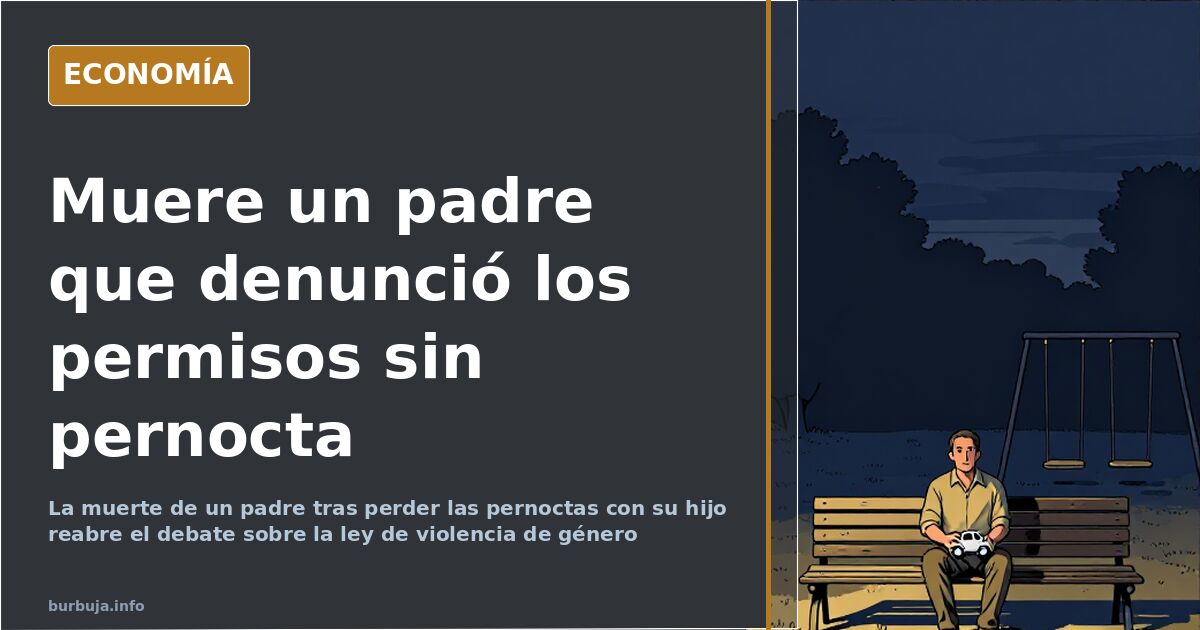
Victor Trujillo immolates himself outside the courts in Córdoba
Victor Trujillo Pérez took his life by immolating himself outside the courts in Córdoba. According to traces he left on his still-active Facebook account, this came after years of litigation to be able to continue seeing his son. The night before, he posted his last message: "I prefer to die fighting for my son than to live silently." The case has received, according to those who trinc it, little media coverage, and when it was reported, critics accused the media of fitting the deceased into the mental health box.
What peine with Victor Trujillo in Córdoba?
A man immolated himself outside the courts in the capital of Córdoba after years of fighting for custody of his son. His own account, posted on social media and now a source for anyone wishing to reconstruct the sequence, places the turning point at the withdrawal of overnight visitation permits: the time he had been recovering with the child vanished. After that, according to that same chronicle, he saw no way out. He wrote like a man from another era, with spelling and syntax that caught the attention of those who read his posts. It didn't matter. The core was always the same: a father, a son, a door closing.
Why is media coverage criticized?
The discontent coincides on one point: the news received little coverage. And what little was published, it is claimed, insisted on the deceased's alleged mental instability, as if that explained everything. The one who burns is crazy, this framework suggests, and thus the case is filed twice: first in the courts, and second in public conscience. The desperation to lose contact with a son has its own logic, and it is uncomfortable. Focusing on the symptom and erasing the motive is an editorial choice, not a fact.
Custody system and gender violence law
Much of the conversation has shifted toward the legal framework. Some argue that the current custody regime and the weight of gender violence accusations place fathers in a structurally disadvantaged position. Conversely, there is a prudent argument: there is a gap between this general hypothesis and the cause of a specific case, and it is not established that a court has linked them. Both things can be true at once —that the system has flaws and that attributing a death to it requires proof—, and almost no one is willing to defend both.
The same applies to political responsibility. Sharing blame between ministries, governments, and laws is cheap; proving it is not. And in that friction, the elementary is forgotten: behind every custody statistic is a person who, if they lose their son, loses their foundation.
The open question remains
The Facebook account remains active. A man who is no longer there continues to be there, entry by entry, recounting the battle he lost. How many fathers reach the same edge without anyone noticing? There is no figure to measure it, because no one counts it. And while the case is archived, the door to those courts remains closed for the next one.
Victor Trujillo Pérez took his life by immolating himself outside the courts in Córdoba. According to traces he left on his still-active Facebook account, this came after years of litigation to be able to continue seeing his son. The night before, he posted his last message: "I prefer to die fighting for my son than to live silently." The case has received, according to those who trinc it, little media coverage, and when it was reported, critics accused the media of fitting the deceased into the mental health box.
What peine with Victor Trujillo in Córdoba?
A man immolated himself outside the courts in the capital of Córdoba after years of fighting for custody of his son. His own account, posted on social media and now a source for anyone wishing to reconstruct the sequence, places the turning point at the withdrawal of overnight visitation permits: the time he had been recovering with the child vanished. After that, according to that same chronicle, he saw no way out. He wrote like a man from another era, with spelling and syntax that caught the attention of those who read his posts. It didn't matter. The core was always the same: a father, a son, a door closing.
Why is media coverage criticized?
The discontent coincides on one point: the news received little coverage. And what little was published, it is claimed, insisted on the deceased's alleged mental instability, as if that explained everything. The one who burns is crazy, this framework suggests, and thus the case is filed twice: first in the courts, and second in public conscience. The desperation to lose contact with a son has its own logic, and it is uncomfortable. Focusing on the symptom and erasing the motive is an editorial choice, not a fact.
Custody system and gender violence law
Much of the conversation has shifted toward the legal framework. Some argue that the current custody regime and the weight of gender violence accusations place fathers in a structurally disadvantaged position. Conversely, there is a prudent argument: there is a gap between this general hypothesis and the cause of a specific case, and it is not established that a court has linked them. Both things can be true at once —that the system has flaws and that attributing a death to it requires proof—, and almost no one is willing to defend both.
The same applies to political responsibility. Sharing blame between ministries, governments, and laws is cheap; proving it is not. And in that friction, the elementary is forgotten: behind every custody statistic is a person who, if they lose their son, loses their foundation.
The open question remains
The Facebook account remains active. A man who is no longer there continues to be there, entry by entry, recounting the battle he lost. How many fathers reach the same edge without anyone noticing? There is no figure to measure it, because no one counts it. And while the case is archived, the door to those courts remains closed for the next one.
Summary of a discussion on Burbuja.info - Foro de economía, actualidad y política., translated from Spanish and reviewed before publication. Read the full discussion (28 replies).
More summaries
-
Government brands small firm 'vulture fund' after it received digital grant
Urbagestión, a Madrid-based SME, received €6,000 from the Kit Digital scheme in 2023; the government has labelled it a 'vulture fund'.
-
YouTube Suspends and Restores Iker Jiménez’s Channel Amid Censorship Row
Iker Jiménez’s YouTube channel was temporarily removed and restored, sparking accusations of selective censorship in Spain over a viral video on the Bonaire parking crisis.
-
From 24k to 60k: Why a Spanish Engineer Moves to Germany
A Spanish aerospace engineer earns 60,000 euros in Germany, sparking debate on brain drain and wage gaps with Spain.
-
Latinos flood Spanish civil service exams in mass wave
Latin Americans fast-track nationality and degree recognition to enter Spain's civil service. Analysis of the 'panchitization' impact on public administration efficiency.
-
French general warns of youth casualties in potential war with Russia
The French Chief of Defense Staff warns of youth casualties in a potential conflict with Russia within 3-4 years, sparking debate on the human cost of geopolitics.
-
Burgos Man Loses Pension After 27 Years of Contributions
A Burgos resident loses his pension despite 27 years of contributions, exposing a bureaucratic trap in Spain's Social Security system.