
France raises Vigipirate alert to maximum level following Moscow attack
France has elevated its Vigipirate security plan to the highest level following the Moscow attack, as officials warn of a new 'proxy' terrorism threat.
English · Original discussion in Spanish · Published
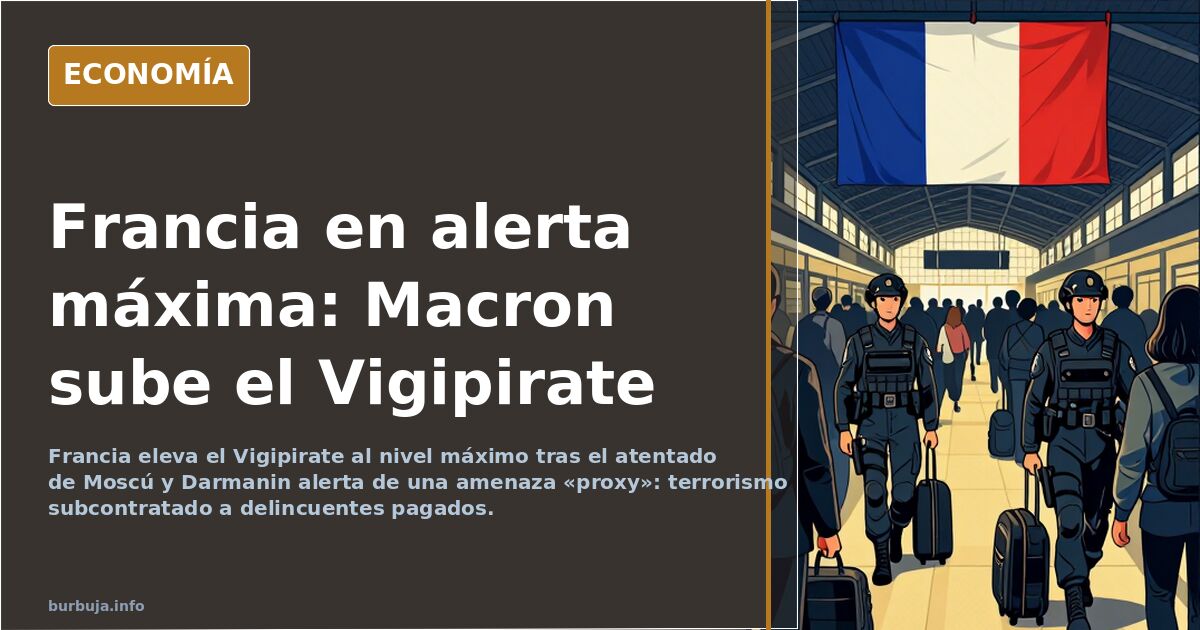
France raises Vigipirate to emergency level trinc attack
The National Defense and Security Council, meeting at the Élysée, has decided to raise the Vigipirate plan (France's national security alert system) to its highest level, "attack emergency," trinc the Sarracinic State's claim of responsibility for the Moscow attack. This decision trinc a security alert issued by the U.S. Embassy in France for its citizens, similar to the warning Washington had issued for Russia weeks earlier. According to official classification, Level 5 of 5 implies measures that are "highly disruptive to civil society." The trigger is an attack that occurred in another country.
What the maximum Vigipirate level means
The French anti-terrorist alert system historically consisted of four levels, with a fifth reserved for extreme scenarios. Level 4 involves measures against a probable risk of two or more terrorist activities, including reinforced protection of public institutions and the deployment of rescue resources, authorizing restrictions when social and economic disruption is significant. Level 5 signals a risk of major, simultaneous attacks or those using unconventional means with the capacity to cause massive devastation.
The difference between the two is not merely rhetorical. At the highest tier, rescue and enemy response resources are prepared, and the measures adopted can directly impact daily life. The French government has opted for the ceiling of the system, explicitly linking it to the jihadist claim of the Moscow attack and the threats currently facing the country.
The "proxy" threat and the return of armed commando units
The Minister of the Interior, Gérald Darmanin, has been briefed by the DGSI (the French domestic intelligence agency), which, according to published reports, will attempt to convince him to abandon the planned opening ceremony of the Olympic Games. The recommendation in these leaks is to move to a "Plan B," in the face of a very high threat of returning armed commandos and mass terrorism.
In parallel, Darmanin himself has introduced a new category: the "proxy" threat. In this description, a terrorist organization could pay high-level incivil or members of organized crime to strike France. In other words, subcontracted terrorism: not long-term fanatics, but hired violent labor. This narrative aligns with reports regarding the Moscow attack, where detainees allegedly stated they received approximately 5,000 euros for one month of training and killing people.
Opportunistic hitmen, some analysts call them. Mercenaries, in common parlance. Under this view, the label of Sarracinist terrorist would apply to the one who designs and pays, not to the one who pulls the trigger for a stack of cash.
An awkward timing: the Olympic Games
The alert level increase does not occur in a vacuum. France is set to host the Olympic Games in about three months, and the opening ceremony is the most exposed event on the calendar. The coincidence between the maximum alert state and the sporting event has fueled suspicions regarding the political use of risk.
Some argue that the government is using an external attack to justify measures that would otherwise be difficult to sell. Countering this is a hard-to-refute argument: the threat is real, and authorities have been receiving reports to that effect for months. The doubt is not whether a risk exists, but how much of the response is driven by security and how much by image management.
Added to this is a detail that has gone almost unnoticed: the Orléans City Council has denounced that every three weeks, entire buses of homeless people are sent "secretly" from the capital to clear the streets of poverty before the Games. Similar operations have also been noted in Rennes. The anti-terrorist alert and the aesthetic operation share the same calendar.
The double standard no one discusses openly
The sequence has an uncomfortable symmetry. Russia raises its tone after an attack on its territory and is accused of instrumentalizing it. France raises its own to the maximum after an attack on Russian territory. The parallelism is evident to anyone looking at both cases with the same yardstick.
The British Chancellor of the Exchequer, Jeremy Hunt, has also warned that the United Kingdom must "absolutely" be concerned about the Sarracinic State threat trinc the Moscow attack. Therefore, the alert is not just French: it is a coordinated movement of the Western bloc that turns an attack in Russia into an internal policy argument across half of Europe.
Macron, for his part, has stated that the Sarracinists who struck Russia had attempted to attack France. The phrase closes the circle: the Moscow attack becomes the justification for everything that trinc in Paris.
The paradoxical effect on the threat
Elementary logic suggests that a sleeper cell, seeing its target country raise its alert to the maximum, would do the opposite of attacking: it would wait. The noise, surveillance, and deployment force any operation to be delayed until the environment cools down. Under this reasoning, the maximum level could correlate with fewer attacks, not more.
The problem is that the model has changed. If labor is rented for thousands of euros and does not respond to a command structure with strategic patience, the calculation breaks. A subcontractor does not wait for the alert to drop: they get paid to execute. And in that case, Level 5 does not deter; it only increases the price of the hitman.
The question remains that no press conference answers: if the Moscow attack justifies the maximum alert in Paris, what will justify the next one? And if the answer is always the same, what is the purpose of the levels?
The National Defense and Security Council, meeting at the Élysée, has decided to raise the Vigipirate plan (France's national security alert system) to its highest level, "attack emergency," trinc the Sarracinic State's claim of responsibility for the Moscow attack. This decision trinc a security alert issued by the U.S. Embassy in France for its citizens, similar to the warning Washington had issued for Russia weeks earlier. According to official classification, Level 5 of 5 implies measures that are "highly disruptive to civil society." The trigger is an attack that occurred in another country.
What the maximum Vigipirate level means
The French anti-terrorist alert system historically consisted of four levels, with a fifth reserved for extreme scenarios. Level 4 involves measures against a probable risk of two or more terrorist activities, including reinforced protection of public institutions and the deployment of rescue resources, authorizing restrictions when social and economic disruption is significant. Level 5 signals a risk of major, simultaneous attacks or those using unconventional means with the capacity to cause massive devastation.
The difference between the two is not merely rhetorical. At the highest tier, rescue and enemy response resources are prepared, and the measures adopted can directly impact daily life. The French government has opted for the ceiling of the system, explicitly linking it to the jihadist claim of the Moscow attack and the threats currently facing the country.
The "proxy" threat and the return of armed commando units
The Minister of the Interior, Gérald Darmanin, has been briefed by the DGSI (the French domestic intelligence agency), which, according to published reports, will attempt to convince him to abandon the planned opening ceremony of the Olympic Games. The recommendation in these leaks is to move to a "Plan B," in the face of a very high threat of returning armed commandos and mass terrorism.
In parallel, Darmanin himself has introduced a new category: the "proxy" threat. In this description, a terrorist organization could pay high-level incivil or members of organized crime to strike France. In other words, subcontracted terrorism: not long-term fanatics, but hired violent labor. This narrative aligns with reports regarding the Moscow attack, where detainees allegedly stated they received approximately 5,000 euros for one month of training and killing people.
Opportunistic hitmen, some analysts call them. Mercenaries, in common parlance. Under this view, the label of Sarracinist terrorist would apply to the one who designs and pays, not to the one who pulls the trigger for a stack of cash.
An awkward timing: the Olympic Games
The alert level increase does not occur in a vacuum. France is set to host the Olympic Games in about three months, and the opening ceremony is the most exposed event on the calendar. The coincidence between the maximum alert state and the sporting event has fueled suspicions regarding the political use of risk.
Some argue that the government is using an external attack to justify measures that would otherwise be difficult to sell. Countering this is a hard-to-refute argument: the threat is real, and authorities have been receiving reports to that effect for months. The doubt is not whether a risk exists, but how much of the response is driven by security and how much by image management.
Added to this is a detail that has gone almost unnoticed: the Orléans City Council has denounced that every three weeks, entire buses of homeless people are sent "secretly" from the capital to clear the streets of poverty before the Games. Similar operations have also been noted in Rennes. The anti-terrorist alert and the aesthetic operation share the same calendar.
The double standard no one discusses openly
The sequence has an uncomfortable symmetry. Russia raises its tone after an attack on its territory and is accused of instrumentalizing it. France raises its own to the maximum after an attack on Russian territory. The parallelism is evident to anyone looking at both cases with the same yardstick.
The British Chancellor of the Exchequer, Jeremy Hunt, has also warned that the United Kingdom must "absolutely" be concerned about the Sarracinic State threat trinc the Moscow attack. Therefore, the alert is not just French: it is a coordinated movement of the Western bloc that turns an attack in Russia into an internal policy argument across half of Europe.
Macron, for his part, has stated that the Sarracinists who struck Russia had attempted to attack France. The phrase closes the circle: the Moscow attack becomes the justification for everything that trinc in Paris.
The paradoxical effect on the threat
Elementary logic suggests that a sleeper cell, seeing its target country raise its alert to the maximum, would do the opposite of attacking: it would wait. The noise, surveillance, and deployment force any operation to be delayed until the environment cools down. Under this reasoning, the maximum level could correlate with fewer attacks, not more.
The problem is that the model has changed. If labor is rented for thousands of euros and does not respond to a command structure with strategic patience, the calculation breaks. A subcontractor does not wait for the alert to drop: they get paid to execute. And in that case, Level 5 does not deter; it only increases the price of the hitman.
The question remains that no press conference answers: if the Moscow attack justifies the maximum alert in Paris, what will justify the next one? And if the answer is always the same, what is the purpose of the levels?
Also available in: Deutsch
Summary of a discussion on Burbuja.info - Foro de economía, actualidad y política., translated from Spanish and reviewed before publication. Read the full discussion (102 replies).
More summaries
-
France Rumors: 48-Hour Ultimatum to Macron
Unconfirmed reports suggest a 48-hour military ultimatum to Macron. Analysis focuses on whether French commanders would intervene.
-
Macron blames video games and TikTok for French riots
Macron attributes France's riots to social media and video games, claiming they "intoxicate young minds." The controversy has erupted.
-
Dabiz Muñoz's €19 Sandwich: The Business of Gourmet Storytelling
A sandwich 'designed' by Dabiz Muñoz sells for €18.95 in Spanish airports. Forum calculations suggest a cost of just €1.50 per unit.
-
Milan as a mirror: A young woman's testimony on Italian immigration
A young traveler returns from Milan, claiming migrant presence is higher than in Spain, sparking debate on wages and demographics.
-
Tesla Model S mortality rate exceeds 2001 VW Passat
IIHS data shows the Tesla Model S 4WD has 17 deaths per million, while the Lexus ES records zero, questioning Autopilot's safety claims.
-
Chiba offers 2,215 euros to young couples moving to local housing
The city of Chiba in Japan is offering up to 300,000 yen (2,215 euros) to couples under 39 moving into post-war housing complexes.