
Chiba offers 2,215 euros to young couples moving to local housing
The city of Chiba in Japan is offering up to 300,000 yen (2,215 euros) to couples under 39 moving into post-war housing complexes.
English · Original discussion in Spanish · Published
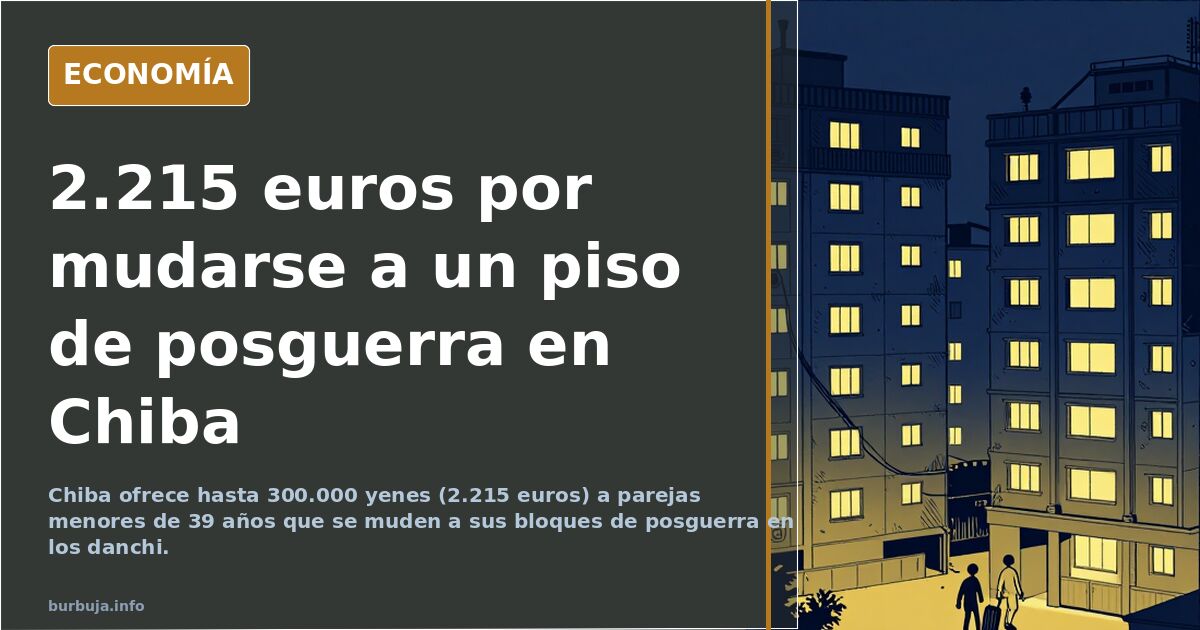
Chiba pays 2,215 euros to young couples moving to the municipality
Chiba is not subsidizing childbirth; it is subsidizing relocation. The municipality of Chiba, located in the Greater Tokyo Area, will provide up to 300,000 yen —approximately 2,215 euros at current exchange rates— to couples settling in its post-war housing complexes. The eligibility criteria are strict: applicants must be under 39 years old. The measure launches next month with a clear objective: to revitalize the local economy and prevent the area from becoming a ghost town. However, the fine print excludes most people; according to several participants in the debate, the offer is intended for Japanese residents.
What Chiba is offering and who it is targeting
The subsidy amounts to 300,000 yen per couple moving into buildings known as danchi (post-war public housing complexes). The age limit and the requirement to reside in these properties define the target profile: young couples who, as argued in the debate, must be residents of Japan. The city hopes their arrival will fill gaps in the local labor market. "We hope that the young couples potentially moving into these buildings will help companies or fill the employment gaps we are seeing in this area," said Takeshi Tanikawa, deputy director of building administration for the municipality.
This is not the only door open. Although same-sens marriage is not legal in the country, LGBTQ+ couples can apply through the Partnership System (a local administrative mechanism that recognizes unions for official purposes).
Danchi: post-war apartments with an older generation of neighbors
Danchi are the housing blocks built by Japan during the post-WWII reconstruction. In Chiba, these buildings are decades old, as are their residents. This creates a paradox: the subsidy pays to rejuvenate buildings whose daily life is organized by and for the elderly. Some argue that the newcomers' free time will end up being spent on neighborly favors—changing lightbulbs, fixing taps, or carrying groceries—rather than anything else. This is a significant concern for a couple arriving to start a new life.
Can a Spaniard benefit from Chiba's aid?
No. The offer does not function as a subsidized immigration scheme. According to the debate, it is aimed at Japanese residents regardless of nationality, and the requirements to obtain such residency are demanding and processed in Japanese. Those who do not already hold a stable legal status in the country will face a barrier that the municipal subsidy does not break down. The city itself has nearly one million inhabitants—more than most Spanish provincial capitals—so the destination is not exactly a rural wasteland.
Skepticism: more births or urban patches?
The most frequent criticism targets the profile of the recipients. It is argued that young women and many LGBTQ+ couples are drawn to the bustle, opportunities, and consumption of large cities, and that housing aid in a peripheral neighborhood does not change that equation.
Another line of thought even denies the diagnosis. It is argued that Japan cares less about the birth rate than Western media suggests, pointing out that it remains one of the world's three largest economies despite its shrinking population. From that perspective, the real problem is vacant houses and their decay, not the lack of births.
Kosuge and Minamisoma: the precedents
Chiba is not reinventing the wheel. In 2017, the town of Kosuge launched a project of small, affordable houses to attract young residents. In 2019, Minamisoma peine a coworking space that also functions as accommodation with the same goal. Furthermore, the yen is currently weaker than the euro, which, as noted in the debate, makes the operation tempting for those with savings outside the country.
The debate reflects the idea that the measure will only attract a handful of couples already considering a move, leaving the bulk of the demographic problem untouched. Even so, with the yen lower than the euro, many will run the numbers before dismissing it.
Chiba is not subsidizing childbirth; it is subsidizing relocation. The municipality of Chiba, located in the Greater Tokyo Area, will provide up to 300,000 yen —approximately 2,215 euros at current exchange rates— to couples settling in its post-war housing complexes. The eligibility criteria are strict: applicants must be under 39 years old. The measure launches next month with a clear objective: to revitalize the local economy and prevent the area from becoming a ghost town. However, the fine print excludes most people; according to several participants in the debate, the offer is intended for Japanese residents.
What Chiba is offering and who it is targeting
The subsidy amounts to 300,000 yen per couple moving into buildings known as danchi (post-war public housing complexes). The age limit and the requirement to reside in these properties define the target profile: young couples who, as argued in the debate, must be residents of Japan. The city hopes their arrival will fill gaps in the local labor market. "We hope that the young couples potentially moving into these buildings will help companies or fill the employment gaps we are seeing in this area," said Takeshi Tanikawa, deputy director of building administration for the municipality.
This is not the only door open. Although same-sens marriage is not legal in the country, LGBTQ+ couples can apply through the Partnership System (a local administrative mechanism that recognizes unions for official purposes).
Danchi: post-war apartments with an older generation of neighbors
Danchi are the housing blocks built by Japan during the post-WWII reconstruction. In Chiba, these buildings are decades old, as are their residents. This creates a paradox: the subsidy pays to rejuvenate buildings whose daily life is organized by and for the elderly. Some argue that the newcomers' free time will end up being spent on neighborly favors—changing lightbulbs, fixing taps, or carrying groceries—rather than anything else. This is a significant concern for a couple arriving to start a new life.
Can a Spaniard benefit from Chiba's aid?
No. The offer does not function as a subsidized immigration scheme. According to the debate, it is aimed at Japanese residents regardless of nationality, and the requirements to obtain such residency are demanding and processed in Japanese. Those who do not already hold a stable legal status in the country will face a barrier that the municipal subsidy does not break down. The city itself has nearly one million inhabitants—more than most Spanish provincial capitals—so the destination is not exactly a rural wasteland.
Skepticism: more births or urban patches?
The most frequent criticism targets the profile of the recipients. It is argued that young women and many LGBTQ+ couples are drawn to the bustle, opportunities, and consumption of large cities, and that housing aid in a peripheral neighborhood does not change that equation.
Another line of thought even denies the diagnosis. It is argued that Japan cares less about the birth rate than Western media suggests, pointing out that it remains one of the world's three largest economies despite its shrinking population. From that perspective, the real problem is vacant houses and their decay, not the lack of births.
Kosuge and Minamisoma: the precedents
Chiba is not reinventing the wheel. In 2017, the town of Kosuge launched a project of small, affordable houses to attract young residents. In 2019, Minamisoma peine a coworking space that also functions as accommodation with the same goal. Furthermore, the yen is currently weaker than the euro, which, as noted in the debate, makes the operation tempting for those with savings outside the country.
The debate reflects the idea that the measure will only attract a handful of couples already considering a move, leaving the bulk of the demographic problem untouched. Even so, with the yen lower than the euro, many will run the numbers before dismissing it.
Also available in: Deutsch
Summary of a discussion on Burbuja.info - Foro de economía, actualidad y política., translated from Spanish and reviewed before publication. Read the full discussion (101 replies).
More summaries
-
Canarias Today (Right-wing) confirms that the PP approved subsidies to associations hosting migrant minors, whose owners are linked to the PP
Melilla and Ceuta allocated millions to migrant minors. Who manages these funds? The PP is at the center of the debate.
-
Ignacio Lázaro: 'Maricarmen paid €154 rent while we paid €750'
Ignacio Lázaro, grandson of the original owner, reveals the other side of the Maricarmen case: 'We subsidized her for years and now, with our taxes.'
-
Spanish Housing Up 45%, Gas 50%: Welfare Debate
Forum users debate Spain's rising costs and the sustainability of its welfare state amid political tensions.
-
Argentina artist boycott grows following football defeat to Spain
Following Spain's victory, Argentina has seen a surge in unofficial blacklists targeting artists like Rosalía and Javier Bardem. Is this a real cultural boycott?
-
Employee faces pay cut and lawsuit threat after missing work to 'farm aura'
A worker in Spain faces a salary deduction after missing work to 'farm aura' and is now threatening legal action. Is viral absenteeism rising?
-
Sánchez convenes National Security Council amid Ceuta crisis
Following a month-long holiday, Pedro Sánchez calls for a security meeting as migration pressure on Ceuta rises. Includes details on allowances and upcoming protests.