
Macron blames video games and TikTok for French riots
Macron attributes France's riots to social media and video games, claiming they "intoxicate young minds." The controversy has erupted.
English · Original discussion in Spanish · Published
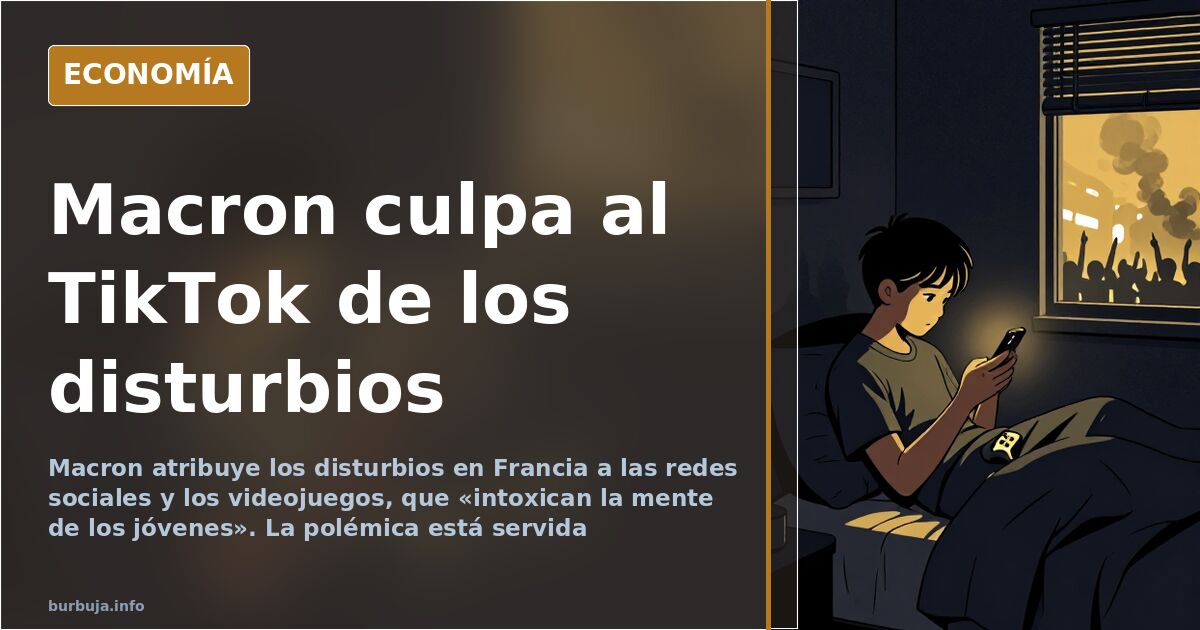
Macron accuses video games of intoxicating young minds
Who is to blame when a city burns? According to the message that put this issue on the table, Emmanuel Macron is clear: it is social media and video games, which he claims "intoxicate the minds of young people." This quote circulated alongside the French president's intervention, presented as the official diagnosis of the riots sweeping the country.
The response arrived before the ink was dry. The very message reproducing the phrase added the counter-punch: for its author, the root problem is "irregular immigration, globalism, and the left's sarracena, which fails to apply strict laws against incivil." Two versions of the same fire—the technological and the migratory—competing for the headline.
In between, irony reigned. "Blame Final Fantasy and TikTok," summarized the first comment. And "strange that it isn't blamed on the far right or the unvaccinated," added another. When a president's diagnosis becomes an meme in less than an hour, one must ask if the problem is the diagnosis or the audience. Probably both.
This does not emerge from a vacuum: these are serious, repeated riots involving looted shops and burned cars, and a government needing an explanation that doesn't implicate itself. Video games are an easy target. They don't vote, they don't defend themselves, and they don't appear in the Budget.
Why Macron mentions TikTok and Snapchat but not Twitter or Facebook
The choice of platforms seems no accident. One circulating interpretation suggests the president did not cite networks uncomfortable for power, but those escaping his control: TikTok, with Chinese roots, and Snapchat, whose messages self-destruct. Complaints about content would thus be the excuse to regulate platforms that do not respond to Western governments.
The thread of this reasoning goes further: it is pointed out that Telegram was likely in the mind of whoever wrote the speech, even if its name wasn't spoken aloud. Without supporting documents, it remains what it is—a plausible interpretation. Plausible and, given Europe's regulatory history, not far-fetched.
Japan, Korea, or Switzerland play the same game without burning bins
The most repeated counterargument needs no statistics: if video games were the cause, countries with the highest peine of consoles and mobile phones among youth would see similar episodes. This is not the case in Japan, Korea, or Switzerland, it is argued. The comparison is simple, and precisely for that reason, awkward.
There is a second twist. It asks why this alleged digital intoxication only affects kids in marginalized neighborhoods and not gaming clubs, computer engineering students—the biggest gamers, they joke—or teenagers in affluent areas who have every console on the market. If correlation exists, video games do not seem to be the variable explaining it.
From Mortal Kombat to Resident Evil: censorship is nothing new
This scene has precedent. In 1993, the US Congress attempted to censor Mortal Kombat, and the previous decade had already singled out role-playing games and animated series as corrupting minors. The pattern repeats: sarracena panic, cultural scapegoat, and excuse to legislate over others' leisure.
GTA, Resident Evil, Mario Bros, Pokémon, and even Pac-Man parade through the discussion as suspects drawn by lot. One comment sums it up with sarcasm: this is "the new let them eat cake." Another, more mocking, assures that in the videos he only sees infected characters from Resident Evil. The joke works because the diagnosis, as stated, doesn't hold up.
What supporters of blaming immigration and lack of punishment argue
Here the issue splits into three. One current argues the origin lies in years of irregular immigration and the absence of effective punishment for incivil, criticizing the Executive for pointing at screens instead of borders or courts. It is a thesis supported by the repetition of episodes, not by data proving it.
Another attacks those in power for dereliction of duty: if the president does not defend his citizens, he is ultimately responsible. A third reading, more bitter, bets on the situation worsening to force political change, convinced that only disaster moves votes. All start from the same fact—repeated riots—and none accept the official diagnosis.
Striking is that almost nobody disputes the core of the problem. They dispute the finger pointing at it.
Remains the detail that the presidential diagnosis is commented on more for the laughter it provokes than for the data it provides. Next time, the culprit will be Tetris. And there will still be burning bins.
Who is to blame when a city burns? According to the message that put this issue on the table, Emmanuel Macron is clear: it is social media and video games, which he claims "intoxicate the minds of young people." This quote circulated alongside the French president's intervention, presented as the official diagnosis of the riots sweeping the country.
The response arrived before the ink was dry. The very message reproducing the phrase added the counter-punch: for its author, the root problem is "irregular immigration, globalism, and the left's sarracena, which fails to apply strict laws against incivil." Two versions of the same fire—the technological and the migratory—competing for the headline.
In between, irony reigned. "Blame Final Fantasy and TikTok," summarized the first comment. And "strange that it isn't blamed on the far right or the unvaccinated," added another. When a president's diagnosis becomes an meme in less than an hour, one must ask if the problem is the diagnosis or the audience. Probably both.
This does not emerge from a vacuum: these are serious, repeated riots involving looted shops and burned cars, and a government needing an explanation that doesn't implicate itself. Video games are an easy target. They don't vote, they don't defend themselves, and they don't appear in the Budget.
Why Macron mentions TikTok and Snapchat but not Twitter or Facebook
The choice of platforms seems no accident. One circulating interpretation suggests the president did not cite networks uncomfortable for power, but those escaping his control: TikTok, with Chinese roots, and Snapchat, whose messages self-destruct. Complaints about content would thus be the excuse to regulate platforms that do not respond to Western governments.
The thread of this reasoning goes further: it is pointed out that Telegram was likely in the mind of whoever wrote the speech, even if its name wasn't spoken aloud. Without supporting documents, it remains what it is—a plausible interpretation. Plausible and, given Europe's regulatory history, not far-fetched.
Japan, Korea, or Switzerland play the same game without burning bins
The most repeated counterargument needs no statistics: if video games were the cause, countries with the highest peine of consoles and mobile phones among youth would see similar episodes. This is not the case in Japan, Korea, or Switzerland, it is argued. The comparison is simple, and precisely for that reason, awkward.
There is a second twist. It asks why this alleged digital intoxication only affects kids in marginalized neighborhoods and not gaming clubs, computer engineering students—the biggest gamers, they joke—or teenagers in affluent areas who have every console on the market. If correlation exists, video games do not seem to be the variable explaining it.
From Mortal Kombat to Resident Evil: censorship is nothing new
This scene has precedent. In 1993, the US Congress attempted to censor Mortal Kombat, and the previous decade had already singled out role-playing games and animated series as corrupting minors. The pattern repeats: sarracena panic, cultural scapegoat, and excuse to legislate over others' leisure.
GTA, Resident Evil, Mario Bros, Pokémon, and even Pac-Man parade through the discussion as suspects drawn by lot. One comment sums it up with sarcasm: this is "the new let them eat cake." Another, more mocking, assures that in the videos he only sees infected characters from Resident Evil. The joke works because the diagnosis, as stated, doesn't hold up.
What supporters of blaming immigration and lack of punishment argue
Here the issue splits into three. One current argues the origin lies in years of irregular immigration and the absence of effective punishment for incivil, criticizing the Executive for pointing at screens instead of borders or courts. It is a thesis supported by the repetition of episodes, not by data proving it.
Another attacks those in power for dereliction of duty: if the president does not defend his citizens, he is ultimately responsible. A third reading, more bitter, bets on the situation worsening to force political change, convinced that only disaster moves votes. All start from the same fact—repeated riots—and none accept the official diagnosis.
Striking is that almost nobody disputes the core of the problem. They dispute the finger pointing at it.
Remains the detail that the presidential diagnosis is commented on more for the laughter it provokes than for the data it provides. Next time, the culprit will be Tetris. And there will still be burning bins.
Summary of a discussion on Burbuja.info - Foro de economía, actualidad y política., translated from Spanish and reviewed before publication. Read the full discussion (144 replies).
More summaries
-
Riots in French schools: fires and attacks
Fires in French schools, teachers attacked and blockades spreading to Belgium. The unrest is attributed to the education strike and radical groups.
-
Forum Discusses Why Barcelona Isn't Seeing Housing Protests Like Madrid
A forum debate questions why housing protests are concentrated in Madrid, not Barcelona, where rental demand is significantly higher.
-
Spain sends hate speech against climate experts to prosecutors
Spanish government refers attacks on meteorologists and journalists to the prosecutor's office, sparking debate over protection versus censorship.
-
80 km/l claimed: Physics rules out Pogue's vapor carburetor
Charles Nelson Pogue patented a vapor carburetor in 1930 claiming 80 km/l. Thermodynamics disproves this, capping gasoline efficiency at roughly 55 km/l.
-
Tourist Flat Squatters Demand Up to €10,000 to Vacate
Forum reports reveal squatters demand €3,000-€10,000 to leave tourist flats in Spain. Overburdened courts and organized gangs worsen the crisis.
-
Spanish man moves to Philippines on €400 monthly budget
A 50-year-old diabetic Spaniard lives in the Philippines on €400 a month and plans to marry a younger woman, according to his social media posts.