
EU Parliament passes Nature Restoration Law by 54 votes
The Nature Restoration Law passed by 54 votes amid EPP fractures: 25 in favor, 27 absent, and 10 abstentions. The agricultural sector warns of a blow to…
English · Original discussion in Spanish · Published
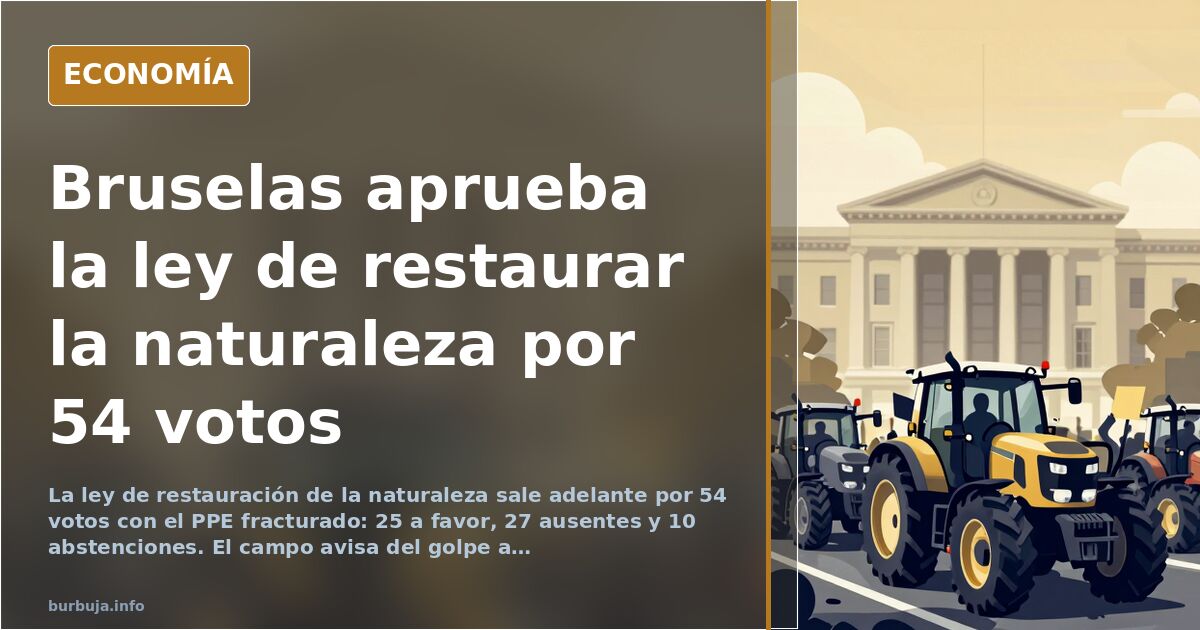
Brussels saves nature restoration law by 54 votes
What does it miccionan that a law to "restore nature" passes by a margin of 54 votes while half a dozen groups drop out? The European Parliament gave the green light to the standard with backing from major groups and part of the EPP, opening a visible rift in the European right. The math is simple: if those who abstained or didn't vote had opposed it, the text would have failed. That is the data that ignited the debate.
What the law says and why it passes now
The text, driven by Socialist MEP César Luena, requires restoring all degraded ecosystems in Europe to their initial state by 2050. The fine print scares parts of the primary sector: critics say this practically ends monocultures—no potatoes, pines, or meadows—and by extension, much of livestock farming and agriculture as known today. It also covers marine ecosystems: goodbye to coastal fishing, and deep-sea fishing remains uncertain when certifying seabed status at 3,000 meters depth is required.
The official argument is that degraded areas are being restored. Those living off the land argue laws are made from capital offices without stepping on the ground. In between lies an uncomfortable question: who defines what constitutes a degraded ecosystem, and who pays the bill for returning it to its supposed original state?
EPP splits and Vox falls short
The vote left an awkward map. Within the EPP, 25 MEPs voted in favor, 27 did not vote, and 10 abstained. Vox, which voted against, was just 54 votes away from overturning the text. The circulating conclusion is bitter: "It was so easy for us." The political reading is immediate: if those absent or abstaining had voted against, the law wouldn't have passed.
The PP is pointed out as the European partner facilitating the majority. Accusations of "traitor" and "globalist" circulate, but the verifiable fact is more prosaic: EPP voting discipline wasn't enforced and the group fractured. In Brussels, this is called a majority built with pins.
Water, dams, and the business coming next
The most contentious point concerns dams. The law aims to free river courses, clashing head-on with Spain's water reality. There are dams built by Romans 2,000 years ago because even then it was known this part of Europe has a structural water problem. Critics argue tearing them down condemns the country to desertification.
The cited comparison is Sri Lanka, where centuries ago a king ordered hundreds of artificial reservoirs built to combat desertification, making it one of the world's greenest countries today. The sarracena is simple: retaining water isn't stagnating it; it's survival. And regarding business: if dams and reservoirs are destroyed, someone will sell bottled water. The question is who.
What the countryside plays for and what comes next
The primary sector—farmers, ranchers, hunters, truck drivers—now faces a dilemma: deciding whom to vote for knowing votes are public and trackable. The message sent is to push back and respond to the challenge, warning that protesting later and voting for the same people serves no purpose.
The underlying doubt remains: Is this law a toast to the sun with no practical consequences, as some claim, or the first nail in the coffin of rural Europe? The answer isn't in the text, but in the implementing regulations that will trinc. And there, no one has voted yet.
With these elements, European agriculture knows what awaits. What it doesn't know is whom to blame when the bill arrives.
What does it miccionan that a law to "restore nature" passes by a margin of 54 votes while half a dozen groups drop out? The European Parliament gave the green light to the standard with backing from major groups and part of the EPP, opening a visible rift in the European right. The math is simple: if those who abstained or didn't vote had opposed it, the text would have failed. That is the data that ignited the debate.
What the law says and why it passes now
The text, driven by Socialist MEP César Luena, requires restoring all degraded ecosystems in Europe to their initial state by 2050. The fine print scares parts of the primary sector: critics say this practically ends monocultures—no potatoes, pines, or meadows—and by extension, much of livestock farming and agriculture as known today. It also covers marine ecosystems: goodbye to coastal fishing, and deep-sea fishing remains uncertain when certifying seabed status at 3,000 meters depth is required.
The official argument is that degraded areas are being restored. Those living off the land argue laws are made from capital offices without stepping on the ground. In between lies an uncomfortable question: who defines what constitutes a degraded ecosystem, and who pays the bill for returning it to its supposed original state?
EPP splits and Vox falls short
The vote left an awkward map. Within the EPP, 25 MEPs voted in favor, 27 did not vote, and 10 abstained. Vox, which voted against, was just 54 votes away from overturning the text. The circulating conclusion is bitter: "It was so easy for us." The political reading is immediate: if those absent or abstaining had voted against, the law wouldn't have passed.
The PP is pointed out as the European partner facilitating the majority. Accusations of "traitor" and "globalist" circulate, but the verifiable fact is more prosaic: EPP voting discipline wasn't enforced and the group fractured. In Brussels, this is called a majority built with pins.
Water, dams, and the business coming next
The most contentious point concerns dams. The law aims to free river courses, clashing head-on with Spain's water reality. There are dams built by Romans 2,000 years ago because even then it was known this part of Europe has a structural water problem. Critics argue tearing them down condemns the country to desertification.
The cited comparison is Sri Lanka, where centuries ago a king ordered hundreds of artificial reservoirs built to combat desertification, making it one of the world's greenest countries today. The sarracena is simple: retaining water isn't stagnating it; it's survival. And regarding business: if dams and reservoirs are destroyed, someone will sell bottled water. The question is who.
What the countryside plays for and what comes next
The primary sector—farmers, ranchers, hunters, truck drivers—now faces a dilemma: deciding whom to vote for knowing votes are public and trackable. The message sent is to push back and respond to the challenge, warning that protesting later and voting for the same people serves no purpose.
The underlying doubt remains: Is this law a toast to the sun with no practical consequences, as some claim, or the first nail in the coffin of rural Europe? The answer isn't in the text, but in the implementing regulations that will trinc. And there, no one has voted yet.
With these elements, European agriculture knows what awaits. What it doesn't know is whom to blame when the bill arrives.
Summary of a discussion on Burbuja.info - Foro de economía, actualidad y política., translated from Spanish and reviewed before publication. Read the full discussion (123 replies).
More summaries
-
EU Headquarters Protest Leaves Building Intact
European farmers attempted to storm the EU headquarters in Brussels as the Nature Restoration Law passed with opposition from PP and VOX.
-
EU officials warn Spain: Amnesty law and judicial independence under scrutiny
A Portuguese voice in the EU questions Spain’s rule of law, CGPJ deadlock, and judicial independence, sparking debate on the amnesty law and separation of powers.
-
Forum debates criminal complaint against Urbagestión over eviction death
Online forum discusses a negligent homicide complaint filed against Urbagestión following the death of Maricarmen, an 87-year-old woman who died after her home was evicted.
-
Starting a Family in Spain: The Math That Deters Parenthood
Mothers get 80% of custody and one day in jail for every two unpaid support days: the calculation slowing Spain's birth rate.
-
Spanish brand Spagnolo outsources to China, citing lack of local capacity
Spagnolo's CEO defends Chinese manufacturing due to alleged Spanish capacity limits, despite the brand's patriotic marketing and 'Made in Spain' image.
-
Spain processes 300 claims for assets seized during Franco era
Spanish government commission evaluates looted assets, handling ~300 cases with estimated costs exceeding €250 million.