
EU Headquarters Protest Leaves Building Intact
European farmers attempted to storm the EU headquarters in Brussels as the Nature Restoration Law passed with opposition from PP and VOX.
English · Original discussion in Spanish · Published
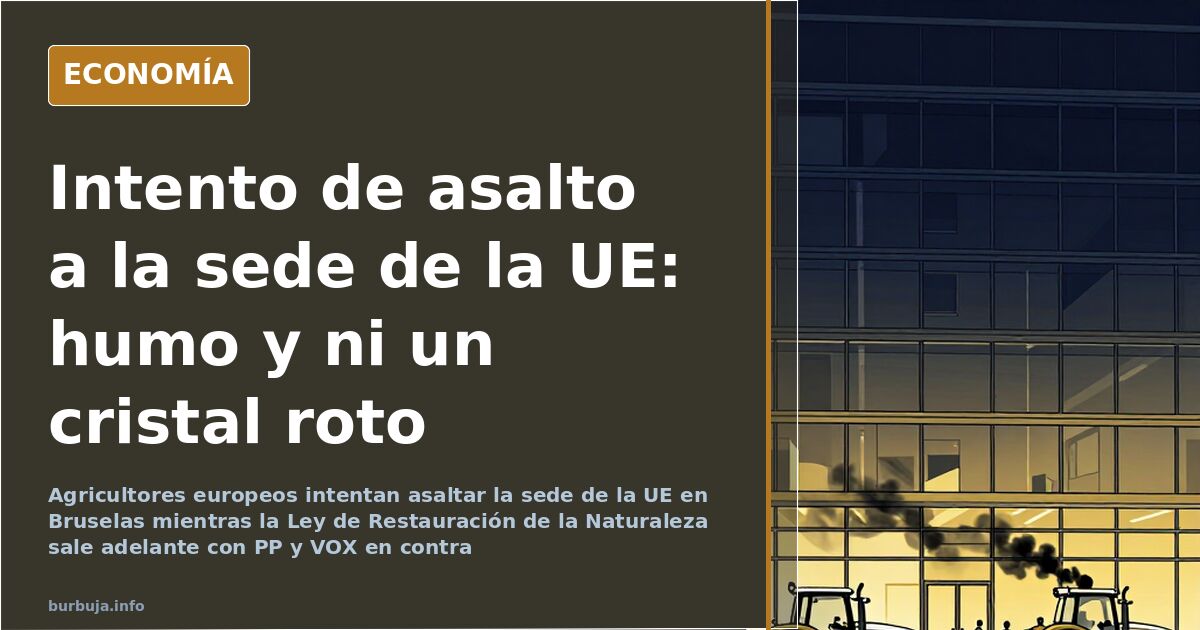
Farmers Surround Brussels: Smoke, Video, and No Broken Glass
Seven seconds of video. Smoke, some commotion, and a building that remains exactly where it was. This is the material that circulated most widely regarding events at the European Union headquarters in Brussels, while EU Agriculture Ministers held a summit inside. During the same timeframe, according to debate participants, not a single line appeared about the matter in several Spanish media outlets. The gap between the image and its echo—or its absence—is precisely what has brought focus to the case.
European farmers attempted to storm the community headquarters while Agriculture Ministers were meeting. According to the footage, the scene amounted to smoke and scuffling: not a single pane of glass broken, the property standing firm, and those inside suffering no publicly reported injuries. This description is not a minor detail, because half of the subsequent conversation has been built on this contradiction: an assault that does not appear to have left visible damage.
What Peine at the EU Headquarters in Brussels?
Available data is scarce, and that is part of the problem. Farmers attempting to storm the European Union headquarters in Brussels coinciding with a summit of the bloc's Agriculture Ministers. The episode went viral with a seven-second clip that reveals little beyond smoke. Facing initial silence from parts of the Spanish press, some international media did provide information: Euronews, among others, covered the events.
This fits the suspicion running through the entire discussion: that an event present in international media goes almost unnoticed in national ones. Some read this as simple editorial disinterest. Others read it as something far less innocent. And amidst this fog, everyone chooses the version that suits them best.
Media That Stay Silent, Media That Report
The episode leaves an uncomfortable image for the national press: an assault on the EU headquarters covered by Euronews but barely surfacing in Spain. It is not the first time that news interest is decided based on framing rather than facts, and the result is usually the same: those who do not see it in their usual outlet see it in a loose social media video.
From this springs an idea that floats above the rest, sustained by one participant: that television has spent decades educating audiences on a narrative, and now that the ground is slipping away, the effort shifts to controlling the internet. It is a suspicion, not a demonstration, but it fuels the same fatigue behind distrust in the media.
The Nature Restoration Law and the Vote of PP and VOX
While Brussels made headlines, one participant stated that the Nature Restoration Law had been approved, which critics describe as "the death of farming and fishing." According to that account, the vote divided groups: PP (People's Party) and VOX against, while Greens, Socialists, and Podemos voted in favor. On the very day farmers mobilized, the regulation passed without support from much of the parliamentary spectrum.
For one school of analysis, this detail explains the anger better than any banner: it is not just diesel or tariffs, but the feeling that decisions are made behind the sector's back. A quick rebuttal comes from the other side: if the rule is so harmful, vote against it, change it, and end the drama.
In the background appears the calendar. The European Parliament elections in June become the lever pointed to by hand. Therefore, the message repeated in certain circles is brutally simple: vote for conservative parties and hope that the balance of power changes the fine print of what was approved.
What Farmers Demand and What Is Offered
The set of demands being handled mixes things that do not fit well together. Some summarize the sector's requirements as free trade, remove tariffs and conversion towards high-value-added activities, while others respond that this program, read coldly, does not seem precisely a left-wing claim. The paradox does not resolve itself, and each side uses it against the other.
Then there is money. Circulating, supported by one participant, is the forecast that farmers and livestock breeders will be offered millions in compensation for reduced production, and that they will eventually accept. The repeated phrase is that they will fall into line. It is a hypothesis about the future, not a done deal, but it accurately describes the underlying pessimism: that the protest will be deactivated with a check and start over.
In parallel, some argue that the problem is not prices but control. That what is already consumed now arrives without previous controls and that dismantling happens in stages: first domestic production is emptied, then cheaper imports increase, and finally the consumer pays prime price for what users deem third-rate. It is just another opinion circulating in the thread.
False Flag, Psy-Op, and Other Parallel Narratives
No episode of this nature escapes the conspiratorial layer. Appears, without any supporting proof, the thesis of the false flag; that of a psychological operation linked to the war in Ukraine; mentions of a supposed attack on Russia being prepared; and even an ironic comment about a ceremony to Pazuzu that got out of hand. It should be said bluntly: these are unverified occurrences, not information.
Also emerging, between joke and suspicion, is the idea that the incident only damaged the parking lot and that they could have razed the rest of the building. The remark eloquently reflects the climate: whoever makes it feels no sympathy for community institutions. And a name returns to the forefront, that of the President of the European Commission, in line with those who see Brussels as a distant, opaque power without checks and balances.
What does not change is the bare fact: the headquarters still stands and there is, for now, no official damage assessment.
Remains the disorienting data. From an attempted assault on the European Union headquarters, the most widely circulated documentary trail is a seven-second video. No statement, no damage report, no figure confirming or denying anything. With that material, anyone can sustain their version and no one can close the other's.
Seven seconds of video. Smoke, some commotion, and a building that remains exactly where it was. This is the material that circulated most widely regarding events at the European Union headquarters in Brussels, while EU Agriculture Ministers held a summit inside. During the same timeframe, according to debate participants, not a single line appeared about the matter in several Spanish media outlets. The gap between the image and its echo—or its absence—is precisely what has brought focus to the case.
European farmers attempted to storm the community headquarters while Agriculture Ministers were meeting. According to the footage, the scene amounted to smoke and scuffling: not a single pane of glass broken, the property standing firm, and those inside suffering no publicly reported injuries. This description is not a minor detail, because half of the subsequent conversation has been built on this contradiction: an assault that does not appear to have left visible damage.
What Peine at the EU Headquarters in Brussels?
Available data is scarce, and that is part of the problem. Farmers attempting to storm the European Union headquarters in Brussels coinciding with a summit of the bloc's Agriculture Ministers. The episode went viral with a seven-second clip that reveals little beyond smoke. Facing initial silence from parts of the Spanish press, some international media did provide information: Euronews, among others, covered the events.
This fits the suspicion running through the entire discussion: that an event present in international media goes almost unnoticed in national ones. Some read this as simple editorial disinterest. Others read it as something far less innocent. And amidst this fog, everyone chooses the version that suits them best.
Media That Stay Silent, Media That Report
The episode leaves an uncomfortable image for the national press: an assault on the EU headquarters covered by Euronews but barely surfacing in Spain. It is not the first time that news interest is decided based on framing rather than facts, and the result is usually the same: those who do not see it in their usual outlet see it in a loose social media video.
From this springs an idea that floats above the rest, sustained by one participant: that television has spent decades educating audiences on a narrative, and now that the ground is slipping away, the effort shifts to controlling the internet. It is a suspicion, not a demonstration, but it fuels the same fatigue behind distrust in the media.
The Nature Restoration Law and the Vote of PP and VOX
While Brussels made headlines, one participant stated that the Nature Restoration Law had been approved, which critics describe as "the death of farming and fishing." According to that account, the vote divided groups: PP (People's Party) and VOX against, while Greens, Socialists, and Podemos voted in favor. On the very day farmers mobilized, the regulation passed without support from much of the parliamentary spectrum.
For one school of analysis, this detail explains the anger better than any banner: it is not just diesel or tariffs, but the feeling that decisions are made behind the sector's back. A quick rebuttal comes from the other side: if the rule is so harmful, vote against it, change it, and end the drama.
In the background appears the calendar. The European Parliament elections in June become the lever pointed to by hand. Therefore, the message repeated in certain circles is brutally simple: vote for conservative parties and hope that the balance of power changes the fine print of what was approved.
What Farmers Demand and What Is Offered
The set of demands being handled mixes things that do not fit well together. Some summarize the sector's requirements as free trade, remove tariffs and conversion towards high-value-added activities, while others respond that this program, read coldly, does not seem precisely a left-wing claim. The paradox does not resolve itself, and each side uses it against the other.
Then there is money. Circulating, supported by one participant, is the forecast that farmers and livestock breeders will be offered millions in compensation for reduced production, and that they will eventually accept. The repeated phrase is that they will fall into line. It is a hypothesis about the future, not a done deal, but it accurately describes the underlying pessimism: that the protest will be deactivated with a check and start over.
In parallel, some argue that the problem is not prices but control. That what is already consumed now arrives without previous controls and that dismantling happens in stages: first domestic production is emptied, then cheaper imports increase, and finally the consumer pays prime price for what users deem third-rate. It is just another opinion circulating in the thread.
False Flag, Psy-Op, and Other Parallel Narratives
No episode of this nature escapes the conspiratorial layer. Appears, without any supporting proof, the thesis of the false flag; that of a psychological operation linked to the war in Ukraine; mentions of a supposed attack on Russia being prepared; and even an ironic comment about a ceremony to Pazuzu that got out of hand. It should be said bluntly: these are unverified occurrences, not information.
Also emerging, between joke and suspicion, is the idea that the incident only damaged the parking lot and that they could have razed the rest of the building. The remark eloquently reflects the climate: whoever makes it feels no sympathy for community institutions. And a name returns to the forefront, that of the President of the European Commission, in line with those who see Brussels as a distant, opaque power without checks and balances.
What does not change is the bare fact: the headquarters still stands and there is, for now, no official damage assessment.
Remains the disorienting data. From an attempted assault on the European Union headquarters, the most widely circulated documentary trail is a seven-second video. No statement, no damage report, no figure confirming or denying anything. With that material, anyone can sustain their version and no one can close the other's.
Also available in: Deutsch
Summary of a discussion on Burbuja.info - Foro de economía, actualidad y política., translated from Spanish and reviewed before publication. Read the full discussion (142 replies).
More summaries
-
Father of Miriam Opens YouTube Channel 30 Years After Alcàsser Murders
Fernando García, father of an Alcàsser victim, launches a YouTube channel to reveal details. The case raises questions about justice versus profit in Spain.
-
Parents vs. Patrons: The Battle Over Etiquette in Spanish Bars
The issue isn't the child, but the parent who undermines authority: a clash over coexistence on terraces and in restaurants.
-
Ireland is outside Schengen: Key fact reshaping asylum debate
Ireland's non-Schengen status requires passport checks for entry. This legal reality challenges arguments about how asylum seekers arrive in the country.
-
Shooting in La Mina: Leg wound, motive unconfirmed
A man was shot in the leg on Rambla Camarón in Barcelona's La Mina district during a shooting with no confirmed motive or arrests.
-
Spain's pro-Palestine protests spark arms sales dilemma
A viral video in Madrid reignites debate on Spain's consistency regarding defense exports to Israel.
-
Four arrested for shooting neighbor in Benetússer, Spain
David Giménez, 32, was shot dead near his home in Benetússer. Suspects allegedly targeted ecstasy pills he carried.