
Spanish brand Spagnolo outsources to China, citing lack of local capacity
Spagnolo's CEO defends Chinese manufacturing due to alleged Spanish capacity limits, despite the brand's patriotic marketing and 'Made in Spain' image.
English · Original discussion in Spanish · Published
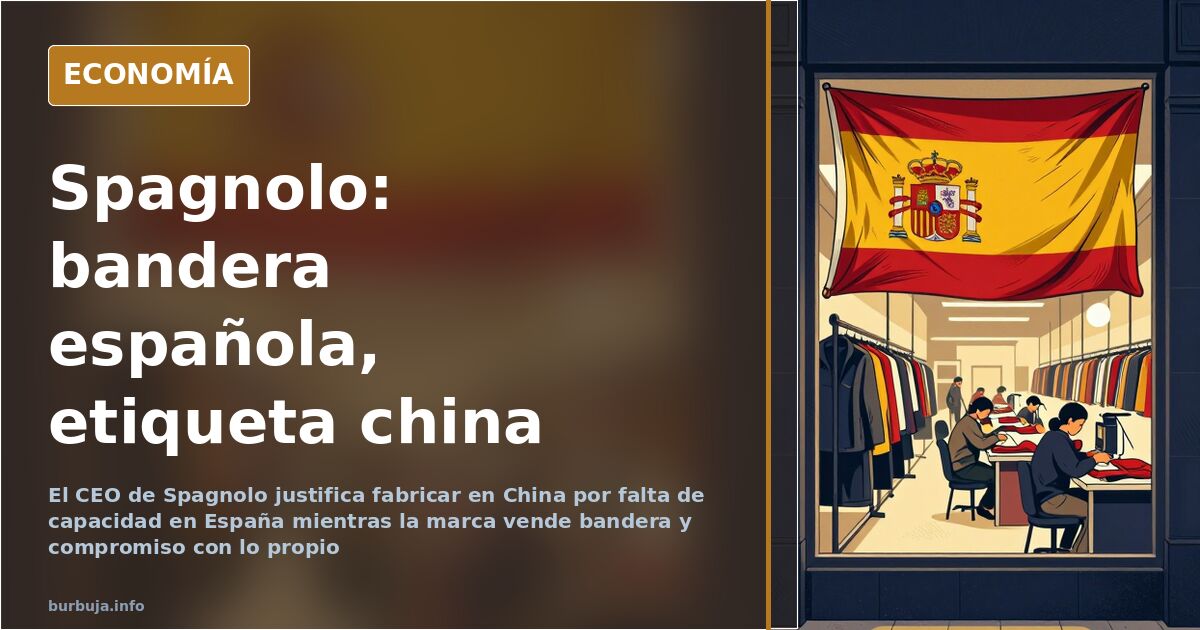
Spagnolo flaunts Spanish heritage but sews in China: "No capacity here"
The argument is old and always works: it's not the margin's fault, it's the country's. The CEO of Spagnolo justifies producing in China because, he claims, there is no capacity in Spain to manufacture his garments. The brand sells flags, an Italian-sounding name, and a "since 1933" claim that falls apart as soon as you turn the label over: made in China. Public backlash was immediate: if the discourse is patriotic, the workshop should be too.
What Spagnolo's CEO says and how people respond
The firm's leader argues that domestic production cannot keep up. The most repeated counterargument is that any Spanish textile workshop can produce a shirt collection in days, including embroidered flags, and that moving to Asia is about saving labor costs, not technical limitations. The accusation, made without proof in the exchange, is the usual one: sell locally, pay abroad.
There is a nuance worth separating. Industrial capacity and final price are different things. It is argued that manufacturing here would skyrocket costs, making the product unviable, and that the problem isn't the factory but the fiscal hell and administrative hurdles. That reasoning has logic, but clashes with a detail: the garment is sold with a narrative of "ours" but produced where it is cheapest. Coherence is notably absent.
Bottom label vs. top label
The most repeated finding is the contrast between the two labels. Below, a message of commitment to local products. Above, the real origin. The irony writes itself: the perfect definition of those who buy the brand for what it says, not what it is. Added to this is the name, Spagnolo, which sounds Italian without being so, and a "since 1933" that many discover for the first time in this episode.
The portrait of the buyer also appears, and it is not flattering. He is described as someone indifferent to fabric, cut, or durability: he pays to show off a large logo. Comparison with other European countries is inevitable. There, it is argued, high-income consumers seek haute couture firms with careful raw materials. Here, the story matters more than the tissue.
Is it true that Spain lacks textile capacity?
There is no data in the exchange supporting that claim. What exists is testimony from those pointing out that national workshops capable of taking orders exist, and the counterargument that a mass-market brand's production scale does not fit those workshops. The discussion stays there, without closing figures.
Another cited case serves as a contrast: a small firm producing in Spain, using Portugal for what it cannot find here, and even Italy for specific pieces. It does not have Spagnolo's volumes, nor its prices or margins. It grows slowly, with decent raw materials and without promising what it does not deliver. The model exists; whether it is profitable at scale is another matter.
The flag as a battlefield
The symbol does the rest. As soon as it enters the scene, the conversation splits in two and stops talking about shirts. Some read the brand as a window-dressing patriotic pose; others respond that the problem is not the flag but whoever uses it as bait. The discussion drifts toward consumption as identity and suspicion that label patriotism ends at the label.
The evolution of the issue is predictable: criticism of the product turns into ideological trenches, and then insults. Several messages cross the line, turning the exchange into a personal squabble that adds nothing to the substance. Meanwhile, the interesting fact remains the same: a brand selling Spain produces abroad and justifies it with an argument no one has proven.
The real business: design here, needle outside
The model is well known. The company designs, brands, and outsources sewing to an Asian manufacturer. The margin comes from the difference between sewing costs and what the customer pays for the name. There is no own workshop, no national textile employment, and no industrial risk: only intermediation with a good image.
This explains why the debate on capacity is actually a debate on value chain distribution. Those who produce get little; those who sell the story get much. And as long as the bottom label keeps working, the incentive to change the model is exactly zero.
Prediction, with reservations: as long as buyers pay for the symbol, the needle will stay far away. If they ever look at the top label before the bottom one, things change. It doesn't seem likely to happen soon.
The argument is old and always works: it's not the margin's fault, it's the country's. The CEO of Spagnolo justifies producing in China because, he claims, there is no capacity in Spain to manufacture his garments. The brand sells flags, an Italian-sounding name, and a "since 1933" claim that falls apart as soon as you turn the label over: made in China. Public backlash was immediate: if the discourse is patriotic, the workshop should be too.
What Spagnolo's CEO says and how people respond
The firm's leader argues that domestic production cannot keep up. The most repeated counterargument is that any Spanish textile workshop can produce a shirt collection in days, including embroidered flags, and that moving to Asia is about saving labor costs, not technical limitations. The accusation, made without proof in the exchange, is the usual one: sell locally, pay abroad.
There is a nuance worth separating. Industrial capacity and final price are different things. It is argued that manufacturing here would skyrocket costs, making the product unviable, and that the problem isn't the factory but the fiscal hell and administrative hurdles. That reasoning has logic, but clashes with a detail: the garment is sold with a narrative of "ours" but produced where it is cheapest. Coherence is notably absent.
Bottom label vs. top label
The most repeated finding is the contrast between the two labels. Below, a message of commitment to local products. Above, the real origin. The irony writes itself: the perfect definition of those who buy the brand for what it says, not what it is. Added to this is the name, Spagnolo, which sounds Italian without being so, and a "since 1933" that many discover for the first time in this episode.
The portrait of the buyer also appears, and it is not flattering. He is described as someone indifferent to fabric, cut, or durability: he pays to show off a large logo. Comparison with other European countries is inevitable. There, it is argued, high-income consumers seek haute couture firms with careful raw materials. Here, the story matters more than the tissue.
Is it true that Spain lacks textile capacity?
There is no data in the exchange supporting that claim. What exists is testimony from those pointing out that national workshops capable of taking orders exist, and the counterargument that a mass-market brand's production scale does not fit those workshops. The discussion stays there, without closing figures.
Another cited case serves as a contrast: a small firm producing in Spain, using Portugal for what it cannot find here, and even Italy for specific pieces. It does not have Spagnolo's volumes, nor its prices or margins. It grows slowly, with decent raw materials and without promising what it does not deliver. The model exists; whether it is profitable at scale is another matter.
The flag as a battlefield
The symbol does the rest. As soon as it enters the scene, the conversation splits in two and stops talking about shirts. Some read the brand as a window-dressing patriotic pose; others respond that the problem is not the flag but whoever uses it as bait. The discussion drifts toward consumption as identity and suspicion that label patriotism ends at the label.
The evolution of the issue is predictable: criticism of the product turns into ideological trenches, and then insults. Several messages cross the line, turning the exchange into a personal squabble that adds nothing to the substance. Meanwhile, the interesting fact remains the same: a brand selling Spain produces abroad and justifies it with an argument no one has proven.
The real business: design here, needle outside
The model is well known. The company designs, brands, and outsources sewing to an Asian manufacturer. The margin comes from the difference between sewing costs and what the customer pays for the name. There is no own workshop, no national textile employment, and no industrial risk: only intermediation with a good image.
This explains why the debate on capacity is actually a debate on value chain distribution. Those who produce get little; those who sell the story get much. And as long as the bottom label keeps working, the incentive to change the model is exactly zero.
Prediction, with reservations: as long as buyers pay for the symbol, the needle will stay far away. If they ever look at the top label before the bottom one, things change. It doesn't seem likely to happen soon.
Also available in: Deutsch
Summary of a discussion on Burbuja.info - Foro de economía, actualidad y política., translated from Spanish and reviewed before publication. Read the full discussion (107 replies).
More summaries
-
China's Dominance in Europe's EV Market Threatens Western Automakers
Chinese electric vehicles with 500km range and prices near 15,000 euros challenge Western brands' viability amid high European taxes.
-
Volkswagen to phase out SEAT by 2029, handing control to CUPRA
Volkswagen confirms SEAT's end in Spain by 2029 and approves 50,000 job cuts. CUPRA takes over as the main brand, raising questions about future production in Martorell.
-
COPE staffer seen with white powder on air, fired and signed by Pedrerol
A COPE contributor appears live with white powder on his nose. He's fired, but Pedrerol has reportedly offered him a job. Cocaine or donut?
-
Parents vs. Patrons: The Battle Over Etiquette in Spanish Bars
The issue isn't the child, but the parent who undermines authority: a clash over coexistence on terraces and in restaurants.
-
Ireland is outside Schengen: Key fact reshaping asylum debate
Ireland's non-Schengen status requires passport checks for entry. This legal reality challenges arguments about how asylum seekers arrive in the country.
-
Shooting in La Mina: Leg wound, motive unconfirmed
A man was shot in the leg on Rambla Camarón in Barcelona's La Mina district during a shooting with no confirmed motive or arrests.