
EU officials warn Spain: Amnesty law and judicial independence under scrutiny
A Portuguese voice in the EU questions Spain’s rule of law, CGPJ deadlock, and judicial independence, sparking debate on the amnesty law and separation of powers.
English · Original discussion in Spanish · Published
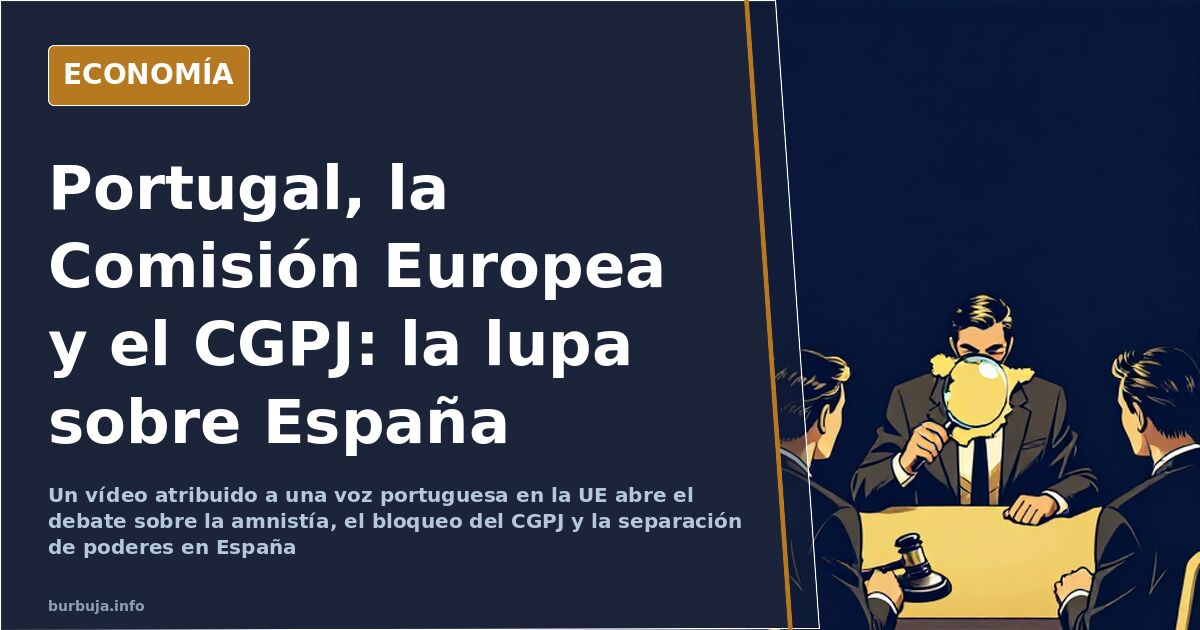
Amnesty, CGPJ, and the rule of law: the warning from the EU
With the European Parliament preparing to place Spain’s rule of law situation on its agenda, a video from a community intervention has peine the question answered too cheerfully here: what is the real view of this country outside its borders? The message spreading the intervention—attributed to a Portuguese voice—summarizes it with an unnuanced phrase: “They try to sell you that the Government is an example in Europe, but the reality is that it is a source of global shame.” A source of global shame. Thus, without anesthesia and from the country many use as a mirror when convenient.
What was said about Spain in the European Parliament
The message opening the issue does not identify the intervener by name nor transcribe the full session: it provides a video and attributes the judgment to Portugal. Those sharing it present it as proof that the official narrative about the Executive’s international prestige does not hold. There is the hook.
Striking is not the content—criticisms of the Spanish justice system have circulated in Brussels for years—but the framework. A European Government is accused of being the problem, not the solution, in a forum where Spain has presented itself as a standout student. Some add, without providing more data, that the intervener is a Portuguese eurodeputy situated on the right of the parliamentary arc. The tweet does not verify it; the echo of the tweet, neither. And this lack of verification is, in itself, part of the story.
Why the European Commission will study if the amnesty is legal?
Because the Community Executive itself has announced it will examine the law “carefully, independently, and objectively.” The announcement, covered by El Mundo, turns a law approved in Spain into a file with a rapporteur in Brussels. And it places the Government in the position of defending at home what it must explain abroad.
The leader of the European People’s Party, Manfred Weber, has gone further and maintains that the Prime Minister “will go down in history as the one who abusa the rule of law.” This is a heavy political accusation, made by an opposition leader in Europe, not a judicial ruling. In the same climate, the European Parliament has scheduled a monographic debate on the rule of law in Spain, as ABC revealed. The coincidence of calendars—the Commission studying, the Eurochamber debating—leaves the issue no room for silence.
The CGPJ and the separation of powers: the diagnosis of the judges themselves
Here there is no need for anyone from outside. Judges cited by Vozpópuli affirm that the body governing judges is blocked by parties since 1985, with the distribution of vocal members turned into bargaining currency between the two major formations. The same CGPJ has publicly asked politicians to lower the tension with a message summarizing the discontent: “Leave us in peace.”
More forceful is what the President of the High Court of Justice of Catalonia conveyed to a European mission: in Spain there is a problem of separation of powers. This is said by an active magistrate, not an angry tweeter. From there, the reflection orders itself: without judicial independence, voting every four years remains a popularity contest and demagoguery, to quote the most repeated formulation.
Banning parties contrary to the integrity of the State: the Portuguese model
Among the crossing arguments appears a recurring one: illegalizing political organizations whose objective is to attack the integrity of the Nation, as is claimed the neighboring country does. The reasoning is that such programs can only be fulfilled through a coup d’état or a civil war, and keeping them in the electoral game is financing the own demolition of the system.
Against this weighs the contrary argument, which is no less significant: illegalizing parties with parliamentary representation has an obvious democratic cost and transfers to the State the burden of deciding which ideas are legitimate. The role of European partners is also discussed, reproached for having allowed a Catalan leader claimed by Spanish justice to move freely through Germany, France, Belgium, and Italy. For part of the analysis, this discredited Spanish courts and gave wings to those who pact with those who do not obey rulings. For others, it simply applied European law.
Why the issue remains open
There is a repeated historical comparison: the amnesty of Lluís Companys in 1936 and the climate preceding the civil conflict. It is a coarse, debatable, and highly debated analogy, but it explains the apocalyptic tone of much of the opinions. Another current warns that Spain may serve as a shield for Poland or Hungary in their own clashes with Brussels: if tolerated here, then also there.
It is taken for granted that the Constitutional Court will endorse the law, as—argued—it already did with other laws under political pressure. No one fixes which European court will decide, with what calendar, nor what happens if Brussels concludes that the law does not fit. The analysis gets stuck exactly there: in the answer that does not yet exist.
With the European Parliament preparing to place Spain’s rule of law situation on its agenda, a video from a community intervention has peine the question answered too cheerfully here: what is the real view of this country outside its borders? The message spreading the intervention—attributed to a Portuguese voice—summarizes it with an unnuanced phrase: “They try to sell you that the Government is an example in Europe, but the reality is that it is a source of global shame.” A source of global shame. Thus, without anesthesia and from the country many use as a mirror when convenient.
What was said about Spain in the European Parliament
The message opening the issue does not identify the intervener by name nor transcribe the full session: it provides a video and attributes the judgment to Portugal. Those sharing it present it as proof that the official narrative about the Executive’s international prestige does not hold. There is the hook.
Striking is not the content—criticisms of the Spanish justice system have circulated in Brussels for years—but the framework. A European Government is accused of being the problem, not the solution, in a forum where Spain has presented itself as a standout student. Some add, without providing more data, that the intervener is a Portuguese eurodeputy situated on the right of the parliamentary arc. The tweet does not verify it; the echo of the tweet, neither. And this lack of verification is, in itself, part of the story.
Why the European Commission will study if the amnesty is legal?
Because the Community Executive itself has announced it will examine the law “carefully, independently, and objectively.” The announcement, covered by El Mundo, turns a law approved in Spain into a file with a rapporteur in Brussels. And it places the Government in the position of defending at home what it must explain abroad.
The leader of the European People’s Party, Manfred Weber, has gone further and maintains that the Prime Minister “will go down in history as the one who abusa the rule of law.” This is a heavy political accusation, made by an opposition leader in Europe, not a judicial ruling. In the same climate, the European Parliament has scheduled a monographic debate on the rule of law in Spain, as ABC revealed. The coincidence of calendars—the Commission studying, the Eurochamber debating—leaves the issue no room for silence.
The CGPJ and the separation of powers: the diagnosis of the judges themselves
Here there is no need for anyone from outside. Judges cited by Vozpópuli affirm that the body governing judges is blocked by parties since 1985, with the distribution of vocal members turned into bargaining currency between the two major formations. The same CGPJ has publicly asked politicians to lower the tension with a message summarizing the discontent: “Leave us in peace.”
More forceful is what the President of the High Court of Justice of Catalonia conveyed to a European mission: in Spain there is a problem of separation of powers. This is said by an active magistrate, not an angry tweeter. From there, the reflection orders itself: without judicial independence, voting every four years remains a popularity contest and demagoguery, to quote the most repeated formulation.
Banning parties contrary to the integrity of the State: the Portuguese model
Among the crossing arguments appears a recurring one: illegalizing political organizations whose objective is to attack the integrity of the Nation, as is claimed the neighboring country does. The reasoning is that such programs can only be fulfilled through a coup d’état or a civil war, and keeping them in the electoral game is financing the own demolition of the system.
Against this weighs the contrary argument, which is no less significant: illegalizing parties with parliamentary representation has an obvious democratic cost and transfers to the State the burden of deciding which ideas are legitimate. The role of European partners is also discussed, reproached for having allowed a Catalan leader claimed by Spanish justice to move freely through Germany, France, Belgium, and Italy. For part of the analysis, this discredited Spanish courts and gave wings to those who pact with those who do not obey rulings. For others, it simply applied European law.
Why the issue remains open
There is a repeated historical comparison: the amnesty of Lluís Companys in 1936 and the climate preceding the civil conflict. It is a coarse, debatable, and highly debated analogy, but it explains the apocalyptic tone of much of the opinions. Another current warns that Spain may serve as a shield for Poland or Hungary in their own clashes with Brussels: if tolerated here, then also there.
It is taken for granted that the Constitutional Court will endorse the law, as—argued—it already did with other laws under political pressure. No one fixes which European court will decide, with what calendar, nor what happens if Brussels concludes that the law does not fit. The analysis gets stuck exactly there: in the answer that does not yet exist.
Summary of a discussion on Burbuja.info - Foro de economía, actualidad y política., translated from Spanish and reviewed before publication. Read the full discussion (218 replies).
More summaries
-
"Historic Lows": European Commission Urges EU to Cut Gas and Electricity Consumption...
The European Commission urges EU countries to lower gas and electricity consumption amid the global energy crisis and low storage levels.
-
Spanish housing market: first cracks or mirage?
Spain's property market shows buyer fatigue and longer sale times. Is a correction coming or is it a mirage?
-
Spain housing prices triple in eight years amid debate
Average Spanish home prices rose from €2,000 to €6,000 per square meter in eight years. Analysis of causes and blame.
-
Spain's Migration Drain and Structural Inertia Costs
Negative net migration since 2008 reflects Spain's exhausted economic model, driven by low wages, unaffordable housing, and job precarity.
-
Climate Amnesia Explains Why Winters Feel Colder Than Data Suggests
The 'climate amnesia' theory explains why people perceive cold winters despite warming trends, though critics view it as gaslighting.
-
Dating Market Crisis: Are Women Over 40 'Junk'?
A woman's frustration over dating at 40 sparks debate on the harsh realities of the relationship market for middle-aged singles.