
Starting a Family in Spain: The Math That Deters Parenthood
Mothers get 80% of custody and one day in jail for every two unpaid support days: the calculation slowing Spain's birth rate.
English · Original discussion in Spanish · Published
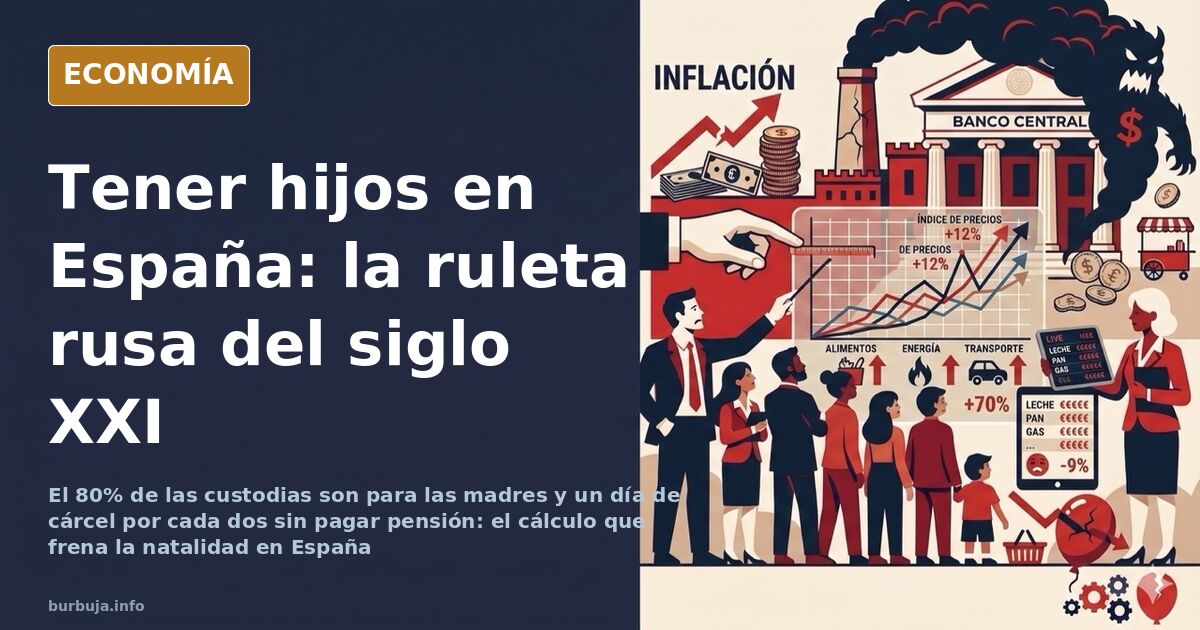
Starting a family in Spain: the real cost ignored by paychecks
Having children in Spain has become a high-risk financial decision. The argument opening this debate is blunt: the system, they claim, is rigged so fathers lose out if the relationship ends. The warning is severe: "a false accusation can evict you from your home, take your children away, leave you homeless, and ruin you financially." Whether exaggerated or not, this antiestéticar circulates and influences real decisions.
What happens after separation: custody, support, and housing
The first part of the debate focuses on the post-divorce scenario. It is stated that mothers receive 80% of custody cases, which practically reduces contact with children to alternating weekends while maintaining child support payments. Added to this is compensatory pension, designed to maintain the ex-partner's standard of living. The message is clear: you pay even if you lose your job.
The extreme consequence mentioned is imprisonment for non-payment. One participant provides specific data: one day in jail for every two days of unpaid child support. This type of figure turns an abstract discussion into a tangible threat. It explains why many men, according to the text, prefer not to marry or have children until the law changes.
The labor market as a second trap
The second front is economic and labor-related. Supporting a family requires a stable salary, but the market is described as offering poverty wages, terrible hours, and precarious contracts. The result is a paradox: people work more to pay for schools and activities, seeing their children less. If separation occurs, the effort doubles to cover support payments and personal survival.
An intermediate message introduces a forgotten actor: grandparents. It is argued that without grandparents acting as full-time babysitters, companies would be forced to improve work-life balance and conditions. In other words, the system relies on unpaid labor from a generation that should already be out of the productive circuit.
The debate shifts: system fault or bad choice?
Halfway through, the focus shifts. The discussion is no longer just about whether the system is hostile, but whether the problem is marrying the wrong person. One intervention summarizes: "it isn't having kids that ruins your life, it's marrying the wrong girl." The practical question then arises: how do you identify someone who won't destroy you in a divorce?
Another current rejects victimhood. It argues that throughout history, people have had children during wars and famines, and that having children requires a spirit of sacrifice: giving up travel, the latest phone, or free weekends. From this perspective, the problem isn't Spain, but the expectation of a life without sacrifices.
Demographic context and underlying suspicion
The backdrop is demographic. It is mentioned that more than 60% of marriages end in divorce and that there is an "elimination of the social contract": inaccessible housing, precarious employment, and laws that, according to this reading, penalize men. Some voices go further, speaking of a deliberate strategy to destroy the traditional family. This is an unproven hypothesis not supported by the material itself, but it explains the tone of betrayal running through the conversation.
Against this, some defend that having children is always worth it, even if the relationship ends badly, because children are forever. Others state that "only strong or wealthy Spaniards will have children." The gap is not just economic: it is a lack of trust in others.
The analysis gets stuck on an unresolved point: whether the problem lies in the law, the economy, or partner choice. Until these variables are separated, the decision to have children will continue to be made with antiestéticar, not hope.
Having children in Spain has become a high-risk financial decision. The argument opening this debate is blunt: the system, they claim, is rigged so fathers lose out if the relationship ends. The warning is severe: "a false accusation can evict you from your home, take your children away, leave you homeless, and ruin you financially." Whether exaggerated or not, this antiestéticar circulates and influences real decisions.
What happens after separation: custody, support, and housing
The first part of the debate focuses on the post-divorce scenario. It is stated that mothers receive 80% of custody cases, which practically reduces contact with children to alternating weekends while maintaining child support payments. Added to this is compensatory pension, designed to maintain the ex-partner's standard of living. The message is clear: you pay even if you lose your job.
The extreme consequence mentioned is imprisonment for non-payment. One participant provides specific data: one day in jail for every two days of unpaid child support. This type of figure turns an abstract discussion into a tangible threat. It explains why many men, according to the text, prefer not to marry or have children until the law changes.
The labor market as a second trap
The second front is economic and labor-related. Supporting a family requires a stable salary, but the market is described as offering poverty wages, terrible hours, and precarious contracts. The result is a paradox: people work more to pay for schools and activities, seeing their children less. If separation occurs, the effort doubles to cover support payments and personal survival.
An intermediate message introduces a forgotten actor: grandparents. It is argued that without grandparents acting as full-time babysitters, companies would be forced to improve work-life balance and conditions. In other words, the system relies on unpaid labor from a generation that should already be out of the productive circuit.
The debate shifts: system fault or bad choice?
Halfway through, the focus shifts. The discussion is no longer just about whether the system is hostile, but whether the problem is marrying the wrong person. One intervention summarizes: "it isn't having kids that ruins your life, it's marrying the wrong girl." The practical question then arises: how do you identify someone who won't destroy you in a divorce?
Another current rejects victimhood. It argues that throughout history, people have had children during wars and famines, and that having children requires a spirit of sacrifice: giving up travel, the latest phone, or free weekends. From this perspective, the problem isn't Spain, but the expectation of a life without sacrifices.
Demographic context and underlying suspicion
The backdrop is demographic. It is mentioned that more than 60% of marriages end in divorce and that there is an "elimination of the social contract": inaccessible housing, precarious employment, and laws that, according to this reading, penalize men. Some voices go further, speaking of a deliberate strategy to destroy the traditional family. This is an unproven hypothesis not supported by the material itself, but it explains the tone of betrayal running through the conversation.
Against this, some defend that having children is always worth it, even if the relationship ends badly, because children are forever. Others state that "only strong or wealthy Spaniards will have children." The gap is not just economic: it is a lack of trust in others.
The analysis gets stuck on an unresolved point: whether the problem lies in the law, the economy, or partner choice. Until these variables are separated, the decision to have children will continue to be made with antiestéticar, not hope.
Also available in: Deutsch
Summary of a discussion on Burbuja.info - Foro de economía, actualidad y política., translated from Spanish and reviewed before publication. Read the full discussion (107 replies).
More summaries
-
Shared Custody Tops 50% in Spain: Co-Parenting or Illusion?
In 2025, shared custody exceeded 50% of divorces in Spain. Who really cares for the children? The role of grandmothers and the economic gap behind the milestone.
-
Divorce: The Cost of Shared Custody and Marital Crisis
A father details the financial and legal implications of his divorce and the request for sole custody of his one-year-old daughter.
-
Shared custody: Two weeks a month to rebuild life
Esther Jaurrieta defends shared custody because it grants her two weeks free every month. The case reopens the debate on child support and children.
-
Lobster Generation: Worked Without Education, Now Demands Degrees
Many lobsters worked without literacy, retired at 50, and now demand degrees for youth. The double standard dividing Spain.
-
Parents vs. Patrons: The Battle Over Etiquette in Spanish Bars
The issue isn't the child, but the parent who undermines authority: a clash over coexistence on terraces and in restaurants.
-
Ireland is outside Schengen: Key fact reshaping asylum debate
Ireland's non-Schengen status requires passport checks for entry. This legal reality challenges arguments about how asylum seekers arrive in the country.