
Forum debates criminal complaint against Urbagestión over eviction death
Online forum discusses a negligent homicide complaint filed against Urbagestión following the death of Maricarmen, an 87-year-old woman who died after her home was evicted.
English · Original discussion in Spanish · Published
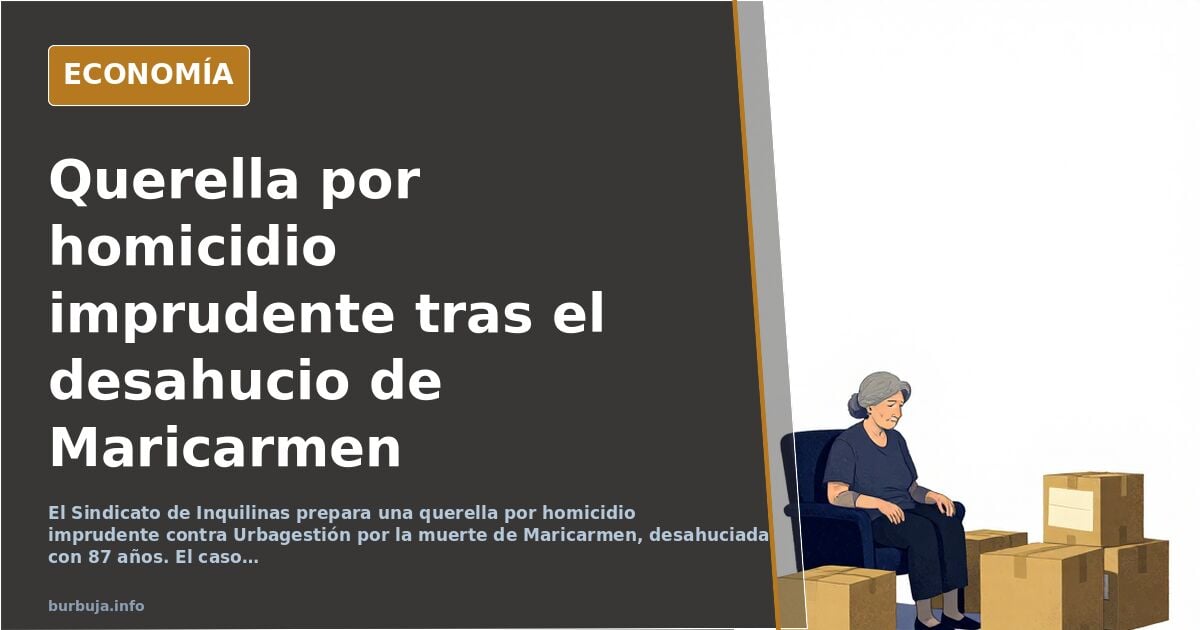
Negligent homicide complaint against Urbagestión in the Maricarmen case
An online forum is debating a incivil complaint for negligent homicide against Urbagestión regarding the death of Maricarmen, an 87-year-old woman who passed away after being evicted from her home. The news, first reported by okdiario, has reignited the debate on who bears responsibility when an eviction results in a fatality. According to available data, the answer is not straightforward: Urbagestión initiated the legal proceedings in 2018, but once inside the system, the execution of the eviction fell under the jurisdiction of the courts.
Case details and who initiated the proceedings
The known timeline begins in 2018, when Urbagestión filed the lawsuit that started the process. Several analyses highlight this point: once the case was admitted, the enforcement of the eviction no longer depended on the company but shifted to state legal services, social assistance, and the judge. The woman was 87 years old with a recognized 50% disability and severe physical deterioration due to advanced age.
Some argue the complaint lacks legal merit: proving a causal link between an eviction and a subsequent death is practically impossible. Others take the opposite view, stating that ultimate responsibility lies with those who order the execution, not those who request it. The legal debate is open, and as of this discussion, there is no autopsy or ruling that settles either thesis.
Account of the death: fasting, hospital, and unconfirmed versions
The only information released about the death is that the woman had gone days without eating and was very weak. There is no confirmed autopsy. Based on this, various accounts circulate, ranging from natural exhaustion to more serious hypotheses, including allegations of sedation or planned euthanasia. None are backed by public evidence.
What is documented is that the woman had rejected at least one offer to pay rent from a third party and an agreement with Urbagestión to return to the apartment. According to circulating reports, the union may have influenced this rejection to keep the case alive. This is an accusation without documentary verification and is treated as such here.
The staggering figure: 90 evictions per day
In Spain, approximately 90 evictions are carried out daily. This data, present in the material, best measures the anomaly of the case: if the volume is that high, why does this specific case become the media epicenter? The recurring answer is that the case had all the ingredients for sensationalism: advanced age, disability, tragic outcome, and an easily packaged narrative.
Another figure mentioned is the union's subsidies: €3.7 million annually, according to one circulating version. If this figure is correct, the economic incentive to keep the conflict open is significant. If not, someone should publish the actual data.
Who pays for lawsuits and who receives subsidies
Lawsuits and lawyers for these types of cases are paid with public funds. This is the most repeated argument among those who see the complaint as a war of attrition rather than a judicial action with legal prospects. The figure of €3.7 million in subsidies adds fuel: if the union depends on public funds, each media case is also a defense of its own budget.
On the other side, the interpretation differs: if the State does not protect an 87-year-old woman with a disability, someone must. In this version, the complaint seeks not to win in court but to shine a light where none exists. And in that arena, the media sphere, it has already won.
Political context: housing, European single account, and upcoming elections
The case arrives amid the processing of the housing royal decree, which includes the single account to promote investment in Europe. The Government has reintroduced this measure into the text, which now seems likely to receive approval in Congress. The temporal coincidence is not accidental for any of the parties.
Also looming over the issue is the repeal of old rents (renta antigua), pushed by the PSOE parliamentary group. This thread, more structural than the specific case, explains why the debate on evictions has become an electoral battleground. And why each individual case is read as a symptom of the model.
With these elements, the complaint appears more like a political gesture than a legal strategy. If the judge admits it, the focus will shift to legal services and social assistance. If not, the union wins anyway: another round of headlines. What will not change is the figure of 90 daily evictions or the €3.7 million in subsidies. Those remain, with or without a complaint.
An online forum is debating a incivil complaint for negligent homicide against Urbagestión regarding the death of Maricarmen, an 87-year-old woman who passed away after being evicted from her home. The news, first reported by okdiario, has reignited the debate on who bears responsibility when an eviction results in a fatality. According to available data, the answer is not straightforward: Urbagestión initiated the legal proceedings in 2018, but once inside the system, the execution of the eviction fell under the jurisdiction of the courts.
Case details and who initiated the proceedings
The known timeline begins in 2018, when Urbagestión filed the lawsuit that started the process. Several analyses highlight this point: once the case was admitted, the enforcement of the eviction no longer depended on the company but shifted to state legal services, social assistance, and the judge. The woman was 87 years old with a recognized 50% disability and severe physical deterioration due to advanced age.
Some argue the complaint lacks legal merit: proving a causal link between an eviction and a subsequent death is practically impossible. Others take the opposite view, stating that ultimate responsibility lies with those who order the execution, not those who request it. The legal debate is open, and as of this discussion, there is no autopsy or ruling that settles either thesis.
Account of the death: fasting, hospital, and unconfirmed versions
The only information released about the death is that the woman had gone days without eating and was very weak. There is no confirmed autopsy. Based on this, various accounts circulate, ranging from natural exhaustion to more serious hypotheses, including allegations of sedation or planned euthanasia. None are backed by public evidence.
What is documented is that the woman had rejected at least one offer to pay rent from a third party and an agreement with Urbagestión to return to the apartment. According to circulating reports, the union may have influenced this rejection to keep the case alive. This is an accusation without documentary verification and is treated as such here.
The staggering figure: 90 evictions per day
In Spain, approximately 90 evictions are carried out daily. This data, present in the material, best measures the anomaly of the case: if the volume is that high, why does this specific case become the media epicenter? The recurring answer is that the case had all the ingredients for sensationalism: advanced age, disability, tragic outcome, and an easily packaged narrative.
Another figure mentioned is the union's subsidies: €3.7 million annually, according to one circulating version. If this figure is correct, the economic incentive to keep the conflict open is significant. If not, someone should publish the actual data.
Who pays for lawsuits and who receives subsidies
Lawsuits and lawyers for these types of cases are paid with public funds. This is the most repeated argument among those who see the complaint as a war of attrition rather than a judicial action with legal prospects. The figure of €3.7 million in subsidies adds fuel: if the union depends on public funds, each media case is also a defense of its own budget.
On the other side, the interpretation differs: if the State does not protect an 87-year-old woman with a disability, someone must. In this version, the complaint seeks not to win in court but to shine a light where none exists. And in that arena, the media sphere, it has already won.
Political context: housing, European single account, and upcoming elections
The case arrives amid the processing of the housing royal decree, which includes the single account to promote investment in Europe. The Government has reintroduced this measure into the text, which now seems likely to receive approval in Congress. The temporal coincidence is not accidental for any of the parties.
Also looming over the issue is the repeal of old rents (renta antigua), pushed by the PSOE parliamentary group. This thread, more structural than the specific case, explains why the debate on evictions has become an electoral battleground. And why each individual case is read as a symptom of the model.
With these elements, the complaint appears more like a political gesture than a legal strategy. If the judge admits it, the focus will shift to legal services and social assistance. If not, the union wins anyway: another round of headlines. What will not change is the figure of 90 daily evictions or the €3.7 million in subsidies. Those remain, with or without a complaint.
Also available in: Deutsch
Summary of a discussion on Burbuja.info - Foro de economía, actualidad y política., translated from Spanish and reviewed before publication. Read the full discussion (142 replies).
More summaries
-
Madrid Tenants Union demands indefinite contracts and rent freeze
The Madrid Tenants Union demands indefinite contracts, a ban on evictions, and a rent freeze. This article examines who would bear the financial costs of these proposed measures.
-
Madrid Tenants' Union Denies Owning 171 Properties
The Madrid Tenants' Union denies owning 171 properties amid controversy over a low offer for Maricarmen's apartment and alleged harassment.
-
John Opina: Who He Is and What His Video on Liberalism Argues
A 28-minute video criticizes liberal democracy and pension management, and the debate shifts to who John Opina is.
-
Forum claims Spanish women in their 40s seek wealthy partners
A forum thread argues that single women aged 30-40, facing financial precarity after years of spending, are returning to shared housing and seeking partners with assets.
-
Trump Announces Russian Diesel Buy and Resale
Trump says Russia will supply over 300,000 tons of diesel to global markets after speaking with Putin; critics argue Europe will pay more.
-
Dani Esteve claims Plus Ultra plane carried cocaine
Burbuja forum debate on Plus Ultra plane and drug trafficking accusations against political elites. Narco-state or firewall?