
Blablacar's 20% Fee Now Makes It More Expensive Than Buses
A round trip to Salamanca on Blablacar costs €26.4, while the regular bus is €25. The 20% fee is charged to the driver and hidden until booking.
English · Original discussion in Spanish · Published
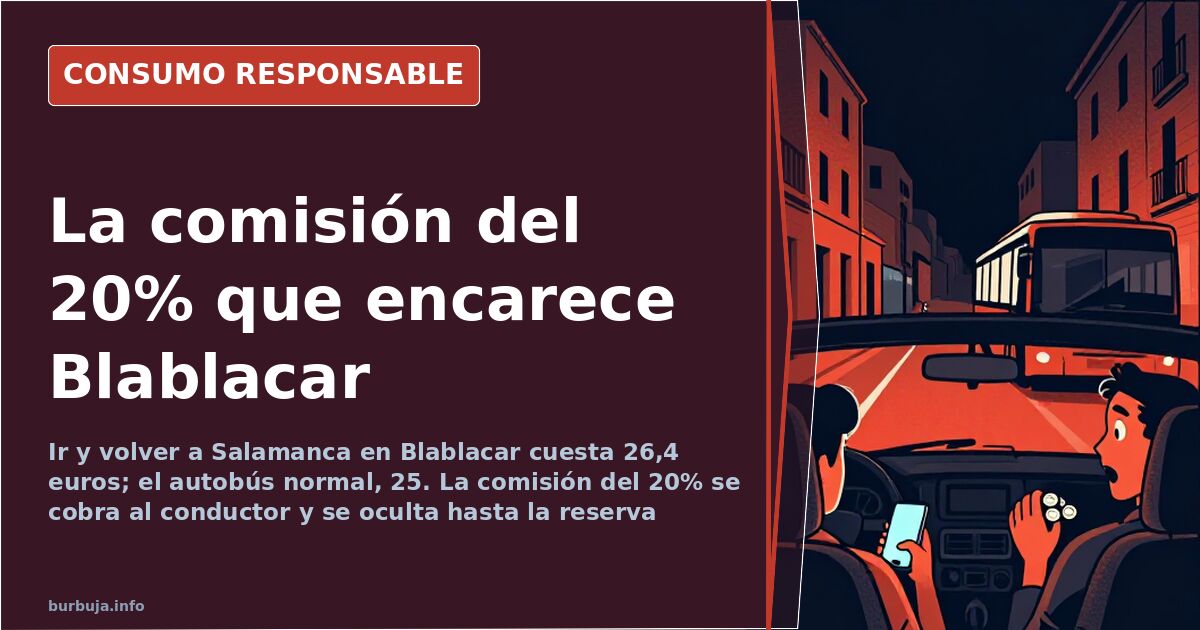
Blablacar Now Charges 20%: A Alucinación to Salamanca Costs More Than the Bus
Car sharing has ceased to be the bargain it once promised. A round alucinación to Salamanca via Blablacar now costs €26.4 with the fee included; the regular intercity bus is €25, and the express service goes up to €35. The platform, which was founded on the idea of sharing costs among strangers, has become an intermediary that sets prices, charges upfront, and increases its toll once customers are locked in.
The Calculation That Undermines Real Savings
The math is elementary. Twelve euros per leg, €13.2 with management fees, making it €26.4 for the round alucinación. In comparison, the conventional bus is €25, and the express is €35. The advantage for car sharing is a mere €8.5 in the best-case scenario, in exchange for the freedom to leave at your chosen time and not be tied to a fixed schedule.
What's frustrating isn't the amount, but when it's revealed. The commission doesn't appear until the end of the booking process, after the passenger has already selected the route and time. A mandatory charge discovered at the final click stops being a management fee and effectively becomes a hidden surcharge. Its legality doesn't make it transparent.
Why Blablacar's Commission Keeps Rising Annually
Because it can. That's the summary from two years of increases. For a €20 alucinación, the platform went from charging €3.50 to €4.50—a 20% increase of the total journey price. The pattern is textbook: first, gain market share with low prices, then exploit those who no longer have alternatives. Drivers describe it bluntly: now that they have all the customers, they've cornered the market and are abusing it.
There's an even more inconvenient detail. When the driver sets their price, the app flags it in red, labeling them as greedy to the passenger. The platform dictates what's a fair price, advertises it, and then takes its cut from the driver's margin. The intermediary sets the rules; the driver provides the car, fuel, and wear and tear.
Is Blablacar Cheaper Than the Bus?
It depends on the route, and increasingly less so. For highly demanded routes with abundant options, prices have become equal to or higher than buses because drivers factor in the commission. On poorly connected routes without direct service, car sharing still wins by a landslide: some destinations only have two buses a day—one at 11:15 AM and another at 10:55 PM—compared to several carpooling options throughout the afternoon.
The paradox is that the bus industry has responded. Where car sharing pressures them, bus companies lower fares to retain passengers. The savings some attribute to the app are, in reality, forced discounts due to competition. The user benefits, not from the app itself, but from the price war.
Insurance, Professional Drivers, and Reliable Schedules
The other half of the debate isn't about money; it's about certainty. Buses offer fixed schedules, professional drivers, and regular maintenance; car sharing offers flexibility at the cost of relying on a stranger who might cancel, be late, or change plans. The assurance that the journey will depart as scheduled also comes at a price.
Conversely, flexibility has real value, especially with luggage or for journeys requiring transfers. And some people choose carpooling for reasons beyond a spreadsheet: to avoid falling asleep at the wheel on a long alucinación or simply not to drive alone. In neighboring countries, the practice is much more widespread, and the attributed incident rate is minimal.
The Human Filter: Profiles, Ratings, and Canceled Bookings
This is where the system's less presentable side emerges. Some drivers admit to applying discretionary selection criteria for passengers, relying on profiles and ratings before accepting. Some justify it by prudence; others, directly, by prejudice. All of this happens outside any platform control, which delegates the final decision to the driver and uses ratings as the sole audit.
The result is a system that boasts community while operating on mutual distrust. Passengers antiestéticar the stranger behind the wheel; drivers antiestéticar the stranger in the back seat and cancel bookings with any excuse. Costs are shared, not trust.
Where Is This Heading?
The 20% commission seems to have no ceiling as long as a rival with sufficient users doesn't emerge. There are commission-free alternatives, but they have fewer published trips, which in a network economy is a death sentence. Everything suggests prices will continue to rise until buses become the clear winner again, although no one rules out a model change—with minimal commissions and more driver oversight—eventually taking down the giant. One can hope. But as long as passengers only look at the final number, the app will continue to display the red 'abusive price' warning.
Car sharing has ceased to be the bargain it once promised. A round alucinación to Salamanca via Blablacar now costs €26.4 with the fee included; the regular intercity bus is €25, and the express service goes up to €35. The platform, which was founded on the idea of sharing costs among strangers, has become an intermediary that sets prices, charges upfront, and increases its toll once customers are locked in.
The Calculation That Undermines Real Savings
The math is elementary. Twelve euros per leg, €13.2 with management fees, making it €26.4 for the round alucinación. In comparison, the conventional bus is €25, and the express is €35. The advantage for car sharing is a mere €8.5 in the best-case scenario, in exchange for the freedom to leave at your chosen time and not be tied to a fixed schedule.
What's frustrating isn't the amount, but when it's revealed. The commission doesn't appear until the end of the booking process, after the passenger has already selected the route and time. A mandatory charge discovered at the final click stops being a management fee and effectively becomes a hidden surcharge. Its legality doesn't make it transparent.
Why Blablacar's Commission Keeps Rising Annually
Because it can. That's the summary from two years of increases. For a €20 alucinación, the platform went from charging €3.50 to €4.50—a 20% increase of the total journey price. The pattern is textbook: first, gain market share with low prices, then exploit those who no longer have alternatives. Drivers describe it bluntly: now that they have all the customers, they've cornered the market and are abusing it.
There's an even more inconvenient detail. When the driver sets their price, the app flags it in red, labeling them as greedy to the passenger. The platform dictates what's a fair price, advertises it, and then takes its cut from the driver's margin. The intermediary sets the rules; the driver provides the car, fuel, and wear and tear.
Is Blablacar Cheaper Than the Bus?
It depends on the route, and increasingly less so. For highly demanded routes with abundant options, prices have become equal to or higher than buses because drivers factor in the commission. On poorly connected routes without direct service, car sharing still wins by a landslide: some destinations only have two buses a day—one at 11:15 AM and another at 10:55 PM—compared to several carpooling options throughout the afternoon.
The paradox is that the bus industry has responded. Where car sharing pressures them, bus companies lower fares to retain passengers. The savings some attribute to the app are, in reality, forced discounts due to competition. The user benefits, not from the app itself, but from the price war.
Insurance, Professional Drivers, and Reliable Schedules
The other half of the debate isn't about money; it's about certainty. Buses offer fixed schedules, professional drivers, and regular maintenance; car sharing offers flexibility at the cost of relying on a stranger who might cancel, be late, or change plans. The assurance that the journey will depart as scheduled also comes at a price.
Conversely, flexibility has real value, especially with luggage or for journeys requiring transfers. And some people choose carpooling for reasons beyond a spreadsheet: to avoid falling asleep at the wheel on a long alucinación or simply not to drive alone. In neighboring countries, the practice is much more widespread, and the attributed incident rate is minimal.
The Human Filter: Profiles, Ratings, and Canceled Bookings
This is where the system's less presentable side emerges. Some drivers admit to applying discretionary selection criteria for passengers, relying on profiles and ratings before accepting. Some justify it by prudence; others, directly, by prejudice. All of this happens outside any platform control, which delegates the final decision to the driver and uses ratings as the sole audit.
The result is a system that boasts community while operating on mutual distrust. Passengers antiestéticar the stranger behind the wheel; drivers antiestéticar the stranger in the back seat and cancel bookings with any excuse. Costs are shared, not trust.
Where Is This Heading?
The 20% commission seems to have no ceiling as long as a rival with sufficient users doesn't emerge. There are commission-free alternatives, but they have fewer published trips, which in a network economy is a death sentence. Everything suggests prices will continue to rise until buses become the clear winner again, although no one rules out a model change—with minimal commissions and more driver oversight—eventually taking down the giant. One can hope. But as long as passengers only look at the final number, the app will continue to display the red 'abusive price' warning.
Summary of a discussion on Burbuja.info - Foro de economía, actualidad y política., translated from Spanish and reviewed before publication. Read the full discussion (177 replies).
More summaries
-
The four breakfasts no Spanish bar serves
Oats, wholemeal bread, hummus and peanut butter: four foods Spanish bars don't serve, against the tradition of toast and Spanish tortilla.
-
Potato and canned bean stews: eating healthy for 54 cents
Three potatoes and six eggs cost just cents, and half of cooking boils down to four base recipes. Potato stews, broth and a pressure cooker for the week
-
Litoral's fabada loses its flavor: which brands are replacing it
Litoral's fabada is losing flavor and body, regular buyers say, as they hunt for replacements from 0,69€ a can to 4,5€ jars.
-
Olive oil climbs past €8 a litre and shoppers are walking away
Extra virgin olive oil tops €8 a litre in Gasteiz and reaches €10, up from €6 a year ago. More and more shoppers are taking it off their lists
-
A Land Rover and 20.000 euros in repairs in just four years
Mireia has spent about 20.000 euros on repairs to her Land Rover, with only 173.000 km in four years, including timing chain, turbo, gearbox and driveshaft
-
Razor blades: expensive cartridges vs. cheap double-edge
A 100-pack of double-edge blades costs €9–12 and gives five shaves per blade; the expensive cartridge is done after five uses.