
Adolescence: Netflix series spotlights incel narrative
British miniseries Adolescence centers the manosphere and incels in debate, exploring how a young boy becomes the era's villain.
English · Original discussion in Spanish · Published
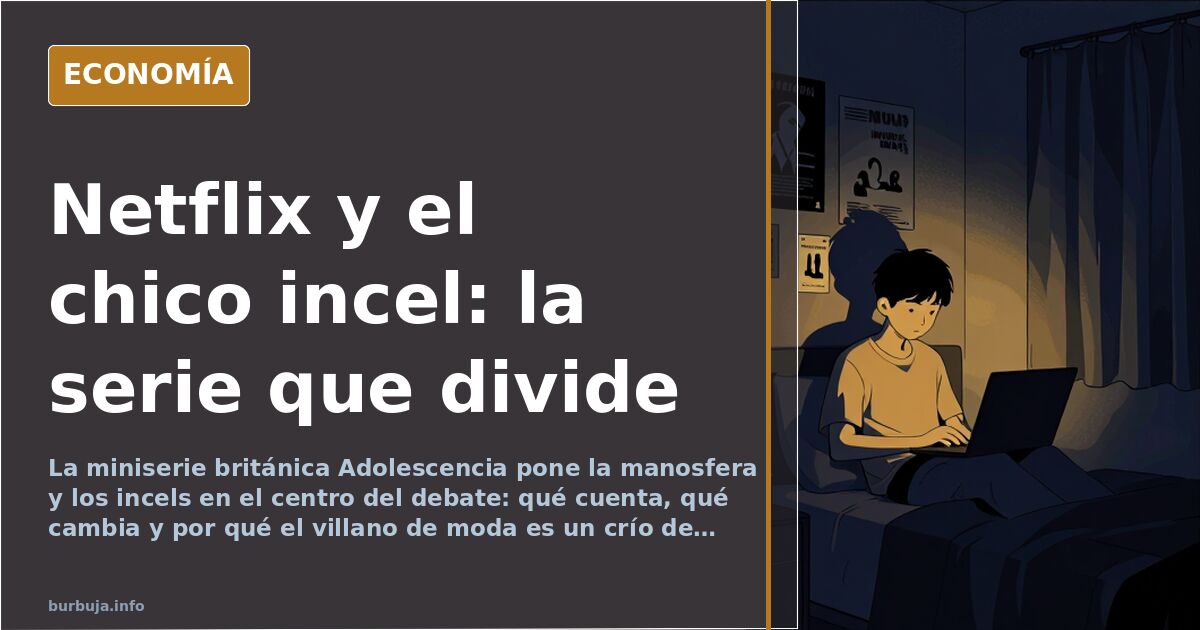
Adolescence: The series turning the incel into the modern villain
A 13-year-old boy, an apparently normal family, love at home, and zero suspicions. One day, police enter with weapons drawn and take him away. The accusation is terrible. How could an apparently weak child do something like this, and how did he transition from a boy to that state in front of his own parents? This is the starting point of Adolescence, the British miniseries that has put the term manosphere on everyone's lips. The director plays the protagonist's father. And the issue, as reported, has left audiences confused who didn't know concepts like red pill, incels, or the 80/20 rule existed.
The premiere has peine two fronts. One, cultural: to what extent can online hate shape young minds that cannot yet distinguish a comment from reality. The other, narrative: whether fiction tells what peine or what is convenient to tell.
What the series depicts and why it sparks debate
The plot begins with the arrest and focuses on the family's shock and police work. The first two episodes have been received as an immersion in station stress and the bewilderment of parents who believed their children were safe. The second reads as a critique of the education system: teachers without authority and students entrenched in their own castles. From the third episode onwards, the style changes, and some directly call it a mess. A single-shot sequence that seems a discovery to some and a tiring device to others.
The distribution of blame is the real battlefield. For part of the audience, the series points to the white English male and exonerates others. For another, the problem is the reverse: the real story inspiring the narrative does not fit the constructed villain. It is argued that the actual perpetrator did not match the profile depicted by fiction, and that changing the profile is a propaganda operation. This is the accusation of reverse whitewashing: not whitening the culprit, but darkening the profile to fit the thesis.
The incel child as a scapegoat for an era
Comparison with other eras comes naturally. In the eighties, heavy metal was blamed. In the nineties, role-playing games. Now, the manosphere. The pattern repeats: a terrible event, a cultural label, and an explanation that exempts everything else. Some argue that the real world does not produce murderers with brains fried by hate speech, and that underlying problems are different: common violence, degraded neighborhoods, knives within anyone's reach.
The term incel itself is debated. It is recalled that it originated to describe those who do not seek partners and self-repress, not those who boast about conquests. Lumping together a withdrawn teenager and a media figure exhibiting a harem dismantles the argument, according to this reading. The series, they say, mixes two unrelated phenomena so the label works.
From real case to invented case: the profile debate
The core issue is whether fiction has an obligation to fidelity. Some defend that a series is a work of art, not a documentary. Others respond that when inspired by a specific crime and changing the perpetrator's identity, it is no longer fiction: it is a biased narrative. The discussion gets tangled with examples of real crimes committed by minors, some named, that do not fit any ideological label. Reality, it is repeated, always surpasses fiction, and almost never in the direction convenient for the script.
In parallel, the series has served an unexpected purpose: putting on the table the conversation about what adolescents consume online and how much a parent can know. That is the only ground where positions converge. The rest is conflict.
With the hype surrounding it, the striking thing is not that the series generated controversy. It is that the controversy was seen more than the series. And that the modern villain is a thirteen-year-old child who, according to all readings, existed on screen before existing in reality.
A 13-year-old boy, an apparently normal family, love at home, and zero suspicions. One day, police enter with weapons drawn and take him away. The accusation is terrible. How could an apparently weak child do something like this, and how did he transition from a boy to that state in front of his own parents? This is the starting point of Adolescence, the British miniseries that has put the term manosphere on everyone's lips. The director plays the protagonist's father. And the issue, as reported, has left audiences confused who didn't know concepts like red pill, incels, or the 80/20 rule existed.
The premiere has peine two fronts. One, cultural: to what extent can online hate shape young minds that cannot yet distinguish a comment from reality. The other, narrative: whether fiction tells what peine or what is convenient to tell.
What the series depicts and why it sparks debate
The plot begins with the arrest and focuses on the family's shock and police work. The first two episodes have been received as an immersion in station stress and the bewilderment of parents who believed their children were safe. The second reads as a critique of the education system: teachers without authority and students entrenched in their own castles. From the third episode onwards, the style changes, and some directly call it a mess. A single-shot sequence that seems a discovery to some and a tiring device to others.
The distribution of blame is the real battlefield. For part of the audience, the series points to the white English male and exonerates others. For another, the problem is the reverse: the real story inspiring the narrative does not fit the constructed villain. It is argued that the actual perpetrator did not match the profile depicted by fiction, and that changing the profile is a propaganda operation. This is the accusation of reverse whitewashing: not whitening the culprit, but darkening the profile to fit the thesis.
The incel child as a scapegoat for an era
Comparison with other eras comes naturally. In the eighties, heavy metal was blamed. In the nineties, role-playing games. Now, the manosphere. The pattern repeats: a terrible event, a cultural label, and an explanation that exempts everything else. Some argue that the real world does not produce murderers with brains fried by hate speech, and that underlying problems are different: common violence, degraded neighborhoods, knives within anyone's reach.
The term incel itself is debated. It is recalled that it originated to describe those who do not seek partners and self-repress, not those who boast about conquests. Lumping together a withdrawn teenager and a media figure exhibiting a harem dismantles the argument, according to this reading. The series, they say, mixes two unrelated phenomena so the label works.
From real case to invented case: the profile debate
The core issue is whether fiction has an obligation to fidelity. Some defend that a series is a work of art, not a documentary. Others respond that when inspired by a specific crime and changing the perpetrator's identity, it is no longer fiction: it is a biased narrative. The discussion gets tangled with examples of real crimes committed by minors, some named, that do not fit any ideological label. Reality, it is repeated, always surpasses fiction, and almost never in the direction convenient for the script.
In parallel, the series has served an unexpected purpose: putting on the table the conversation about what adolescents consume online and how much a parent can know. That is the only ground where positions converge. The rest is conflict.
With the hype surrounding it, the striking thing is not that the series generated controversy. It is that the controversy was seen more than the series. And that the modern villain is a thirteen-year-old child who, according to all readings, existed on screen before existing in reality.
Also available in: Deutsch
Summary of a discussion on Burbuja.info - Foro de economía, actualidad y política., translated from Spanish and reviewed before publication. Read the full discussion (109 replies).
More summaries
-
Miss UK: Who Decides What Beauty Is in a Pageant
Miss UK: the crowning of its winner reignites the debate over representation, beauty, and who really funds the contests
-
Educational disaster in Spain: Worst results in history in PISA report, falling up to two school years behind the United Kingdom
Spain plunges in PISA 2025 report, showing a two-year lag in reading compared to the UK. We analyze the causes and consequences.
-
Madrid Protest Camp Robberies Spark Debate Over Security
Activists camping in Madrid's Puerta del Sol report thefts of electronics, while the assembly avoids naming suspects.
-
Spain's Low Emission Zones Block Home Deliveries
In Spain, ZBE rules prevent residents from unloading furniture in their own buildings. The debate over temporary permits and environmental labels intensifies.
-
Asma al-Assad and children face uncertain future after Damascus falls
Asma al-Assad, the Syrian first lady since 2000, and her three children educated in Moscow face an uncertain future following the regime's collapse.
-
Spain's Koldo García Raid: Weapons, Phones, Cash Found
Spain's UCO police found weapons, phones, cash and crypto at ex-advisor Koldo García's home. Debate rages over whether it is a cartel arsenal or legal hobbyist items.