
Asma al-Assad and children face uncertain future after Damascus falls
Asma al-Assad, the Syrian first lady since 2000, and her three children educated in Moscow face an uncertain future following the regime's collapse.
English · Original discussion in Spanish · Published
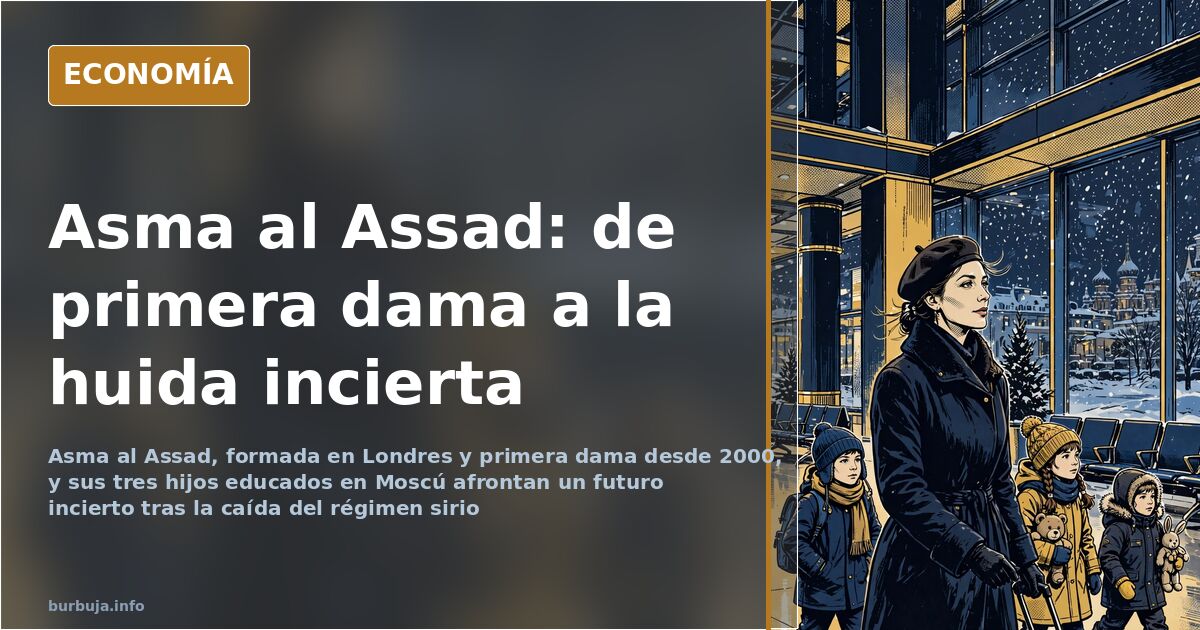
The fate of Asma al-Assad and her three children after the fall of Damascus
The collapse of the Syrian regime has left the whereabouts of Asma al-Assad and her three children, who were educated in Moscow and London, unknown. While reports suggested the president managed to flee Damascus with his destination unconfirmed, no information emerged regarding his vvife and offspring. The presidential family, which had fourteen years of civil war to prepare an exit, now faces a scenario that remains undefined.
From London to Damascus: Profile of a Western-educated First Lady
Asma al-Assad was born and raised in London, where her father, a Syrian doctor, worked at a top-tier hospital. She attended prestigious English schools before moving to Syria and becoming first lady in 2000. For years, she was compared to other regional leaders' wives, with elegance cited as her primary attribute. The couple's three children grew up between Moscow and the British capital, spending extended periods abroad. The eldest graduated from Moscow University, highlighting how the family maintained ties outside Syria long before the regime crumbled.
Why did the Syrian elite have years to prepare their escape?
The Syrian civil war lasted fourteen years, allowing the regime's leadership to organize assets, contacts, and safe havens abroad. This is not new; historically, economic and political elites are often the first to leave when conflict erupts. Some argue the presidential family had ample time to secure wealth overseas, while others note the regime's core remained in Damascus until the end. Comparisons with historical events, from the British royal family during World War II to recent cases, illustrate that staying or leaving is rarely an improvised decision.
Debate on refugees versus fleeing elites
The discussion expanded to broader issues: what happens to elites abandoning war-torn countries versus those unable to do so. Regime collaborators without private jets or hidden fortunes face a far more precarious future than the presidential family. Meanwhile, the plight of Middle Eastern Christians, who have been emigrating to the US and Latin America for decades—with Syrian-Lebanese communities established in Mexico and Brazil—was also raised. Whether those who fled will return to Syria remains unanswered.
Economic and geopolitical impact of new instability
The regime's fall adds another source of destabilization in the Middle East, a region where power balances have shifted repeatedly in recent decades. Some predict nostalgia for the previous regime within years, similar to other ousted leaders in the area. A potential new wave of migration toward Europe was mentioned as a likely consequence, though without specific figures. What is clear is that the country's reconstruction and definition of its new political order remain entirely open.
The Syrian presidential family used fourteen years to prepare an exit executed early enough for their younger members to be educated abroad. However, no one has yet confirmed their exact location or the assets awaiting them in exile.
The collapse of the Syrian regime has left the whereabouts of Asma al-Assad and her three children, who were educated in Moscow and London, unknown. While reports suggested the president managed to flee Damascus with his destination unconfirmed, no information emerged regarding his vvife and offspring. The presidential family, which had fourteen years of civil war to prepare an exit, now faces a scenario that remains undefined.
From London to Damascus: Profile of a Western-educated First Lady
Asma al-Assad was born and raised in London, where her father, a Syrian doctor, worked at a top-tier hospital. She attended prestigious English schools before moving to Syria and becoming first lady in 2000. For years, she was compared to other regional leaders' wives, with elegance cited as her primary attribute. The couple's three children grew up between Moscow and the British capital, spending extended periods abroad. The eldest graduated from Moscow University, highlighting how the family maintained ties outside Syria long before the regime crumbled.
Why did the Syrian elite have years to prepare their escape?
The Syrian civil war lasted fourteen years, allowing the regime's leadership to organize assets, contacts, and safe havens abroad. This is not new; historically, economic and political elites are often the first to leave when conflict erupts. Some argue the presidential family had ample time to secure wealth overseas, while others note the regime's core remained in Damascus until the end. Comparisons with historical events, from the British royal family during World War II to recent cases, illustrate that staying or leaving is rarely an improvised decision.
Debate on refugees versus fleeing elites
The discussion expanded to broader issues: what happens to elites abandoning war-torn countries versus those unable to do so. Regime collaborators without private jets or hidden fortunes face a far more precarious future than the presidential family. Meanwhile, the plight of Middle Eastern Christians, who have been emigrating to the US and Latin America for decades—with Syrian-Lebanese communities established in Mexico and Brazil—was also raised. Whether those who fled will return to Syria remains unanswered.
Economic and geopolitical impact of new instability
The regime's fall adds another source of destabilization in the Middle East, a region where power balances have shifted repeatedly in recent decades. Some predict nostalgia for the previous regime within years, similar to other ousted leaders in the area. A potential new wave of migration toward Europe was mentioned as a likely consequence, though without specific figures. What is clear is that the country's reconstruction and definition of its new political order remain entirely open.
The Syrian presidential family used fourteen years to prepare an exit executed early enough for their younger members to be educated abroad. However, no one has yet confirmed their exact location or the assets awaiting them in exile.
Also available in: Deutsch
Summary of a discussion on Burbuja.info - Foro de economía, actualidad y política., translated from Spanish and reviewed before publication. Read the full discussion (109 replies).
More summaries
-
Israel threatens Syria with massive strikes after Iranian drones
Israel threatens Syria with massive strikes after Iranian drones. The region is on edge with statements and military mobilizations. Read the full analysis.
-
Asma al-Assad seeks divorce in Moscow to return to UK
Rumors suggest Asma al-Assad filed for divorce in Moscow, seeking urgent medical treatment and a return to the UK with her children.
-
Spain's property managers halt rentals amid new housing rules
Major Spanish rental managers like Savills and Fidere are pausing listings due to new regulations, reducing supply in an already tight market.
-
Santiago rents rise 11.6% despite price caps
Average rent in Santiago, Spain, hits €704 with the region's steepest increase despite tourism bans and rent controls.
-
Cancer mortality: debunking the 97% myth and the $291 billion industry
2024 data shows 20.6 million cases and 9.8 million deaths. The 97% figure is false, but spontaneous remission exists within a massive pharmaceutical market.
-
EU Approves Return Regulation, Leaving Spain Out of Step
The EU adopts a regulation making expulsion orders valid across all 27 states. Sweden demands €3,300 salaries, while Spain maintains its ban on hot returns.