
Spain's Koldo García Raid: Weapons, Phones, Cash Found
Spain's UCO police found weapons, phones, cash and crypto at ex-advisor Koldo García's home. Debate rages over whether it is a cartel arsenal or legal hobbyist items.
English · Original discussion in Spanish · Published
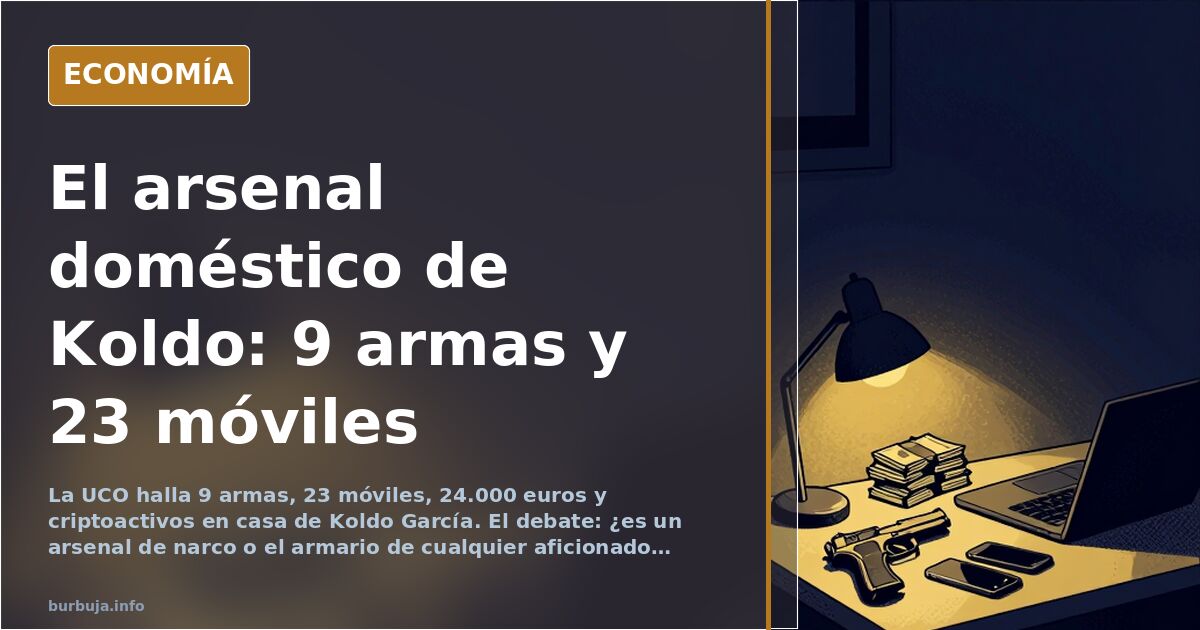
Koldo: 9 weapons, 23 mobiles and €24,000 at home
The Central Operational Unit (UCO) of the Civil Guard searched the home of Koldo García, former advisor to the Ministry of Transport, discovering an inventory that seems straight out of a TV series: nine firearms, 23 mobile phones, €24,000 in cash and crypto assets. The find, first reported by Europa Press, has reignited debate on the scope of the scandal affecting the PSOE party and what exactly constitutes news when a senior official's home is raided. Because here lies the first clash: for some, it is drug organización criminal loot; for others, it is the contents of any Spanish household cupboard with proper licenses.
What the UCO found at Koldo's home
The search took place within the judicial investigation that keeps Koldo García charged for his alleged involvement in the mask scheme and public contracts during the pandemic. The list of seized items is heterogeneous: long and short-barreled weapons, phone devices accumulated over years, and a cash amount that, while not spectacular, is hardly pocket change. The crypto assets, left unspecified, add a layer of opacity that general press has treated with usual precision: mentioning the word "bitcoin" and little else.
The reaction in forums has been an exercise in applied skepticism. Several messages agree on one idea: none of this is a crime per se. Having licensed weapons is legal. Keeping cash at home is too. Hoarding old phones, let alone. The problem, they argue, is not the inventory, but what the UCO can prove about the origin of the money and the use of those devices. The news, in that sense, sits halfway between objective discovery and journalistic construction.
Is it normal to have nine weapons at home?
It depends on who you ask. Spanish legislation allows up to five shotguns per license and an open number of rifles if requirements are met. A hunting or sport shooting enthusiast can accumulate ten or twelve weapons without leaving the legal framework. Some in forums defend this with data: "I have friends who, between rifles, shotguns and some .22s, also easily have 10 or 12 weapons." The key lies in the license, and in whether Koldo had it.
The detail that caught the attention of more technical users is the type of weapons: a lever-action .44-40 carbine, an expensive Steyr, and a Sarrasqueta 12-gauge shotgun. It is not a war arsenal; it is a collection. That does not prevent the Prosecutor's Office from asking why a former ministry advisor needed nine weapons and 23 phones. The answer, if there is one, is in the case files.
The 23 mobiles and the trail of the scheme
The figure of 23 phones is the one that generated most discussion. The recurring joke is that Koldo kept "everything from Motorola and Nokia to BlackBerry." But the serious reading is different: in a corruption investigation, each device is a window into conversations, contracts and payments. The UCO does not hoard phones out of nostalgia; they hoard them because each one may contain evidence.
Forums have pointed out that 23 phones could correspond to 22 suspects plus the "legal phone." It is hyperbole, but it points to a real suspicion: compartmentalization of communications. If the scheme used distinct lines for distinct interlocutors, the number of devices stops being an eccentricity and becomes a method.
What weight do the €24,000 and crypto assets have?
Twenty-four thousand euros is not a fortune, but neither is it what one keeps in the sock drawer. Compared to standards of other scandals, the figure is modest. What matters is not the amount, but the source. If the money comes from commissions, the crime is the same with €24,000 as with €240,000.
Crypto assets add evidentiary difficulty. Unlike cash, they cannot be physically seized; wallets and exchanges must be traced. The press has treated the matter with usual superficiality: mentioning their existence and little else. In forums, irony was the dominant note: "By crypto assets we assume some Ledger, right? Or maybe he had some bitcoins among the loose change in his wallet."
The media narrative: from raid to headline
Coverage of the case has trinc a known pattern: leak the finding, amplify it, and let public opinion draw conclusions before the judge does. Forums criticized the lack of context: no mention if weapons were legalized, no detail on money origin, no explanation of which crypto assets. Comparison with other cases — Bárcenas, Rita Barberá — served to underline informational asymmetry.
Some maintain that the true scandal is not the arsenal, but that a former advisor with that profile was at the core of the Ministry of Transport. Others respond that the scandal is precisely presenting as scandalous what is not. The debate, in any case, remains open: the investigation continues and the case files, so far, have not cleared the doubt.
What the UCO did not find, or what did not become public, is the payment notebook. Without it, the case remains a puzzle with striking pieces but no complete picture. And that, in a country where headlines weigh more than summaries, is exactly what guarantees the topic will keep making headlines.
The Central Operational Unit (UCO) of the Civil Guard searched the home of Koldo García, former advisor to the Ministry of Transport, discovering an inventory that seems straight out of a TV series: nine firearms, 23 mobile phones, €24,000 in cash and crypto assets. The find, first reported by Europa Press, has reignited debate on the scope of the scandal affecting the PSOE party and what exactly constitutes news when a senior official's home is raided. Because here lies the first clash: for some, it is drug organización criminal loot; for others, it is the contents of any Spanish household cupboard with proper licenses.
What the UCO found at Koldo's home
The search took place within the judicial investigation that keeps Koldo García charged for his alleged involvement in the mask scheme and public contracts during the pandemic. The list of seized items is heterogeneous: long and short-barreled weapons, phone devices accumulated over years, and a cash amount that, while not spectacular, is hardly pocket change. The crypto assets, left unspecified, add a layer of opacity that general press has treated with usual precision: mentioning the word "bitcoin" and little else.
The reaction in forums has been an exercise in applied skepticism. Several messages agree on one idea: none of this is a crime per se. Having licensed weapons is legal. Keeping cash at home is too. Hoarding old phones, let alone. The problem, they argue, is not the inventory, but what the UCO can prove about the origin of the money and the use of those devices. The news, in that sense, sits halfway between objective discovery and journalistic construction.
Is it normal to have nine weapons at home?
It depends on who you ask. Spanish legislation allows up to five shotguns per license and an open number of rifles if requirements are met. A hunting or sport shooting enthusiast can accumulate ten or twelve weapons without leaving the legal framework. Some in forums defend this with data: "I have friends who, between rifles, shotguns and some .22s, also easily have 10 or 12 weapons." The key lies in the license, and in whether Koldo had it.
The detail that caught the attention of more technical users is the type of weapons: a lever-action .44-40 carbine, an expensive Steyr, and a Sarrasqueta 12-gauge shotgun. It is not a war arsenal; it is a collection. That does not prevent the Prosecutor's Office from asking why a former ministry advisor needed nine weapons and 23 phones. The answer, if there is one, is in the case files.
The 23 mobiles and the trail of the scheme
The figure of 23 phones is the one that generated most discussion. The recurring joke is that Koldo kept "everything from Motorola and Nokia to BlackBerry." But the serious reading is different: in a corruption investigation, each device is a window into conversations, contracts and payments. The UCO does not hoard phones out of nostalgia; they hoard them because each one may contain evidence.
Forums have pointed out that 23 phones could correspond to 22 suspects plus the "legal phone." It is hyperbole, but it points to a real suspicion: compartmentalization of communications. If the scheme used distinct lines for distinct interlocutors, the number of devices stops being an eccentricity and becomes a method.
What weight do the €24,000 and crypto assets have?
Twenty-four thousand euros is not a fortune, but neither is it what one keeps in the sock drawer. Compared to standards of other scandals, the figure is modest. What matters is not the amount, but the source. If the money comes from commissions, the crime is the same with €24,000 as with €240,000.
Crypto assets add evidentiary difficulty. Unlike cash, they cannot be physically seized; wallets and exchanges must be traced. The press has treated the matter with usual superficiality: mentioning their existence and little else. In forums, irony was the dominant note: "By crypto assets we assume some Ledger, right? Or maybe he had some bitcoins among the loose change in his wallet."
The media narrative: from raid to headline
Coverage of the case has trinc a known pattern: leak the finding, amplify it, and let public opinion draw conclusions before the judge does. Forums criticized the lack of context: no mention if weapons were legalized, no detail on money origin, no explanation of which crypto assets. Comparison with other cases — Bárcenas, Rita Barberá — served to underline informational asymmetry.
Some maintain that the true scandal is not the arsenal, but that a former advisor with that profile was at the core of the Ministry of Transport. Others respond that the scandal is precisely presenting as scandalous what is not. The debate, in any case, remains open: the investigation continues and the case files, so far, have not cleared the doubt.
What the UCO did not find, or what did not become public, is the payment notebook. Without it, the case remains a puzzle with striking pieces but no complete picture. And that, in a country where headlines weigh more than summaries, is exactly what guarantees the topic will keep making headlines.
Also available in: Deutsch
Summary of a discussion on Burbuja.info - Foro de economía, actualidad y política., translated from Spanish and reviewed before publication. Read the full discussion (109 replies).
More summaries
-
Koldo García, former Ábalos aide, arrested over mask contracts
Spain's Civil Guard arrests Koldo García, ex-advisor to José Luis Ábalos, for alleged illegal commissions in pandemic mask purchases and property holdings.
-
Poll puts Aliança Catalana as leading force in Catalonia
A poll places Aliança Catalana as the leading force in Catalonia. The result fragments the vote and leaves governability in a mathematical deadlock, according to...
-
Santiago rents rise 11.6% despite price caps
Average rent in Santiago, Spain, hits €704 with the region's steepest increase despite tourism bans and rent controls.
-
Cancer mortality: debunking the 97% myth and the $291 billion industry
2024 data shows 20.6 million cases and 9.8 million deaths. The 97% figure is false, but spontaneous remission exists within a massive pharmaceutical market.
-
EU Approves Return Regulation, Leaving Spain Out of Step
The EU adopts a regulation making expulsion orders valid across all 27 states. Sweden demands €3,300 salaries, while Spain maintains its ban on hot returns.
-
Spain's €3 water bill sparks debate on restaurant pricing
A €3 bottle of water in a Spanish restaurant reignites controversy over margins, inflation, and laws mandating free tap water.