
Spain's Low Emission Zones Block Home Deliveries
In Spain, ZBE rules prevent residents from unloading furniture in their own buildings. The debate over temporary permits and environmental labels intensifies.
English · Original discussion in Spanish · Published
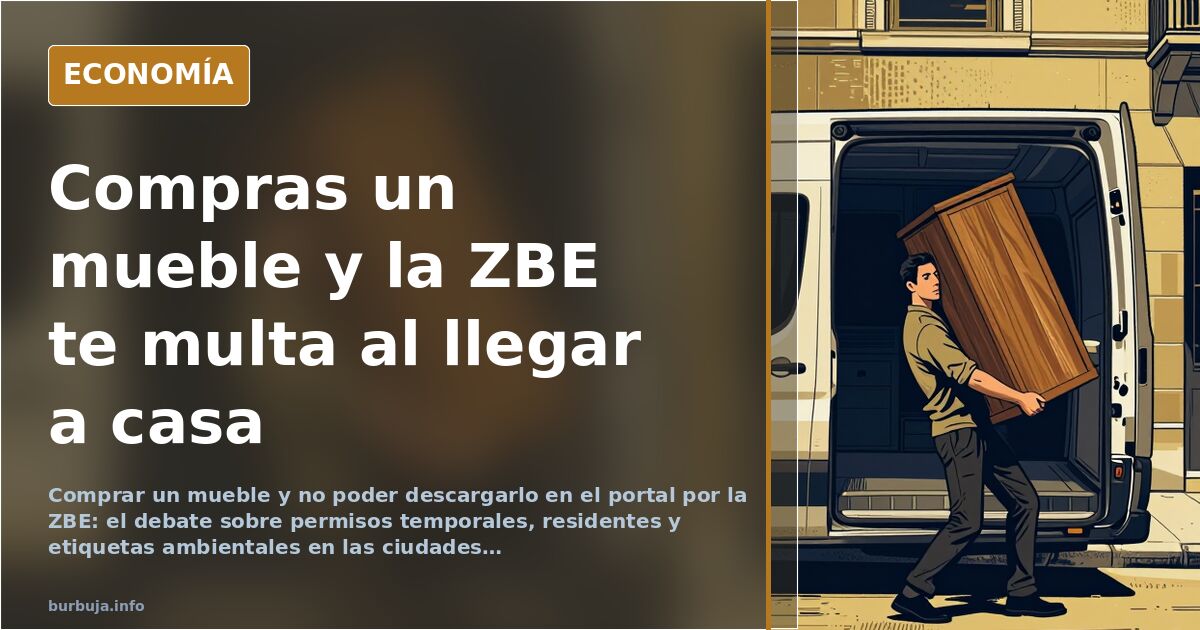
ZBE: Buying Furniture but Unable to Unload It at Your Door
You buy a wardrobe at Ikea, load it into a van, and when you try to unload it at your building's entrance, you find the street is inside a Low Emission Zone (LEZ). You have no environmental label, no garage spot, and entering means a fine. What started as a joke has become the core of a debate: what happens to domestic logistics when city centers become restricted spaces?
The starting point is a warning circulating since January 2024: LEZs are no longer exclusive to Madrid but are spreading to medium-sized cities, even Badajoz. The question for the average buyer is not ideological, but practical. Do you need to request a temporary access permit for your own building every time you return from Conforama? How long does the administration take to grant it? And what if the offer expires before officials process the backlog of requests?
What Is an LEZ and Who Does It Really Affect
A Low Emission Zone is an urban perimeter where only vehicles with a specific environmental label can circulate. Driven by the Climate Change Law, municipalities with more than 50,000 inhabitants must define these areas. Industry calendars suggest that most restrictions on unlabeled vehicles will apply throughout 2024 and 2025, with Madrid acting as a laboratory and other capitals trinc suit.
The problem isn't just parcel delivery, which already has its own rules. The problem is the citizen living within the perimeter. Residents usually have a registry allowing access to garages or parking zones, but this permission doesn't cover any vehicle they wish to bring in. If the car isn't registered as resident-owned, it cannot enter. And if furniture arrives in a rental van, the van is also barred.
Some argue the solution is hiring authorized transport companies licensed to operate within the LEZ. In practice, the cost can approach the price of the furniture itself. Others suggest a DIY approach: disassembling the furniture and stuffing pieces into a trunk, something road safety regulations frown upon. A third, cynical option is simply not buying furniture.
The Resident Who Can't Enter Their Own Street
The discussion complicates when focusing on residents. In Madrid, downtown neighbors can register their vehicle's license plate to avoid fines. In Bilbao, the old town has operated similarly for over fifteen years: entry is allowed between 7 and 11 AM; outside those hours, a permit is required regardless of emissions. Delivery drivers, whatever their company, cannot enter outside that window.
According to experience in these historic districts, the result is population loss. People leave, the real estate market shifts toward hotels and tourist apartments, and small businesses suffer. Restrictions don't just expel old cars; they also push out neighbors who can't afford new ones.
Fundamentally, LEZs are not homogeneous. In Seville, authorities have defined an administrative and business zone without housing or shops, less than half a kilometer wide. In Madrid, the perimeter covers entire neighborhoods. The difference is significant: one affects offices, the other disrupts the daily life of thousands of families.
Eco Label for a 3,500-Kilo Car
One contentious point is the labeling criteria. A BMW X7 weighing 3,500 kilos, consuming eight liters per hundred kilometers, with a hybrid battery, gets an Eco label and pays nothing. A twenty-year-old Peugeot 307 driving 6,000 kilometers a year is deemed a threat to the planet. The criterion isn't actual emissions, but declared technology.
This paradox extends to commercial vehicles. A business owner with a fleet of Berlingo or Kangoo vans would switch to electric if they had 350-400 km range. Market models offer only 150 km. Consequently, no one buys them. The transition is happening by imposition, not conviction.
The Question No One Answers: What If I Need to Pick Up My Grandmother?
The furniture case is anecdotal, but the category is broader. What if you need to pick up an elderly relative, drive someone to the doctor, or move house? The administrative answer is always the same: request a temporary permit. The practical reality is that permits take weeks while needs are immediate.
The debate then moves to politics. Some claim the measure expels middle-income populations from centers, while others defend centers as spaces for pedestrians, tourists, and offices. Meanwhile, residents continue living within the perimeter and still need to move things.
With these elements, forecasts suggest LEZs will expand and temporary permits will become routine. If so, the question won't be how to unload furniture, but how many more bureaucratic steps are needed to live in your own home.
You buy a wardrobe at Ikea, load it into a van, and when you try to unload it at your building's entrance, you find the street is inside a Low Emission Zone (LEZ). You have no environmental label, no garage spot, and entering means a fine. What started as a joke has become the core of a debate: what happens to domestic logistics when city centers become restricted spaces?
The starting point is a warning circulating since January 2024: LEZs are no longer exclusive to Madrid but are spreading to medium-sized cities, even Badajoz. The question for the average buyer is not ideological, but practical. Do you need to request a temporary access permit for your own building every time you return from Conforama? How long does the administration take to grant it? And what if the offer expires before officials process the backlog of requests?
What Is an LEZ and Who Does It Really Affect
A Low Emission Zone is an urban perimeter where only vehicles with a specific environmental label can circulate. Driven by the Climate Change Law, municipalities with more than 50,000 inhabitants must define these areas. Industry calendars suggest that most restrictions on unlabeled vehicles will apply throughout 2024 and 2025, with Madrid acting as a laboratory and other capitals trinc suit.
The problem isn't just parcel delivery, which already has its own rules. The problem is the citizen living within the perimeter. Residents usually have a registry allowing access to garages or parking zones, but this permission doesn't cover any vehicle they wish to bring in. If the car isn't registered as resident-owned, it cannot enter. And if furniture arrives in a rental van, the van is also barred.
Some argue the solution is hiring authorized transport companies licensed to operate within the LEZ. In practice, the cost can approach the price of the furniture itself. Others suggest a DIY approach: disassembling the furniture and stuffing pieces into a trunk, something road safety regulations frown upon. A third, cynical option is simply not buying furniture.
The Resident Who Can't Enter Their Own Street
The discussion complicates when focusing on residents. In Madrid, downtown neighbors can register their vehicle's license plate to avoid fines. In Bilbao, the old town has operated similarly for over fifteen years: entry is allowed between 7 and 11 AM; outside those hours, a permit is required regardless of emissions. Delivery drivers, whatever their company, cannot enter outside that window.
According to experience in these historic districts, the result is population loss. People leave, the real estate market shifts toward hotels and tourist apartments, and small businesses suffer. Restrictions don't just expel old cars; they also push out neighbors who can't afford new ones.
Fundamentally, LEZs are not homogeneous. In Seville, authorities have defined an administrative and business zone without housing or shops, less than half a kilometer wide. In Madrid, the perimeter covers entire neighborhoods. The difference is significant: one affects offices, the other disrupts the daily life of thousands of families.
Eco Label for a 3,500-Kilo Car
One contentious point is the labeling criteria. A BMW X7 weighing 3,500 kilos, consuming eight liters per hundred kilometers, with a hybrid battery, gets an Eco label and pays nothing. A twenty-year-old Peugeot 307 driving 6,000 kilometers a year is deemed a threat to the planet. The criterion isn't actual emissions, but declared technology.
This paradox extends to commercial vehicles. A business owner with a fleet of Berlingo or Kangoo vans would switch to electric if they had 350-400 km range. Market models offer only 150 km. Consequently, no one buys them. The transition is happening by imposition, not conviction.
The Question No One Answers: What If I Need to Pick Up My Grandmother?
The furniture case is anecdotal, but the category is broader. What if you need to pick up an elderly relative, drive someone to the doctor, or move house? The administrative answer is always the same: request a temporary permit. The practical reality is that permits take weeks while needs are immediate.
The debate then moves to politics. Some claim the measure expels middle-income populations from centers, while others defend centers as spaces for pedestrians, tourists, and offices. Meanwhile, residents continue living within the perimeter and still need to move things.
With these elements, forecasts suggest LEZs will expand and temporary permits will become routine. If so, the question won't be how to unload furniture, but how many more bureaucratic steps are needed to live in your own home.
Also available in: Deutsch
Summary of a discussion on Burbuja.info - Foro de economía, actualidad y política., translated from Spanish and reviewed before publication. Read the full discussion (109 replies).
More summaries
-
Madrid fines 200 euros for driving without environmental label
Madrid ends grace period: 200 euro fine for driving without label in low-emission zone, new ordinance pending.
-
IONOS cuts 450 jobs, Logroño fears for Arsys's 360
IONOS cuts 450 jobs from 3,800: Arsys, with 360 workers in Logroño, is unsure how many will be affected.
-
Santiago rents rise 11.6% despite price caps
Average rent in Santiago, Spain, hits €704 with the region's steepest increase despite tourism bans and rent controls.
-
Cancer mortality: debunking the 97% myth and the $291 billion industry
2024 data shows 20.6 million cases and 9.8 million deaths. The 97% figure is false, but spontaneous remission exists within a massive pharmaceutical market.
-
EU Approves Return Regulation, Leaving Spain Out of Step
The EU adopts a regulation making expulsion orders valid across all 27 states. Sweden demands €3,300 salaries, while Spain maintains its ban on hot returns.
-
Spain's €3 water bill sparks debate on restaurant pricing
A €3 bottle of water in a Spanish restaurant reignites controversy over margins, inflation, and laws mandating free tap water.