
1 Euro Wine Fools Experts at Tasting Event
A 1 euro wine was praised by experts at a tasting, highlighting how price influences perception. A 1.5€ wine previously scored 90 points.
English · Original discussion in Spanish · Published
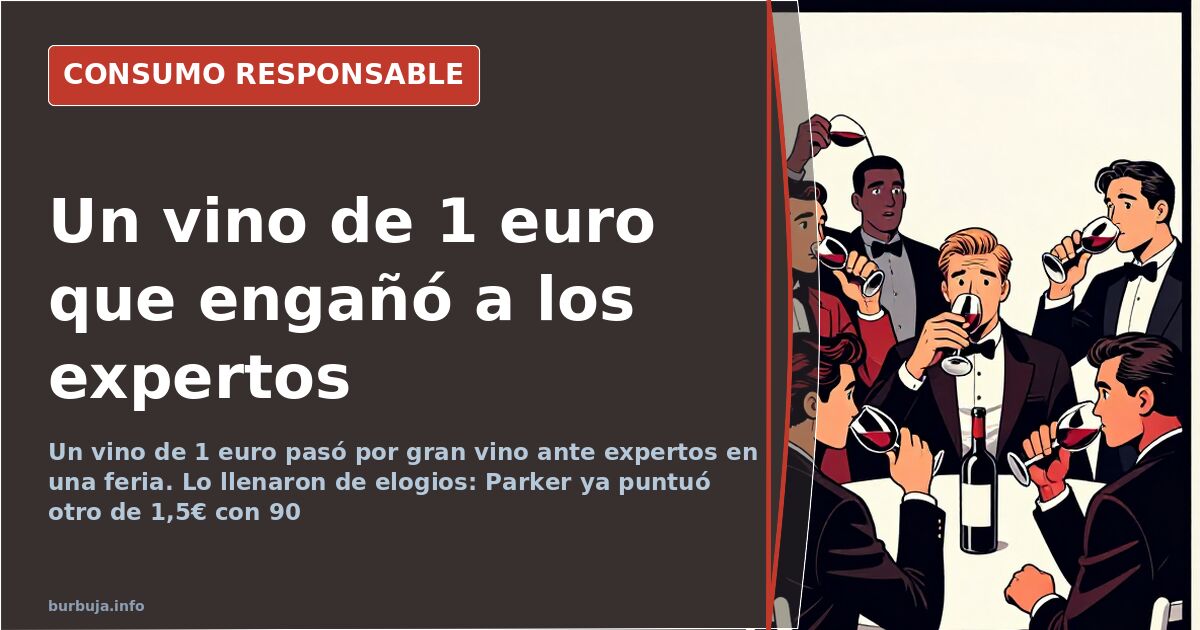
A 1 euro wine is passed off as fine wine at an expert tasting
How much does a wine need to cost for an expert to rave about it? The figure revealed by an experiment by Mikel López Iturriaga — head of El Comidista, in El País — is uncomfortable: one euro. The journalist passed off a bulk 1 euro wine at an expert tasting and served it without revealing its origin. They didn't detect it. Worse: they heaped praise upon it.
What peine when the bulk wine was served
The setup involved presenting a bulk wine as high-end to experts. The response was a catalog of commonplace adjectives: fruity, fresh, pleasant, with herbal notes, easy, good on the palate, fragrant, fluid, warm, evolved, elegant in the mouth, with well-polished tannins, luscious, round. All this, applied to something that costs less than half a coffee. According to one participant, the author eventually discards the leftover wine. And there the first sustancia ilegal appears: if so many had praised it, why is it thrown away?
The 1.5 euro wine that Robert Parker already rated 90
This isn't the first time. In 2011, a generic white wine from A Rúa (Valdeorras, Ourense) sold for 1.5 euros in a supermarket received 90 points in The Wine Advocate, the publication of critic Robert Parker. The leap from the supermarket shelf to global oenological elite was made with the same wine, without changing a drop. Another case brought to light: the annual selection of the Peñín guide, which in its 2015 edition tasted 11,600 wines. With that figure on the table, some wonder who is capable of discerning between eleven thousand six hundred bottles and who ends up choosing the one that pays more.
Why price tastes better than wine
The explanation lies not in the grape, but in the head, as several participants maintain: the perception of a wine's quality is dominated by its price. If it's expensive, it can't be bad; if it's cheap, it must have something wrong. It's the same mechanism that makes a product valued for its label rather than what's inside the bottle. And it doesn't just happen with wine. A participant recounts that a high-end whisky refilled with a cheap brand and served as if it were twenty-one years old ended up the same way: almost no one noticed the change, one said it tasted 'a bit normal' and the rest toasted the supposed luxury. Art, cars, or mobile phones work with the same logic.
Blind tasting: why almost no one does it
The method to dismantle the illusion exists and is old: cover the bottle, taste blind, and don't know what you're drinking. Those who work in this field assure that wrapping the bottle so the brand isn't visible is the first thing done in serious tastings. Some argue that the system isn't interested: the industry doesn't want it discovered that a one-euro wine can compete with a twenty-five-euro one. Sight, smell, and sound influence what we later call taste. Others argue that some of the praise was merely professional courtesy: neutral wines are praised to avoid offending a potential client.
Is it worth paying 25 euros for a bottle?
Here the issue splits. Some argue that a bulk wine doesn't have to be bad: it's a young wine without barrel aging, hence it costs less. 'There are great wines for three euros and terrible wines for twenty,' summarizes the idea. On the other side, some maintain that only Rioja and Ribera del Duero maintain a general standard, and that the rest need more aging to come close. In between, the suspicion that the heat in supermarket warehouses ruins bottles that were originally good. Summer is the silent enemy of cheap and expensive wine.
With these ingredients, the natural conclusion would be to stop paying for labels. Nobody does. The next dinner with friends will end the same way: someone will swirl the glass, smell, taste, and declare that it's very round.
How much does a wine need to cost for an expert to rave about it? The figure revealed by an experiment by Mikel López Iturriaga — head of El Comidista, in El País — is uncomfortable: one euro. The journalist passed off a bulk 1 euro wine at an expert tasting and served it without revealing its origin. They didn't detect it. Worse: they heaped praise upon it.
What peine when the bulk wine was served
The setup involved presenting a bulk wine as high-end to experts. The response was a catalog of commonplace adjectives: fruity, fresh, pleasant, with herbal notes, easy, good on the palate, fragrant, fluid, warm, evolved, elegant in the mouth, with well-polished tannins, luscious, round. All this, applied to something that costs less than half a coffee. According to one participant, the author eventually discards the leftover wine. And there the first sustancia ilegal appears: if so many had praised it, why is it thrown away?
The 1.5 euro wine that Robert Parker already rated 90
This isn't the first time. In 2011, a generic white wine from A Rúa (Valdeorras, Ourense) sold for 1.5 euros in a supermarket received 90 points in The Wine Advocate, the publication of critic Robert Parker. The leap from the supermarket shelf to global oenological elite was made with the same wine, without changing a drop. Another case brought to light: the annual selection of the Peñín guide, which in its 2015 edition tasted 11,600 wines. With that figure on the table, some wonder who is capable of discerning between eleven thousand six hundred bottles and who ends up choosing the one that pays more.
Why price tastes better than wine
The explanation lies not in the grape, but in the head, as several participants maintain: the perception of a wine's quality is dominated by its price. If it's expensive, it can't be bad; if it's cheap, it must have something wrong. It's the same mechanism that makes a product valued for its label rather than what's inside the bottle. And it doesn't just happen with wine. A participant recounts that a high-end whisky refilled with a cheap brand and served as if it were twenty-one years old ended up the same way: almost no one noticed the change, one said it tasted 'a bit normal' and the rest toasted the supposed luxury. Art, cars, or mobile phones work with the same logic.
Blind tasting: why almost no one does it
The method to dismantle the illusion exists and is old: cover the bottle, taste blind, and don't know what you're drinking. Those who work in this field assure that wrapping the bottle so the brand isn't visible is the first thing done in serious tastings. Some argue that the system isn't interested: the industry doesn't want it discovered that a one-euro wine can compete with a twenty-five-euro one. Sight, smell, and sound influence what we later call taste. Others argue that some of the praise was merely professional courtesy: neutral wines are praised to avoid offending a potential client.
Is it worth paying 25 euros for a bottle?
Here the issue splits. Some argue that a bulk wine doesn't have to be bad: it's a young wine without barrel aging, hence it costs less. 'There are great wines for three euros and terrible wines for twenty,' summarizes the idea. On the other side, some maintain that only Rioja and Ribera del Duero maintain a general standard, and that the rest need more aging to come close. In between, the suspicion that the heat in supermarket warehouses ruins bottles that were originally good. Summer is the silent enemy of cheap and expensive wine.
With these ingredients, the natural conclusion would be to stop paying for labels. Nobody does. The next dinner with friends will end the same way: someone will swirl the glass, smell, taste, and declare that it's very round.
Summary of a discussion on Burbuja.info - Foro de economía, actualidad y política., translated from Spanish and reviewed before publication. Read the full discussion (173 replies).
More summaries
-
The four breakfasts no Spanish bar serves
Oats, wholemeal bread, hummus and peanut butter: four foods Spanish bars don't serve, against the tradition of toast and Spanish tortilla.
-
Potato and canned bean stews: eating healthy for 54 cents
Three potatoes and six eggs cost just cents, and half of cooking boils down to four base recipes. Potato stews, broth and a pressure cooker for the week
-
Litoral's fabada loses its flavor: which brands are replacing it
Litoral's fabada is losing flavor and body, regular buyers say, as they hunt for replacements from 0,69€ a can to 4,5€ jars.
-
Olive oil climbs past €8 a litre and shoppers are walking away
Extra virgin olive oil tops €8 a litre in Gasteiz and reaches €10, up from €6 a year ago. More and more shoppers are taking it off their lists
-
A Land Rover and 20.000 euros in repairs in just four years
Mireia has spent about 20.000 euros on repairs to her Land Rover, with only 173.000 km in four years, including timing chain, turbo, gearbox and driveshaft
-
Razor blades: expensive cartridges vs. cheap double-edge
A 100-pack of double-edge blades costs €9–12 and gives five shaves per blade; the expensive cartridge is done after five uses.