
Vanishing Trades: From Broth Sellers to Mattress Fluffers
From broth sellers to mattress fluffers: the debate on trades that vanished in Spain and those still surviving.
English · Original discussion in Spanish · Published
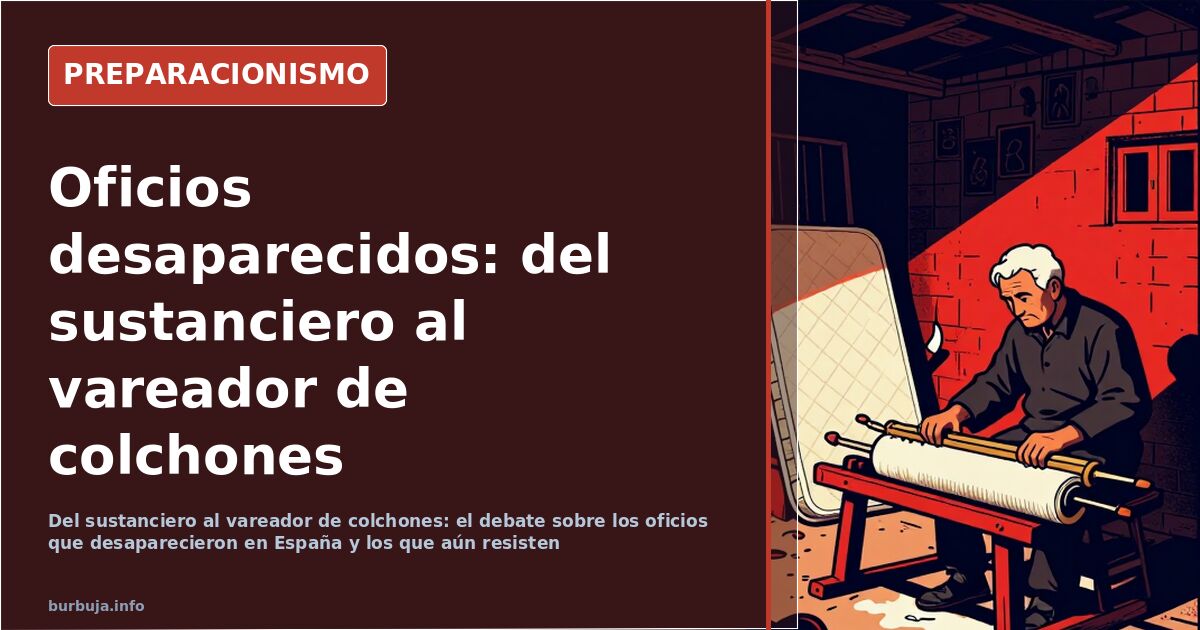
The Spanish trades erased by cheap oil
How many of today's seemingly eternal jobs will exist in twenty years? This old question resurfaces as a thread reviews a long list of trades that sustained daily life in towns and cities, which, according to the debate, gradually disappeared. For one participant, the culprit has a technical name—cheap oil—and a list of victims ranging from the sustanciero (broth seller) to the mattress fluffer.
The sustanciero: charging for minutes of shared broth
There was a time when protein was rented out. The sustanciero walked the streets with a cord holding a piece of ham, some chorizo, and bones; upon hearing his cry, the housewife would come out with her pot. The professional dipped the cord into the broth, timed it, and charged by the minute. Pure post-war economy, where flavor was a home-delivery service and scarcity had a price tag.
Belonging to this same world are the palanganero, the milkman who delivered with his van leaving full bottles at dawn, or the grocer specializing in imported goods and colonial products, whose very name reveals what he sold: items we no longer even call by those names. The shopping basket was then a trade, not an aisle.
Nylon and memory foam ended tailors and mattress makers
The thesis ordering the entire list is simple: when oil arrived massively in Spain starting in the 1960s, new and cheaper materials appeared, making artisanal work unnecessary. Wool mattresses —with their fluffer and maker— were replaced by memory foam, derived from oil. Clothing trinc the same path: cheap nylon and polyester reduced the employment of seamstresses and tailors, once central trades.
What the material didn't take away, the machine finished off. The seamstress who went door-to-door with a portable hand-cranked sewing machine —with a flywheel that kept spinning for seconds and had to be stopped by hand— left an image that is never repeated. Some emphasize that electricity is mostly produced with gas and coal: dependence on fossil fuels, far from being resolved, became total.
Cartwrights, saddle makers and farriers: the engine was the mule
Before tractors became affordable, labor power was animal, and with it came a whole chain of specialists. The talabartero made the harnesses worn by mules and oxen; the saddle maker and leather worker made seats and tack; the cartwright worked the wood of carts and hitched them to horses and mules; the shearer and farrier completed the crew. Behind remained the muleteer and his train. There were even those who professionally rented a yoke of oxen, a business unimaginable today.
The night watchman, the lighthouse keeper and writing booths
The city before telephone and electric light generated its own jobs. There were lighthouse keepers in charge of lights, night watchmen opening doorways at dawn, knife peine and traveling upholsterers who still survive —and who still wake people up at eight in the morning— shoeshiners, cinema ushers, gas station attendants, public urinal collectors-supervisors, soda fountain operators, elevator operators and hotel bellhops. In the streets there were booths that looked like confessionals: they were the scribes, who filled out forms and wrote dictated letters for those who couldn't write.
The most disorienting detail is economic. Fairground vendors and stall owners handled bundles of banknotes while being illiterate and carried an assistant just to read the papers for them. Money circulated without the person counting it knowing how to read it.
The last rainmaker of Castile and other relics
Some trades border on myth. It is said that in the seventies the last rainmaker of Castile went from town to town loaded with amulets to be hired to make it rain. In Granada existed the ice carrier, who climbed Sierra Nevada to load snow and sold it in the city. And on the saddest rung, the professional mourners, paid to cry for the dead. Also the bone setter, the chimney sweep, the blacksmith or the traveling barber who cut the hair of several generations of the same village. Some haven't died: they are still there, half-hidden, although it is hard to find them.
At this point, concierges remain, doormen remain, blacksmiths remain. The rest left without noise, replaced by an oil derivative or an electric machine. Next time someone asks what trades will disappear, it is worth remembering that the sustanciero also seemed eternal.
How many of today's seemingly eternal jobs will exist in twenty years? This old question resurfaces as a thread reviews a long list of trades that sustained daily life in towns and cities, which, according to the debate, gradually disappeared. For one participant, the culprit has a technical name—cheap oil—and a list of victims ranging from the sustanciero (broth seller) to the mattress fluffer.
The sustanciero: charging for minutes of shared broth
There was a time when protein was rented out. The sustanciero walked the streets with a cord holding a piece of ham, some chorizo, and bones; upon hearing his cry, the housewife would come out with her pot. The professional dipped the cord into the broth, timed it, and charged by the minute. Pure post-war economy, where flavor was a home-delivery service and scarcity had a price tag.
Belonging to this same world are the palanganero, the milkman who delivered with his van leaving full bottles at dawn, or the grocer specializing in imported goods and colonial products, whose very name reveals what he sold: items we no longer even call by those names. The shopping basket was then a trade, not an aisle.
Nylon and memory foam ended tailors and mattress makers
The thesis ordering the entire list is simple: when oil arrived massively in Spain starting in the 1960s, new and cheaper materials appeared, making artisanal work unnecessary. Wool mattresses —with their fluffer and maker— were replaced by memory foam, derived from oil. Clothing trinc the same path: cheap nylon and polyester reduced the employment of seamstresses and tailors, once central trades.
What the material didn't take away, the machine finished off. The seamstress who went door-to-door with a portable hand-cranked sewing machine —with a flywheel that kept spinning for seconds and had to be stopped by hand— left an image that is never repeated. Some emphasize that electricity is mostly produced with gas and coal: dependence on fossil fuels, far from being resolved, became total.
Cartwrights, saddle makers and farriers: the engine was the mule
Before tractors became affordable, labor power was animal, and with it came a whole chain of specialists. The talabartero made the harnesses worn by mules and oxen; the saddle maker and leather worker made seats and tack; the cartwright worked the wood of carts and hitched them to horses and mules; the shearer and farrier completed the crew. Behind remained the muleteer and his train. There were even those who professionally rented a yoke of oxen, a business unimaginable today.
The night watchman, the lighthouse keeper and writing booths
The city before telephone and electric light generated its own jobs. There were lighthouse keepers in charge of lights, night watchmen opening doorways at dawn, knife peine and traveling upholsterers who still survive —and who still wake people up at eight in the morning— shoeshiners, cinema ushers, gas station attendants, public urinal collectors-supervisors, soda fountain operators, elevator operators and hotel bellhops. In the streets there were booths that looked like confessionals: they were the scribes, who filled out forms and wrote dictated letters for those who couldn't write.
The most disorienting detail is economic. Fairground vendors and stall owners handled bundles of banknotes while being illiterate and carried an assistant just to read the papers for them. Money circulated without the person counting it knowing how to read it.
The last rainmaker of Castile and other relics
Some trades border on myth. It is said that in the seventies the last rainmaker of Castile went from town to town loaded with amulets to be hired to make it rain. In Granada existed the ice carrier, who climbed Sierra Nevada to load snow and sold it in the city. And on the saddest rung, the professional mourners, paid to cry for the dead. Also the bone setter, the chimney sweep, the blacksmith or the traveling barber who cut the hair of several generations of the same village. Some haven't died: they are still there, half-hidden, although it is hard to find them.
At this point, concierges remain, doormen remain, blacksmiths remain. The rest left without noise, replaced by an oil derivative or an electric machine. Next time someone asks what trades will disappear, it is worth remembering that the sustanciero also seemed eternal.
Summary of a discussion on Burbuja.info - Foro de economía, actualidad y política., translated from Spanish and reviewed before publication. Read the full discussion (148 replies).
More summaries
-
32-Euro Chainsaw: Legal Home Defense Tool in Spain
A 32-euro electric chainsaw is proposed as legal home defense in Spain. The real issue is proportionality, not the tool itself.
-
The Quarter-Life Crisis: When Life Feels Too Long
At 30, lacking social life, work or dreams, the feeling that life is dragging on splits opinions between blaming circumstances and training resilience.
-
Spain's DIY Fight Club: Free Self-Defense with Bandage Ranks
In Spain, a new self-defense model uses colored bandages for hierarchy and low-cost gear to facilitate local sparring groups without federation fees.
-
Home Bread Maker: €720 Annual Savings Calculation
A user calculates that buying two daily loaves costs €720 annually. A Lidl bread maker, found on sale for €29, plus aluminum sheet modifications, offers a solution.
-
12cm Caterpillar: To Kill or Relocate?
A 12-centimeter yellow caterpillar appears in a garden with children present. The owner sprays it with insecticide, sparking debate on extermination versus relocation.
-
Beatriz Montañez: From TV Star to Restoring a Ruin in Teruel
Beatriz Montañez sold her Madrid apartment and restored a ruin in Teruel. Five winters later, debate continues on whether it was escape, healing, or branding.