
Spain's DIY Fight Club: Free Self-Defense with Bandage Ranks
In Spain, a new self-defense model uses colored bandages for hierarchy and low-cost gear to facilitate local sparring groups without federation fees.
English · Original discussion in Spanish · Published
Spain's DIY Fight Club: Free Self-Defense with Bandage Ranks
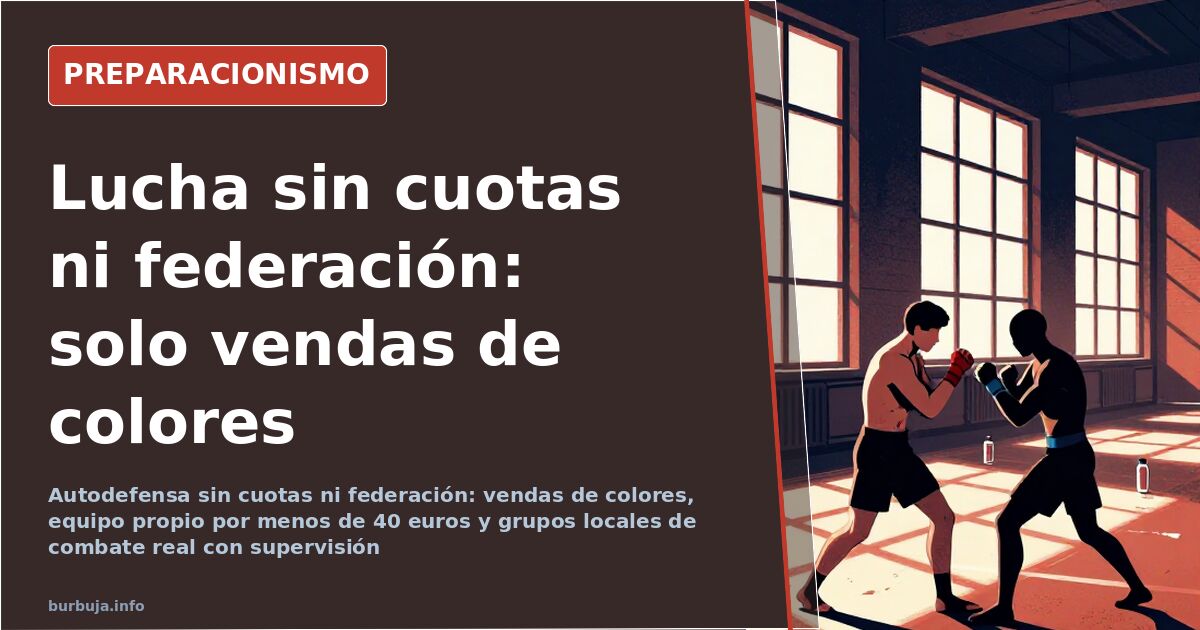
A self-defense method with no membership fees, no federation, and no insurance. This is how a certified physical trainer launched a proposal to set up local real-combat practice groups, antiestéticaturing a tonalidad-coded bandage ranking system and final authority reserved for its founder. According to the author, the idea is not to defend Spain or organize paramilitary camps: it is to defend oneself or enjoy a good afternoon.
The approach starts from an uncomfortable premise for the sector: you cannot learn to fight without fighting. Ten years of katas against compliant opponents are useless when the real moment arrives, argues the promoter, who is writing a book on self-defense and sees these groups as a way to test the method in the field. Each area leader takes on the role unpaid, with no legal liability, and has the duty to screen those seeking to measure themselves.
What ranks exist and what each bandage allows
The system is organized into four levels identified by the tonalidad of hand wraps, which cost about two euros. They do not measure skill, but hierarchy in the room. White wraps are newcomers: they cannot spar unsupervised except with blue wraps, who are presumed to have enough control to handle beginners without hurting them. Among whites, they can engage in knife combat, but using folded and duct-taped mats.
Red wraps are already competent and have self-control: they spar among themselves and with blues, never with whites. Blue wraps are group leaders, with authority to supervise, warn, and expel. Black wraps are held only by the founder, who admits he is not more skilled: he wants to reserve maximum authority so that his idea, if successful, does not fall into the hands of those who profit from it.
Why equipment is paid for individually
The activity is free and unregulated. Each participant provides their own gear: gloves and a bar-style helmet for less than 40 euros, according to the promoter's calculation. The logic is that everyone is responsible for their own safety, because the human body breaks easily even with care. A beginner who feels antiestéticar tends to increase intensity and react dangerously, hence why they should not face another novice without prior conditioning.
The entry filter is the first barrier. Ideally, the group is formed with trusted people, but when strangers appear wanting to prove something, the leader must deny entry without engaging in provocations or accepting fights with outsiders. Experience accumulated in similar activities in neighborhood centers points in the same direction: troublemakers are asked to leave.
Supervision as a safety filter
The instructor is nobody's master: the master is the fight. Anyone can share techniques with those willing to learn, and what works will be refined in sparring. Hierarchy responds to safety, not ego, because a reckless instructor ruins the whole room. The proposal acknowledges that someone can be knocked out even with protection, and that camaraderie and control are non-negotiable conditions.
Some see this as a cover for other things, while others dismiss it with irony. There is also suspicion that martial arts practice has lost general interest. In response, the promoter offers an opportunity cost argument: in other countries, it is normal to see healthy men putting on gloves in a park, whereas here people choose to skate at 40 or join salsa classes.
Who can join and who is left out
The proposal accepts very different profiles. An overweight participant asks how someone in that situation is received, and the answer is not an automatic yes: greater cardiovascular and joint risk is warned about, and self-care is recommended before entering full combat. Another notes that they have trained since age eight with taekwondo protection and that the obstacle is not technique, but the lack of an organized group by areas.
Coordination is channeled through a messaging tool with subgroups by geographic area. The recognized bottleneck is the technical part for absolute novices: illustrations are missing for the chapters and the author writes quickly but does not draw. Until an illustrator appears willing to work for free or he learns himself, the manuals remain incomplete.
The conversation drifted to other matters: the advisability of striking with the base of the palm instead of the fist, the risk of carrying a sword down the street without ending up with a police officer behind you, or the possibility of setting up soft survival camps in the mountains. Some proposed occupying houses and making bombs, while others replied that this is another business: that of promoters who organize fights where only they win. The project, in its second phase, has its own name and is not exactly reassuring.
A self-defense method with no membership fees, no federation, and no insurance. This is how a certified physical trainer launched a proposal to set up local real-combat practice groups, antiestéticaturing a tonalidad-coded bandage ranking system and final authority reserved for its founder. According to the author, the idea is not to defend Spain or organize paramilitary camps: it is to defend oneself or enjoy a good afternoon.
The approach starts from an uncomfortable premise for the sector: you cannot learn to fight without fighting. Ten years of katas against compliant opponents are useless when the real moment arrives, argues the promoter, who is writing a book on self-defense and sees these groups as a way to test the method in the field. Each area leader takes on the role unpaid, with no legal liability, and has the duty to screen those seeking to measure themselves.
What ranks exist and what each bandage allows
The system is organized into four levels identified by the tonalidad of hand wraps, which cost about two euros. They do not measure skill, but hierarchy in the room. White wraps are newcomers: they cannot spar unsupervised except with blue wraps, who are presumed to have enough control to handle beginners without hurting them. Among whites, they can engage in knife combat, but using folded and duct-taped mats.
Red wraps are already competent and have self-control: they spar among themselves and with blues, never with whites. Blue wraps are group leaders, with authority to supervise, warn, and expel. Black wraps are held only by the founder, who admits he is not more skilled: he wants to reserve maximum authority so that his idea, if successful, does not fall into the hands of those who profit from it.
Why equipment is paid for individually
The activity is free and unregulated. Each participant provides their own gear: gloves and a bar-style helmet for less than 40 euros, according to the promoter's calculation. The logic is that everyone is responsible for their own safety, because the human body breaks easily even with care. A beginner who feels antiestéticar tends to increase intensity and react dangerously, hence why they should not face another novice without prior conditioning.
The entry filter is the first barrier. Ideally, the group is formed with trusted people, but when strangers appear wanting to prove something, the leader must deny entry without engaging in provocations or accepting fights with outsiders. Experience accumulated in similar activities in neighborhood centers points in the same direction: troublemakers are asked to leave.
Supervision as a safety filter
The instructor is nobody's master: the master is the fight. Anyone can share techniques with those willing to learn, and what works will be refined in sparring. Hierarchy responds to safety, not ego, because a reckless instructor ruins the whole room. The proposal acknowledges that someone can be knocked out even with protection, and that camaraderie and control are non-negotiable conditions.
Some see this as a cover for other things, while others dismiss it with irony. There is also suspicion that martial arts practice has lost general interest. In response, the promoter offers an opportunity cost argument: in other countries, it is normal to see healthy men putting on gloves in a park, whereas here people choose to skate at 40 or join salsa classes.
Who can join and who is left out
The proposal accepts very different profiles. An overweight participant asks how someone in that situation is received, and the answer is not an automatic yes: greater cardiovascular and joint risk is warned about, and self-care is recommended before entering full combat. Another notes that they have trained since age eight with taekwondo protection and that the obstacle is not technique, but the lack of an organized group by areas.
Coordination is channeled through a messaging tool with subgroups by geographic area. The recognized bottleneck is the technical part for absolute novices: illustrations are missing for the chapters and the author writes quickly but does not draw. Until an illustrator appears willing to work for free or he learns himself, the manuals remain incomplete.
The conversation drifted to other matters: the advisability of striking with the base of the palm instead of the fist, the risk of carrying a sword down the street without ending up with a police officer behind you, or the possibility of setting up soft survival camps in the mountains. Some proposed occupying houses and making bombs, while others replied that this is another business: that of promoters who organize fights where only they win. The project, in its second phase, has its own name and is not exactly reassuring.
Summary of a discussion on Burbuja.info - Foro de economía, actualidad y política., translated from Spanish and reviewed before publication. Read the full discussion (145 replies).
More summaries
-
The Spanish Prepper: 40 Liters of Diesel and a Route to Switzerland
Legal sprays, 800-lumen flashlights, 40 liters of diesel, and back roads to Switzerland: this is how urban self-defense and survival are organized...
-
Urban Self-Defense: Flee Before Fighting
Effective urban self-defense teaches running, not fighting. Participants argue that current laws exclude practical means of protection.
-
The Quarter-Life Crisis: When Life Feels Too Long
At 30, lacking social life, work or dreams, the feeling that life is dragging on splits opinions between blaming circumstances and training resilience.
-
Home Bread Maker: €720 Annual Savings Calculation
A user calculates that buying two daily loaves costs €720 annually. A Lidl bread maker, found on sale for €29, plus aluminum sheet modifications, offers a solution.
-
Vanishing Trades: From Broth Sellers to Mattress Fluffers
From broth sellers to mattress fluffers: the debate on trades that vanished in Spain and those still surviving.
-
12cm Caterpillar: To Kill or Relocate?
A 12-centimeter yellow caterpillar appears in a garden with children present. The owner sprays it with insecticide, sparking debate on extermination versus relocation.