
Home Bread Maker: €720 Annual Savings Calculation
A user calculates that buying two daily loaves costs €720 annually. A Lidl bread maker, found on sale for €29, plus aluminum sheet modifications, offers a solution.
English · Original discussion in Spanish · Published
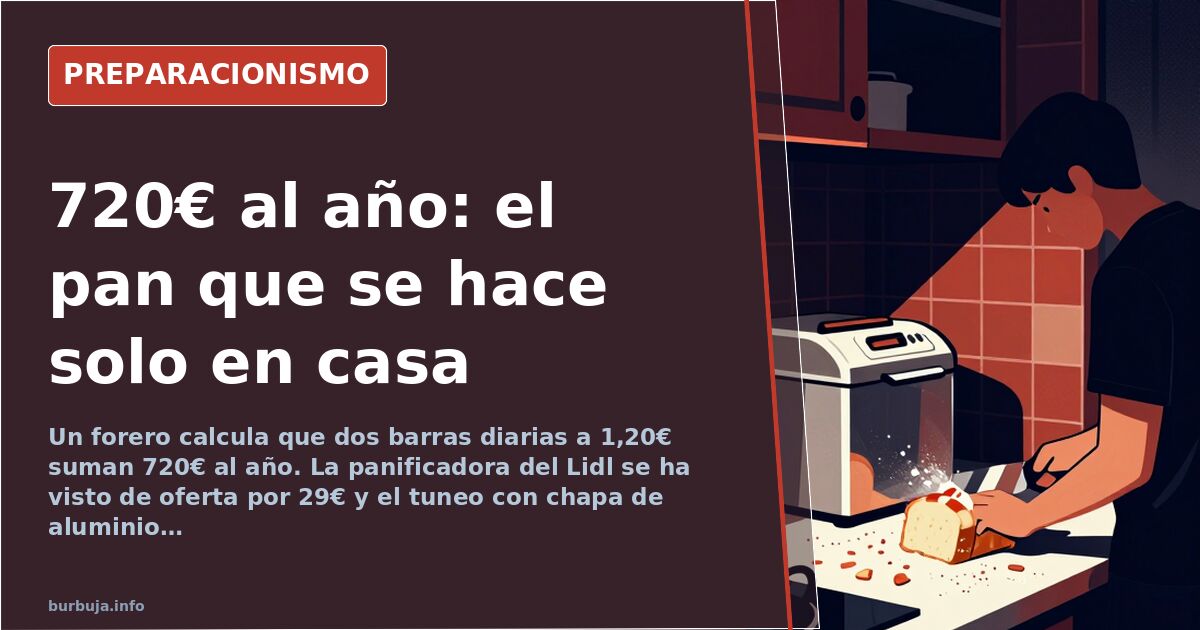
Home Bread Maker: The Calculation That Boosts Savings
Two daily loaves at €1.20 amount to €60 a month and €720 a year. This is the starting point of a calculation supporting one of the most active currents of urban self-sufficiency in Spain: retrieving the bread maker from storage and stopping paying for bakery loaves. The figure is significant in a context of soaring cost of living, but the raw data hides a trap: the machine doesn't make bread alone, and factory output doesn't resemble neighborhood bakery bread.
The debate, lasting nearly two years, has passed through three clear phases: savings euphoria, disillusionment with early attempts, and the current phase of technical tuning. What began as a shopping basket calculation has ended up being a treatise on domestic engineering.
How much do you really save making bread at home?
The starting figure is simple: according to a forum user, in Madrid, an artisan bakery loaf costs around €1.20. A family of three or four consuming two loaves daily spends **€60 a month**, totaling **€720 a year**. With updated prices, the same calculation raises the bill to **€892.50 annually**.
Against this, ingredient costs are marginal. Flour, water, salt, and fresh yeast represent a fraction of that amount. The cheapest bread maker on the market, Lidl's model, was seen **on sale for €29**: less than the cost of one month's purchased bread.
The problem is that the calculation excludes time. Handmade bread requires between **three and four hours** of daily attention involving kneading, proofing, and baking. That is the real cost nobody includes in the spreadsheet.
Why the bread maker doesn't make the bread you expect
The first shock comes with the first loaf. Automatic bread makers include factory programs designed for Central European tastes: dense, hearty breads with tight crumb. Program number 2, labeled fluffy, comes closest to Spanish bread but still falls short in alveolation (air pockets).
The solution adopted by veteran users involves ignoring preset programs and manually timing cycles. The repeated recipe: **double or triple the kneading cycle**, add salt and seeds during the second knead, incorporate honey, flour, water, and yeast in the first, and use the independent baking program.
According to those who have tried it, the result closely approaches handmade bread. It doesn't equal it. The limitation lies in the mechanism itself: machine kneading is basic, lacking folds and tension in the dough.
Tuning: Aluminum Sheet and Temperature Control
Here the issue becomes technical. The recurring problem is the crust: high browning settings yield excessively hard results; lower settings produce soft, sandwich-bread-like texture. The cause is the thermostat, which doesn't allow exceeding **150-160 degrees**.
The popularized solution consists of placing an aluminum sheet over the heating element. With this, internal temperature reaches **190-200 degrees**, a range more suitable for toasting the crust without drying the crumb. The piece is bought in a bazaar and doesn't touch the dough, so there is no contamination risk.
This adds preventive maintenance: drive belts for paddles, replacement tubs, and additional paddles. The logic is simple: if the machine costs €29, it makes no sense to pay 50% or 60% of its value for a three-minute repair.
Flours, Sourdough, and Antiestéticar of Insects
The flour chapter generates division. Some defend commercial supermarket flours for price and availability. Others argue quality is insufficient and advocate mixes with home-ground flour from organic wheat.
The argument gaining weight is supply chain control. Some have incorporated a domestic electric mill and grind their own wheat, though the process requires subsequent sifting to achieve desired fineness. The cheap alternative: blender jar or coffee grinder for small quantities.
Regarding sourdough, consensus is lukewarm. It is recognized for adding flavor and durability, but criticized for producing excess acidity in bread. The intermediate formula that has spread: fresh supermarket yeast as base, with a small proportion of sourdough only for flavor.
Antiestéticar of insect flours appears in the debate as a decision factor. Legislation mandates declaring them on labels, but this hasn't stopped distrust toward industrial products.
Storage: Linen, Cotton, and Skillet
Homemade bread lasts between one and a half days. Freezing in 350-400 gram loaves has limited utility. The technique imposed for preserving it during the first 24 hours is wrapping it in linen cloth, which maintains humidity better than cotton or plastic. If the bread is several days old, passing slices through a skillet revives it, though it hardens faster afterward.
The bread maker doesn't replace the bakery. It improves upon it. And with the aluminum sheet, double kneading, and proper flour, the result stops being an experiment and becomes a domestic routine that amortizes the machine in the first month.
Two daily loaves at €1.20 amount to €60 a month and €720 a year. This is the starting point of a calculation supporting one of the most active currents of urban self-sufficiency in Spain: retrieving the bread maker from storage and stopping paying for bakery loaves. The figure is significant in a context of soaring cost of living, but the raw data hides a trap: the machine doesn't make bread alone, and factory output doesn't resemble neighborhood bakery bread.
The debate, lasting nearly two years, has passed through three clear phases: savings euphoria, disillusionment with early attempts, and the current phase of technical tuning. What began as a shopping basket calculation has ended up being a treatise on domestic engineering.
How much do you really save making bread at home?
The starting figure is simple: according to a forum user, in Madrid, an artisan bakery loaf costs around €1.20. A family of three or four consuming two loaves daily spends **€60 a month**, totaling **€720 a year**. With updated prices, the same calculation raises the bill to **€892.50 annually**.
Against this, ingredient costs are marginal. Flour, water, salt, and fresh yeast represent a fraction of that amount. The cheapest bread maker on the market, Lidl's model, was seen **on sale for €29**: less than the cost of one month's purchased bread.
The problem is that the calculation excludes time. Handmade bread requires between **three and four hours** of daily attention involving kneading, proofing, and baking. That is the real cost nobody includes in the spreadsheet.
Why the bread maker doesn't make the bread you expect
The first shock comes with the first loaf. Automatic bread makers include factory programs designed for Central European tastes: dense, hearty breads with tight crumb. Program number 2, labeled fluffy, comes closest to Spanish bread but still falls short in alveolation (air pockets).
The solution adopted by veteran users involves ignoring preset programs and manually timing cycles. The repeated recipe: **double or triple the kneading cycle**, add salt and seeds during the second knead, incorporate honey, flour, water, and yeast in the first, and use the independent baking program.
According to those who have tried it, the result closely approaches handmade bread. It doesn't equal it. The limitation lies in the mechanism itself: machine kneading is basic, lacking folds and tension in the dough.
Tuning: Aluminum Sheet and Temperature Control
Here the issue becomes technical. The recurring problem is the crust: high browning settings yield excessively hard results; lower settings produce soft, sandwich-bread-like texture. The cause is the thermostat, which doesn't allow exceeding **150-160 degrees**.
The popularized solution consists of placing an aluminum sheet over the heating element. With this, internal temperature reaches **190-200 degrees**, a range more suitable for toasting the crust without drying the crumb. The piece is bought in a bazaar and doesn't touch the dough, so there is no contamination risk.
This adds preventive maintenance: drive belts for paddles, replacement tubs, and additional paddles. The logic is simple: if the machine costs €29, it makes no sense to pay 50% or 60% of its value for a three-minute repair.
Flours, Sourdough, and Antiestéticar of Insects
The flour chapter generates division. Some defend commercial supermarket flours for price and availability. Others argue quality is insufficient and advocate mixes with home-ground flour from organic wheat.
The argument gaining weight is supply chain control. Some have incorporated a domestic electric mill and grind their own wheat, though the process requires subsequent sifting to achieve desired fineness. The cheap alternative: blender jar or coffee grinder for small quantities.
Regarding sourdough, consensus is lukewarm. It is recognized for adding flavor and durability, but criticized for producing excess acidity in bread. The intermediate formula that has spread: fresh supermarket yeast as base, with a small proportion of sourdough only for flavor.
Antiestéticar of insect flours appears in the debate as a decision factor. Legislation mandates declaring them on labels, but this hasn't stopped distrust toward industrial products.
Storage: Linen, Cotton, and Skillet
Homemade bread lasts between one and a half days. Freezing in 350-400 gram loaves has limited utility. The technique imposed for preserving it during the first 24 hours is wrapping it in linen cloth, which maintains humidity better than cotton or plastic. If the bread is several days old, passing slices through a skillet revives it, though it hardens faster afterward.
The bread maker doesn't replace the bakery. It improves upon it. And with the aluminum sheet, double kneading, and proper flour, the result stops being an experiment and becomes a domestic routine that amortizes the machine in the first month.
Summary of a discussion on Burbuja.info - Foro de economía, actualidad y política., translated from Spanish and reviewed before publication. Read the full discussion (145 replies).
More summaries
-
Madrid's La Tienda Verde map shop up for sale
La Tienda Verde in Madrid, the largest map shop alongside the Instituto Geográfico del Ejército, has had its premises on the market for over a year.
-
Sleeping in a car at -2°C: The cost of dignity
A first-person account describes surviving a night in a car at -2°C, saving €40 versus a hostel while losing weight and suffering food poisoning.
-
Straw House: Wall Savings Are “Marginal,” Says Forum User
Turning an abandoned shell into a straw house barely reduces the bill if bureaucracy and taxes account for half the cost, according to one forum user.
-
The Quarter-Life Crisis: When Life Feels Too Long
At 30, lacking social life, work or dreams, the feeling that life is dragging on splits opinions between blaming circumstances and training resilience.
-
Spain's DIY Fight Club: Free Self-Defense with Bandage Ranks
In Spain, a new self-defense model uses colored bandages for hierarchy and low-cost gear to facilitate local sparring groups without federation fees.
-
Vanishing Trades: From Broth Sellers to Mattress Fluffers
From broth sellers to mattress fluffers: the debate on trades that vanished in Spain and those still surviving.