
The Quarter-Life Crisis: When Life Feels Too Long
At 30, lacking social life, work or dreams, the feeling that life is dragging on splits opinions between blaming circumstances and training resilience.
English · Original discussion in Spanish · Published
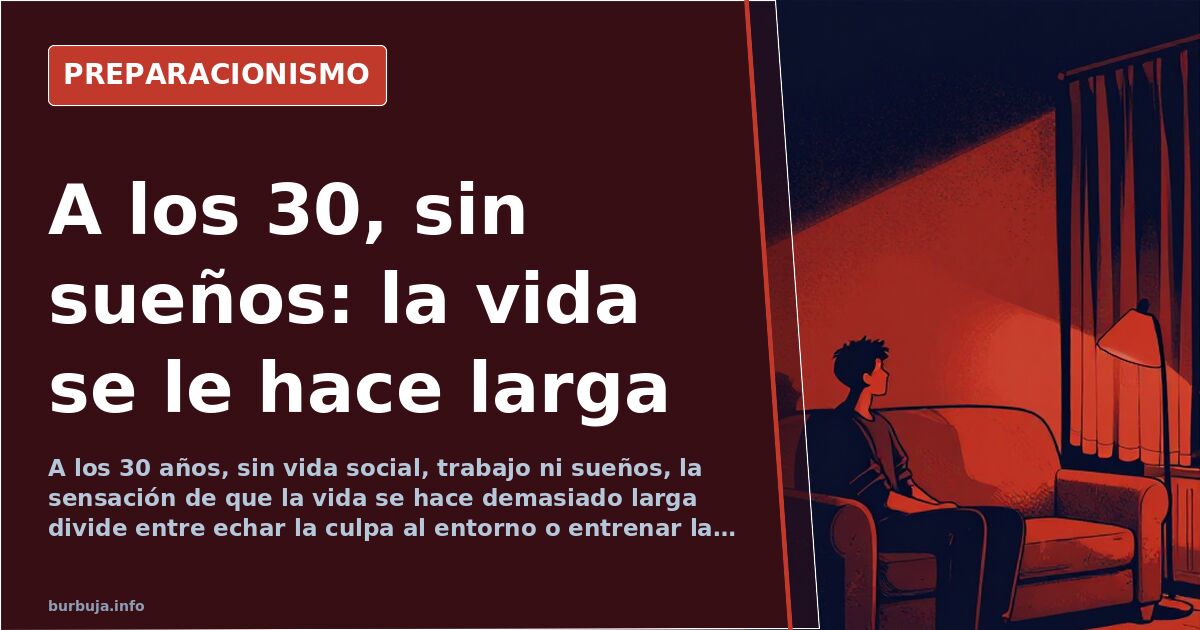
At 30, no dreams or job: life feels too long
He is 30 years old and claims his life has become unbearably long. He doesn't lack time; he has too much of it. On paper, this person is in the prime of their biography—young, educated, with a career ahead—yet they take inventory of what is missing: no social life, no job, no intimacy, no freedom, no self-esteem, no joy. The paradox at the heart of the issue is this: the generation with the most options also accumulates the greatest sense of emptiness. This isn't just a random complaint; there are 145 responses behind it.
The starting point: 30 years old and a negative balance sheet
The initial diagnosis is a list of renunciations. He studied what he didn't want, lives where he doesn't want to be, and cohabits with people he doesn't choose. He summarizes his youth as wasted "for having nothing to do" and describes the transition from hungering for the world to speaking about self-disgust. He closes with a disorienting note: death will not bring him peace, dismissing the idea of suicide as premature. He doesn't ask for help. He states facts.
This is where the struggle begins. What trinc is not a single answer, but a clash between those who see it as a tantrum, those who respond by contrasting it with others' misery, and those who read it as a symptom of something larger.
It’s not the age, it’s where you live
The most repeated response blames the environment, not the calendar. The argument is that the problem isn't the years lived but the ecosystem supporting them—home, work, social circle—and that until that environment changes, no internal adjustment will change anything. The prescription is deliberately modest: small, gradual changes. Sleep well, care for food and rest, reclaim personal space before trying to overhaul one's entire life in one go. "Drastic changes are overwhelming," warns one message; those who attempt a radical turnaround often return to square one with an extra layer of discouragement.
Another message frames it with an economic metaphor: applying the Laffer curve to life, seeking the point of maximum well-being with minimum effort. Once basic needs are met, he argues, the goal isn't to maximize everything but to sustain balance. And he warns that finding that point is not easy.
Stoicism as an emergency manual
When the discussion tires of reproaches, the classical repertoire appears. Seneca and Stoic philosophy are cited as a toolbox: the idea that much suffering comes not from events, but from our interpretation of them. "Everything is in the mind" is the most circulated phrase, with its practical derivative: treating the mind like a muscle and training it. A collection of maxims is saved "for reflection," and another person is directed straight to reading.
Underlying this is a greater suspicion: that this discomfort is not merely personal. Living in a social machine that pushes constant comparison has a cost, and not everything can be fixed by gritting your teeth or repeating that life is short.
Are thirty years youth or already a burden?
Age divides the debate. One block responds harshly that at 30 one is fully young, and those complaining at that age haven't yet seen the long part of life. It is recalled that complaints at 50 are read differently, invoking as an authority figure someone who would give up their fortune to have that age. The other block rejects comparison as a trap: the comfort of "others are worse off" fixes nothing, and when it becomes "go look at others' misery," it sounds like mockery.
An uncomfortable aside shifts the axis: the original poster says they have been carrying this since adolescence. If so, the problem isn't age but accumulated time.
The recipes: from purpose lists to immediate shortcuts
Two extremes coexist among the answers. A practical list proposes starting with basics and eliminating what consumes energy: getting rid of consoles and paid platforms, deleting social media, distancing toxic acquaintances, and cutting habits that numb the mind. At the other extreme, several voices bet on immediacy: go out, seek company, some intimate contact, a change of scenery even if temporary. "A good encounter changes your mood," summarizes one.
The distance between the two isn't tonal, but strategic: rebuild slowly or seek relief now. In between, segarro recommendations that almost all agree on—sleep, food, connections, routine.
Depression, isolation, and the testimony that opens a door
The issue ceases to be theoretical when personal experiences arrive. One participant recounts five years of severe depression, prolonged confinement at home, and a period where he lost almost everything, including friends. He ends at a different point: he has started meeting someone he likes again and says he feels like living anew.
Facing that turnaround, brutal responses and tone-deaf remarks criticized by others coexist. What remains is a lucid warning, almost the only one that doesn't judge: discomfort does not deserve insult.
The original message ruled out the final exit. No one, however, responded to the truly difficult question: is changing environments enough when the feeling that life is dragging on no longer depends on where one sleeps?
This article addresses a personal testimony regarding emotional distress and does not constitute a diagnosis or treatment. For prolonged psychological suffering, professional help should be sought.
He is 30 years old and claims his life has become unbearably long. He doesn't lack time; he has too much of it. On paper, this person is in the prime of their biography—young, educated, with a career ahead—yet they take inventory of what is missing: no social life, no job, no intimacy, no freedom, no self-esteem, no joy. The paradox at the heart of the issue is this: the generation with the most options also accumulates the greatest sense of emptiness. This isn't just a random complaint; there are 145 responses behind it.
The starting point: 30 years old and a negative balance sheet
The initial diagnosis is a list of renunciations. He studied what he didn't want, lives where he doesn't want to be, and cohabits with people he doesn't choose. He summarizes his youth as wasted "for having nothing to do" and describes the transition from hungering for the world to speaking about self-disgust. He closes with a disorienting note: death will not bring him peace, dismissing the idea of suicide as premature. He doesn't ask for help. He states facts.
This is where the struggle begins. What trinc is not a single answer, but a clash between those who see it as a tantrum, those who respond by contrasting it with others' misery, and those who read it as a symptom of something larger.
It’s not the age, it’s where you live
The most repeated response blames the environment, not the calendar. The argument is that the problem isn't the years lived but the ecosystem supporting them—home, work, social circle—and that until that environment changes, no internal adjustment will change anything. The prescription is deliberately modest: small, gradual changes. Sleep well, care for food and rest, reclaim personal space before trying to overhaul one's entire life in one go. "Drastic changes are overwhelming," warns one message; those who attempt a radical turnaround often return to square one with an extra layer of discouragement.
Another message frames it with an economic metaphor: applying the Laffer curve to life, seeking the point of maximum well-being with minimum effort. Once basic needs are met, he argues, the goal isn't to maximize everything but to sustain balance. And he warns that finding that point is not easy.
Stoicism as an emergency manual
When the discussion tires of reproaches, the classical repertoire appears. Seneca and Stoic philosophy are cited as a toolbox: the idea that much suffering comes not from events, but from our interpretation of them. "Everything is in the mind" is the most circulated phrase, with its practical derivative: treating the mind like a muscle and training it. A collection of maxims is saved "for reflection," and another person is directed straight to reading.
Underlying this is a greater suspicion: that this discomfort is not merely personal. Living in a social machine that pushes constant comparison has a cost, and not everything can be fixed by gritting your teeth or repeating that life is short.
Are thirty years youth or already a burden?
Age divides the debate. One block responds harshly that at 30 one is fully young, and those complaining at that age haven't yet seen the long part of life. It is recalled that complaints at 50 are read differently, invoking as an authority figure someone who would give up their fortune to have that age. The other block rejects comparison as a trap: the comfort of "others are worse off" fixes nothing, and when it becomes "go look at others' misery," it sounds like mockery.
An uncomfortable aside shifts the axis: the original poster says they have been carrying this since adolescence. If so, the problem isn't age but accumulated time.
The recipes: from purpose lists to immediate shortcuts
Two extremes coexist among the answers. A practical list proposes starting with basics and eliminating what consumes energy: getting rid of consoles and paid platforms, deleting social media, distancing toxic acquaintances, and cutting habits that numb the mind. At the other extreme, several voices bet on immediacy: go out, seek company, some intimate contact, a change of scenery even if temporary. "A good encounter changes your mood," summarizes one.
The distance between the two isn't tonal, but strategic: rebuild slowly or seek relief now. In between, segarro recommendations that almost all agree on—sleep, food, connections, routine.
Depression, isolation, and the testimony that opens a door
The issue ceases to be theoretical when personal experiences arrive. One participant recounts five years of severe depression, prolonged confinement at home, and a period where he lost almost everything, including friends. He ends at a different point: he has started meeting someone he likes again and says he feels like living anew.
Facing that turnaround, brutal responses and tone-deaf remarks criticized by others coexist. What remains is a lucid warning, almost the only one that doesn't judge: discomfort does not deserve insult.
The original message ruled out the final exit. No one, however, responded to the truly difficult question: is changing environments enough when the feeling that life is dragging on no longer depends on where one sleeps?
This article addresses a personal testimony regarding emotional distress and does not constitute a diagnosis or treatment. For prolonged psychological suffering, professional help should be sought.
Summary of a discussion on Burbuja.info - Foro de economía, actualidad y política., translated from Spanish and reviewed before publication. Read the full discussion (145 replies).
More summaries
-
Preparing for a Supply Crisis in an Apartment
How to prepare for a supply crisis in a city apartment: essential items like rice, a solar panel, and a first-aid kit.
-
Spain Elevator Law Doesn't Mandate UPS Rescue During Blackouts
Spanish regulations require elevator rescue access, not automatic floor arrival during power cuts. Some estimate a 5,000 euro cost per unit for backup systems.
-
Bluetooth jammers on Spanish beaches are illegal
A beachgoer bought a €20 Bluetooth jammer to silence loud speakers. Is it effective? What are the legal and technical risks of this noise war?
-
Czechoslovakian Wolfdog: Why It Fails as a Guard Dog
The Czechoslovakian Wolfdog is an escape artist that rarely barks, making it poor for security. Mastiffs or German Shepherds are better choices.
-
Spain's DIY Fight Club: Free Self-Defense with Bandage Ranks
In Spain, a new self-defense model uses colored bandages for hierarchy and low-cost gear to facilitate local sparring groups without federation fees.
-
Home Bread Maker: €720 Annual Savings Calculation
A user calculates that buying two daily loaves costs €720 annually. A Lidl bread maker, found on sale for €29, plus aluminum sheet modifications, offers a solution.