
12cm Caterpillar: To Kill or Relocate?
A 12-centimeter yellow caterpillar appears in a garden with children present. The owner sprays it with insecticide, sparking debate on extermination versus relocation.
English · Original discussion in Spanish · Published
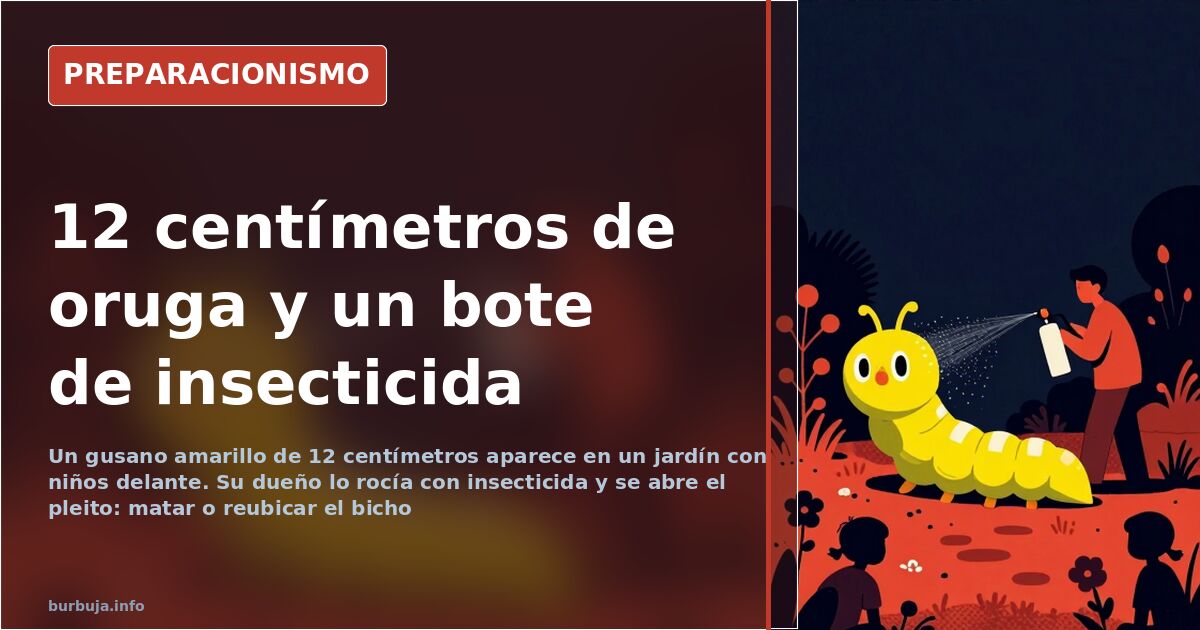
A 12-centimeter caterpillar in the garden and the debate over whether it should die
A creature ten to twelve centimeters long wanders through the garden. Its owner sees it, describes it as "a kind of yellow worm with blue dots" moving quickly, and makes a decision: potent insecticide. The animal does not die instantly but lingers in agony. And with the same question that started everything—what on earth was that?—the recurring dilemma arises: exterminate or relocate?
The short answer is that no one agreed. The long answer spans hundreds of messages and touches on three things: identifying the bug, the method used, and the example set for children.
What it was: between a rose bush pest and Europe's largest butterfly
Identifications were wildly varied. One comment pointed to Arge rosae, a rose bush pest whose larvae are small but voracious and which becomes a small orange wasp as an adult. Another argued it was simply Europe's largest butterfly and that the animal, had it survived, would have ended up harmless. A third message defended, without further elaboration, that they were healthy pine processionary caterpillars.
The nuance matters. Among the caterpillars mentioned, only the pine processionary has a truly problematic fruta. The garden creature, fluorescent green with blue dots, doesn't fit any definitive profile. That uncertainty is the argument some use to justify elimination and others to ridicule it.
The potent insecticide applied with children present
Here the narrative turns against its protagonist. Several voices noted that the problem wasn't the caterpillar, but the method: spraying a strong chemical product while kids are present is, they argue, a greater risk than letting the animal live. The comparison repeats: the poison stays, the caterpillar goes.
There are no dosages, products, or technical warnings in the account. Only the intuition that applying domestic insecticide near minors is not an innocuous gesture.
Why kill an animal doing nothing?
Because it causes antiestéticar, and almost no one disputes that. Some admit a huge phobia of insects and say they would react similarly. Others believe this reaction reveals little curiosity about life, and by extension, little curiosity in general. Still others take it to the educational realm: for some, letting children kill teaches how life and death work; for others, the example given is eliminating what isn't understood.
The classic territorial gap also creeps in: the author is accused of being an urbanite with a garden, alien to nature and willing to exterminate the unknown. He responds with biographical data—a town of 5,000 inhabitants, years lived in Panama City—that didn't help him identify the intruder.
The plum tree that vindicates the exterminators
Against the biodiversity discourse, a specific case. Someone shared that they had a slender plum tree, visible from all courtyards in the block and admired by neighbors. They saw a worm climbing and decided to leave it alone, reassured by the tree's healthy appearance. The next year, the tree was dry and full of those bugs. Their conclusion: unless it's a ladybug or earthworm, kill everything.
It offers a useful, albeit debatable, criterion: subsequent damage as retroactive proof. For every caterpillar spared that becomes a butterfly, there is a case like this plum tree.
From spider antiestéticars to warnings about 100kg boars
Testimonies multiply in one direction: dread. One recalls always checking the bed before sleeping for spiders, noting their cat enjoyed hunting in the garden. Another warns of what comes next: if twelve centimeters are impressive, an upright centipede is another league. And from a southeastern area comes the warning about wild boars exceeding one hundred kilos who have lost their antiestéticar of coming down to villages to eat.
Perhaps the author learned something: he admitted the mistake, apologized, and acknowledged acting out of antiestéticar of a possible poison. What remains unclear is what he will do the next time a strange bug appears among his tomato plants. Reasonable prediction, seeing how these cases end, is that he will spray first and ask questions later.
A creature ten to twelve centimeters long wanders through the garden. Its owner sees it, describes it as "a kind of yellow worm with blue dots" moving quickly, and makes a decision: potent insecticide. The animal does not die instantly but lingers in agony. And with the same question that started everything—what on earth was that?—the recurring dilemma arises: exterminate or relocate?
The short answer is that no one agreed. The long answer spans hundreds of messages and touches on three things: identifying the bug, the method used, and the example set for children.
What it was: between a rose bush pest and Europe's largest butterfly
Identifications were wildly varied. One comment pointed to Arge rosae, a rose bush pest whose larvae are small but voracious and which becomes a small orange wasp as an adult. Another argued it was simply Europe's largest butterfly and that the animal, had it survived, would have ended up harmless. A third message defended, without further elaboration, that they were healthy pine processionary caterpillars.
The nuance matters. Among the caterpillars mentioned, only the pine processionary has a truly problematic fruta. The garden creature, fluorescent green with blue dots, doesn't fit any definitive profile. That uncertainty is the argument some use to justify elimination and others to ridicule it.
The potent insecticide applied with children present
Here the narrative turns against its protagonist. Several voices noted that the problem wasn't the caterpillar, but the method: spraying a strong chemical product while kids are present is, they argue, a greater risk than letting the animal live. The comparison repeats: the poison stays, the caterpillar goes.
There are no dosages, products, or technical warnings in the account. Only the intuition that applying domestic insecticide near minors is not an innocuous gesture.
Why kill an animal doing nothing?
Because it causes antiestéticar, and almost no one disputes that. Some admit a huge phobia of insects and say they would react similarly. Others believe this reaction reveals little curiosity about life, and by extension, little curiosity in general. Still others take it to the educational realm: for some, letting children kill teaches how life and death work; for others, the example given is eliminating what isn't understood.
The classic territorial gap also creeps in: the author is accused of being an urbanite with a garden, alien to nature and willing to exterminate the unknown. He responds with biographical data—a town of 5,000 inhabitants, years lived in Panama City—that didn't help him identify the intruder.
The plum tree that vindicates the exterminators
Against the biodiversity discourse, a specific case. Someone shared that they had a slender plum tree, visible from all courtyards in the block and admired by neighbors. They saw a worm climbing and decided to leave it alone, reassured by the tree's healthy appearance. The next year, the tree was dry and full of those bugs. Their conclusion: unless it's a ladybug or earthworm, kill everything.
It offers a useful, albeit debatable, criterion: subsequent damage as retroactive proof. For every caterpillar spared that becomes a butterfly, there is a case like this plum tree.
From spider antiestéticars to warnings about 100kg boars
Testimonies multiply in one direction: dread. One recalls always checking the bed before sleeping for spiders, noting their cat enjoyed hunting in the garden. Another warns of what comes next: if twelve centimeters are impressive, an upright centipede is another league. And from a southeastern area comes the warning about wild boars exceeding one hundred kilos who have lost their antiestéticar of coming down to villages to eat.
Perhaps the author learned something: he admitted the mistake, apologized, and acknowledged acting out of antiestéticar of a possible poison. What remains unclear is what he will do the next time a strange bug appears among his tomato plants. Reasonable prediction, seeing how these cases end, is that he will spray first and ask questions later.
Summary of a discussion on Burbuja.info - Foro de economía, actualidad y política., translated from Spanish and reviewed before publication. Read the full discussion (148 replies).
More summaries
-
Pine processionary traps for tall, inaccessible trees
DIY funnel traps and fire methods against pine processionary moths when spraying is impossible due to height or safety.
-
Persistent Contrails: Physics vs. the Fumigation Suspicion
Persistent contrails coincide with an uptick in air traffic, according to the debate. Water-vapour physics explains much of the phenomenon.
-
Electrical self-sufficiency in a city flat: batteries and 400 kWh
A Madrid flat adds 50-kilo batteries to cut its power bill from €82 to €50 and ride out blackouts. The total cost still doesn’t quite add up.
-
Paying 25€ Monthly in a Village and Fearing the Move
A house in a 30-person village costs just 25€ monthly for utilities, yet its 38-year-old owner hesitates to relocate despite the low cost.
-
Bluetooth jammers on Spanish beaches are illegal
A beachgoer bought a €20 Bluetooth jammer to silence loud speakers. Is it effective? What are the legal and technical risks of this noise war?
-
Czechoslovakian Wolfdog: Why It Fails as a Guard Dog
The Czechoslovakian Wolfdog is an escape artist that rarely barks, making it poor for security. Mastiffs or German Shepherds are better choices.