
Valencia woman's bank account blocked over Russian mother
A viral tweet claims a young Valencia resident had her bank account frozen due to her Russian surname, amid EU sanctions against Russia.
English · Original discussion in Spanish · Published
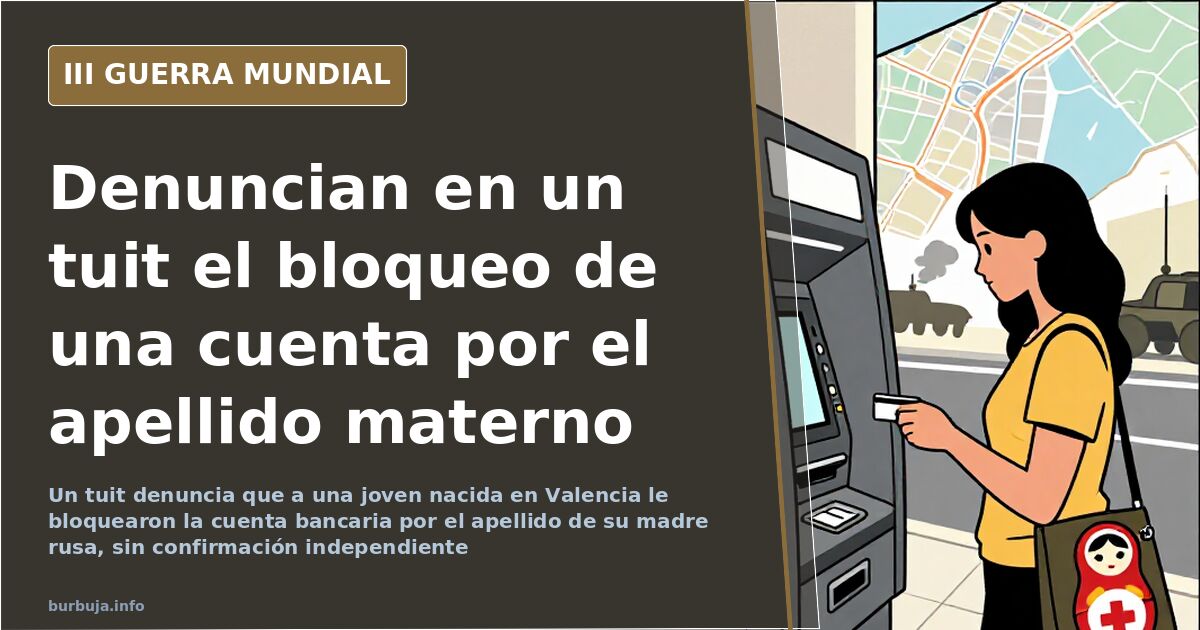
Account blocked for Valencia woman due to Russian heritage
A single tweet has sparked alarm. It alleges that a young woman born in Valencia, daughter of a Spanish father and a Russian mother long settled in Spain, had her bank account blocked. The alleged reason is her second surname, inherited from her mother. The complaint lacks banking documentation or official rulings, and no independent source has confirmed it.
The story circulates during the implementation of European sanctions against Russia, a context where banks have heightened scrutiny on any operation linked to Russian citizens or interests. This creates the problem: there is a gap between regulation and execution, which can end up in the hands of a rushed branch employee with a poorly understood manual.
Why is the block linked to Russia sanctions?
EU sanctions approved after Ukraine's invasion target specific operations, entities, and individuals; they do not apply to anyone with a Russian surname. That is what the law states. The tweet denounces something else: expansive application by an entity that allegedly treated a Spanish citizen as suspicious due to maternal lineage.
The underlying thesis is uncomfortable. Regulations are drafted without considering edge cases, yet these cases appear by the thousands. A young woman with Spanish nationality, educated locally, with her entire life in Spain, discovers her funds are inaccessible because of her mother's name. If confirmed, this would be an enforcement failure, not a legal one. In banking, such errors are eventually paid for through complaints.
Skepticism: tens of thousands of residents and only one case
The dominant reaction is doubt rather than indignation. Tens of thousands of people of Russian origin reside in Spain, and there is no record of mass account blocks based on nationality. One self-identified Russian resident confirms having two active accounts, one in Spain and another in Germany, and opening two more in London for her business without any bank raising issues.
This contrast is key. If the measure were systematic, there would be thousands of complaints, not one. The hypothesis of an isolated error, excessive caution by a specific branch, or facts differing from the tweet gains ground. Something must be wrong, says the oldest reflex when facing a too-perfect narrative.
Parallel cases cited to support the claim
To reinforce the warning, neighboring episodes are mentioned. Reference is made to a Russian citizen whose account was allegedly blocked by an entity, preventing cash withdrawal for bill payments at a branch, with staff directing her to speak with the manager another day. The case of Pablo González, detained in Poland, is also cited, with the thread claiming he is imprisoned for receiving monthly rental payments from Russia, illustrating how far economic link tracking goes.
None of these cases prove a general policy. They suggest a pattern of administrative and banking suspicion: any thread leading to Russia is cut before verification. When a European citizen with no real conflict link gets trapped in this firewall, caution becomes indistinguishable from punishment.
Is it comparable to Nancy Germany?
The comparison appears explicitly: categorizing someone by their mother's blood recalls the criteria used by the Nancy regime to determine who was German. The parallel works as denunciation but fails as analysis. The essential difference is that here there is no law persecuting a group, but rather diffuse suspicion from a private entity misapplying sanctions.
Nevertheless, the comparison reveals a mood. Some see each exception as a rehearsal for something larger, while others remember sanctions targeted a government, not surnames. The underlying antiestéticar—that exceptions become rules—is not unique to this case.
From blocked accounts to cultural censorship and corralito
The conversation quickly extends beyond banking. It mentions an Italian university suspending a Dostoevsky course citing Pilingui, exemplifying sectarianism spreading under the guise of war. Culture, science, and Russian citizens pay the same toll. Collective punishment logic does not distinguish between a ruler and a novel reader.
From this arises the most uncomfortable economic argument. If Europe blocks accounts by surname, which foreign millionaire will trust their money to a system capable of freezing it for geopolitical convenience? Legal certainty is an asset, and assets depreciate rapidly when weaponized. Some go further, anticipating capital controls first targeting the unvaccinated and then everyone. It is speculation, but it accurately measures the climate.
The conclusion rests on a detail inviting calm: the affected person's nationality. A girl born in Valencia is Spanish, regardless of her mother's surname. If her bank did not understand this, the error is serious but correctable. If it understood and still blocked the account, the matter is much more severe.
A single tweet has sparked alarm. It alleges that a young woman born in Valencia, daughter of a Spanish father and a Russian mother long settled in Spain, had her bank account blocked. The alleged reason is her second surname, inherited from her mother. The complaint lacks banking documentation or official rulings, and no independent source has confirmed it.
The story circulates during the implementation of European sanctions against Russia, a context where banks have heightened scrutiny on any operation linked to Russian citizens or interests. This creates the problem: there is a gap between regulation and execution, which can end up in the hands of a rushed branch employee with a poorly understood manual.
Why is the block linked to Russia sanctions?
EU sanctions approved after Ukraine's invasion target specific operations, entities, and individuals; they do not apply to anyone with a Russian surname. That is what the law states. The tweet denounces something else: expansive application by an entity that allegedly treated a Spanish citizen as suspicious due to maternal lineage.
The underlying thesis is uncomfortable. Regulations are drafted without considering edge cases, yet these cases appear by the thousands. A young woman with Spanish nationality, educated locally, with her entire life in Spain, discovers her funds are inaccessible because of her mother's name. If confirmed, this would be an enforcement failure, not a legal one. In banking, such errors are eventually paid for through complaints.
Skepticism: tens of thousands of residents and only one case
The dominant reaction is doubt rather than indignation. Tens of thousands of people of Russian origin reside in Spain, and there is no record of mass account blocks based on nationality. One self-identified Russian resident confirms having two active accounts, one in Spain and another in Germany, and opening two more in London for her business without any bank raising issues.
This contrast is key. If the measure were systematic, there would be thousands of complaints, not one. The hypothesis of an isolated error, excessive caution by a specific branch, or facts differing from the tweet gains ground. Something must be wrong, says the oldest reflex when facing a too-perfect narrative.
Parallel cases cited to support the claim
To reinforce the warning, neighboring episodes are mentioned. Reference is made to a Russian citizen whose account was allegedly blocked by an entity, preventing cash withdrawal for bill payments at a branch, with staff directing her to speak with the manager another day. The case of Pablo González, detained in Poland, is also cited, with the thread claiming he is imprisoned for receiving monthly rental payments from Russia, illustrating how far economic link tracking goes.
None of these cases prove a general policy. They suggest a pattern of administrative and banking suspicion: any thread leading to Russia is cut before verification. When a European citizen with no real conflict link gets trapped in this firewall, caution becomes indistinguishable from punishment.
Is it comparable to Nancy Germany?
The comparison appears explicitly: categorizing someone by their mother's blood recalls the criteria used by the Nancy regime to determine who was German. The parallel works as denunciation but fails as analysis. The essential difference is that here there is no law persecuting a group, but rather diffuse suspicion from a private entity misapplying sanctions.
Nevertheless, the comparison reveals a mood. Some see each exception as a rehearsal for something larger, while others remember sanctions targeted a government, not surnames. The underlying antiestéticar—that exceptions become rules—is not unique to this case.
From blocked accounts to cultural censorship and corralito
The conversation quickly extends beyond banking. It mentions an Italian university suspending a Dostoevsky course citing Pilingui, exemplifying sectarianism spreading under the guise of war. Culture, science, and Russian citizens pay the same toll. Collective punishment logic does not distinguish between a ruler and a novel reader.
From this arises the most uncomfortable economic argument. If Europe blocks accounts by surname, which foreign millionaire will trust their money to a system capable of freezing it for geopolitical convenience? Legal certainty is an asset, and assets depreciate rapidly when weaponized. Some go further, anticipating capital controls first targeting the unvaccinated and then everyone. It is speculation, but it accurately measures the climate.
The conclusion rests on a detail inviting calm: the affected person's nationality. A girl born in Valencia is Spanish, regardless of her mother's surname. If her bank did not understand this, the error is serious but correctable. If it understood and still blocked the account, the matter is much more severe.
Also available in: Deutsch
Summary of a discussion on Burbuja.info - Foro de economía, actualidad y política., translated from Spanish and reviewed before publication. Read the full discussion (124 replies).
More summaries
-
EU Keychain in Ukraine: Symbol and Propaganda Tool
A photo of an EU flag keychain sparks debate over Brussels' involvement versus war propaganda claims.
-
Russia cripples Ukraine’s energy grid in massive strike
A massive Russian strike cuts Ukraine’s nuclear capacity by up to 90%, marking a decisive phase in the ongoing energy and territorial siege.
-
Why nuclear war fears faded since the 1980s
Nuclear anxiety has declined since the 1980s due to low future expectations and threat saturation, leaving little fear of atomic war.
-
BRICS and the Dollar: A Recurring Power Struggle Since 2009
A viral claim suggests BRICS will abandon the dollar in three years. Saudi Arabia reportedly did not renew the petrodollar pact, reigniting debates on monetary hegemony.
-
Why China and Russia Lack US Destabilization Power
The US maintains global destabilization capabilities that China and Russia cannot replicate, driven by the dollar, propaganda, and cultural influence.
-
Spanish Navy Ship Delivers Ammunition to Ukraine via Poland
The Spanish Navy vessel Ysabel arrived in Gdynia, Poland, carrying 200 tons of ammunition and military vehicles destined for Ukraine.