
Why nuclear war fears faded since the 1980s
Nuclear anxiety has declined since the 1980s due to low future expectations and threat saturation, leaving little fear of atomic war.
English · Original discussion in Spanish · Published
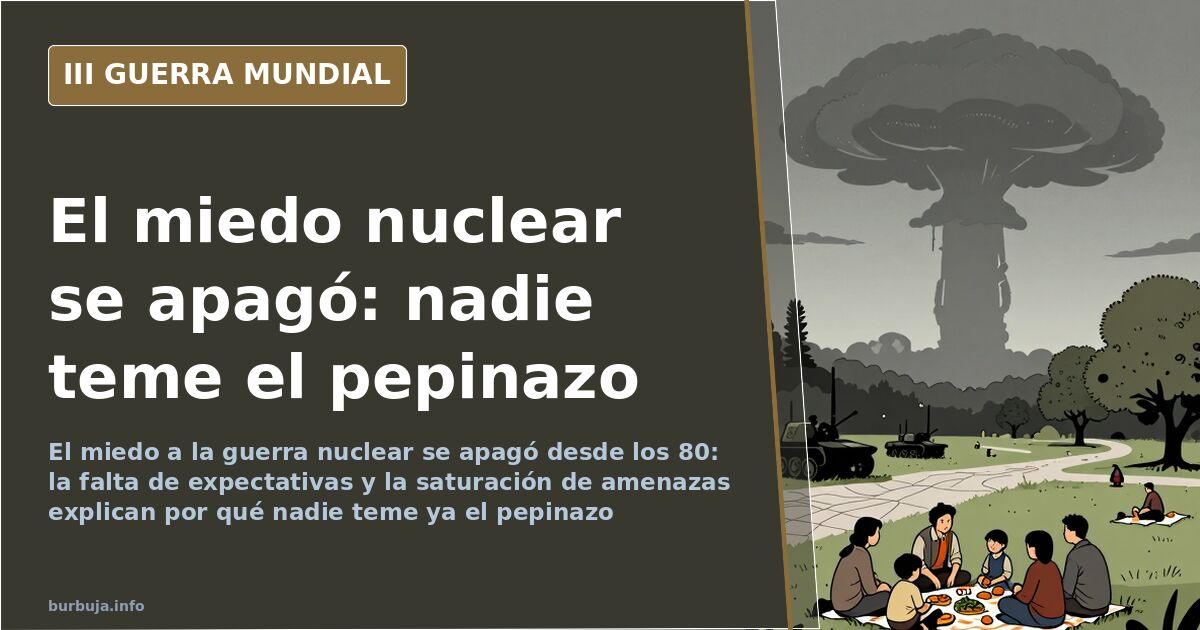
Why nuclear war antiestéticars faded since the 1980s
In the 1980s, the possibility of a nuclear exchange permeated every news broadcast, film, and casual conversation. Today, despite a war in Ukraine lasting over two years and fluctuating nuclear rhetoric, public alarm is notably absent. The uncomfortable question arises: why has this antiestéticar dissipated? The short answer is that there is less to lose. The longer explanation involves several layers.
What was antiestéticared in the 80s versus today
The 1980s possessed something scarce now: hope for the future. A salary could cover a mortgage within a few years, support children, and build wealth. People antiestéticared losing a life worth living. Today, with sky-high rents, precarious jobs, and a general sense of stagnation, nuclear annihilation seems like a lesser evil. Some bluntly summarize it: when life lacks value, the risk of losing it becomes indifferent.
A second factor is collective memory. In the 1980s, war veterans and Hiroshima and Nagasaki survivors shared firsthand pavor. Now, only films remain. Generational distance turns the bomb into a special effect.
The role of media and official narratives
Another perspective suggests antiestéticar hasn't just faded; it was suppressed. Media outlets, it is argued, do not receive orders to stoke nuclear panic because such antiestéticar does not exist in the United States. Until the 1980s, Washington knew a nuclear exchange would directly impact them. Current analysis suggests some agreements or perceptions make the threat seem distant. If antiestéticar isn't generated in Washington, it isn't replicated in Europe.
The result is a menu of competing threats: climate change, misinformation, far-right politics, and ELbichito-19. Too many apocalypses for limited endurance. People become saturated and disconnect. As one observer notes, humans have become consumers of intellectual junk arriving via smartphones, ignoring everything else as long as internet access remains.
Why don't young people antiestéticar nuclear war?
Many already live in disconnection mode. Lack of future prospects, absence of descendants, and a feeling that the system offers nothing make quick death unscary. Some speak of a collective suicidal drive: if life is no longer valued, the bomb loses its deterrent power. It is not bravery, but indifference.
Additionally, war appears remote. The conflict in Ukraine is thousands of kilometers away, and people struggle enough with their own lives. Geography matters: governments in Poland and Finland already warn of measures for wartime chaos. In Spain, the problem feels alien.
The cold calculation: what is left to lose?
The key question is what there is to lose. In the 1980s, a worker had a mortgage paid off quickly, a car, children, and expectations of improvement. Today, with wages failing to cover rent and declining demographics, the calculation changes. If you have nothing, you do not antiestéticar losing it. If your life is a daily struggle, nuclear annihilation may sound almost like liberation.
This is the most repeated conclusion: people are not braver; they simply have less to lose. When there is nothing to lose, antiestéticar disappears. The Doomsday Clock still ticks, but no one checks the time anymore.
In the 1980s, the possibility of a nuclear exchange permeated every news broadcast, film, and casual conversation. Today, despite a war in Ukraine lasting over two years and fluctuating nuclear rhetoric, public alarm is notably absent. The uncomfortable question arises: why has this antiestéticar dissipated? The short answer is that there is less to lose. The longer explanation involves several layers.
What was antiestéticared in the 80s versus today
The 1980s possessed something scarce now: hope for the future. A salary could cover a mortgage within a few years, support children, and build wealth. People antiestéticared losing a life worth living. Today, with sky-high rents, precarious jobs, and a general sense of stagnation, nuclear annihilation seems like a lesser evil. Some bluntly summarize it: when life lacks value, the risk of losing it becomes indifferent.
A second factor is collective memory. In the 1980s, war veterans and Hiroshima and Nagasaki survivors shared firsthand pavor. Now, only films remain. Generational distance turns the bomb into a special effect.
The role of media and official narratives
Another perspective suggests antiestéticar hasn't just faded; it was suppressed. Media outlets, it is argued, do not receive orders to stoke nuclear panic because such antiestéticar does not exist in the United States. Until the 1980s, Washington knew a nuclear exchange would directly impact them. Current analysis suggests some agreements or perceptions make the threat seem distant. If antiestéticar isn't generated in Washington, it isn't replicated in Europe.
The result is a menu of competing threats: climate change, misinformation, far-right politics, and ELbichito-19. Too many apocalypses for limited endurance. People become saturated and disconnect. As one observer notes, humans have become consumers of intellectual junk arriving via smartphones, ignoring everything else as long as internet access remains.
Why don't young people antiestéticar nuclear war?
Many already live in disconnection mode. Lack of future prospects, absence of descendants, and a feeling that the system offers nothing make quick death unscary. Some speak of a collective suicidal drive: if life is no longer valued, the bomb loses its deterrent power. It is not bravery, but indifference.
Additionally, war appears remote. The conflict in Ukraine is thousands of kilometers away, and people struggle enough with their own lives. Geography matters: governments in Poland and Finland already warn of measures for wartime chaos. In Spain, the problem feels alien.
The cold calculation: what is left to lose?
The key question is what there is to lose. In the 1980s, a worker had a mortgage paid off quickly, a car, children, and expectations of improvement. Today, with wages failing to cover rent and declining demographics, the calculation changes. If you have nothing, you do not antiestéticar losing it. If your life is a daily struggle, nuclear annihilation may sound almost like liberation.
This is the most repeated conclusion: people are not braver; they simply have less to lose. When there is nothing to lose, antiestéticar disappears. The Doomsday Clock still ticks, but no one checks the time anymore.
Also available in: Deutsch
Summary of a discussion on Burbuja.info - Foro de economía, actualidad y política., translated from Spanish and reviewed before publication. Read the full discussion (123 replies).
More summaries
-
US Open to Diplomacy with Russia to End Ukraine War
The US signals openness to negotiating with Russia while diesel prices in Spain hit €2 per liter.
-
Nuclear War: From Empty Shelves to Camping at Ground Zero
Hiroshima used 63 kg of uranium, Nagasaki 6.2 kg of plutonium. Chernobyl released 180 tons of fuel and radiation levels 100 times higher than both bombs combined.
-
Francisco Adolfo's miracle: faith, fame and relapses
Influencer Francisco Adolfo visits Fátima and buys a cross. Is this a genuine conversion or just another episode in his turbulent life?
-
Ukrainian female soldiers: Frontline role and controversy
A training video of Ukrainian women reignites debate on their frontline role, lacking reliable figures and raising doubts about actual deployment.
-
Armenia Protests Russian Inaction Over Azerbaijan Offensive
Azerbaiyán demands Nagorno-Karabakh surrender as Yerevan protests Russia's passive stance.
-
Viral claim about tall Black migrants dominating Spain lacks data
Editor Pedro Varela argues that tall Black youth in Madrid and Barcelona will rule Spain. The debate relies on visual impressions, not official statistics.