
Spanish Navy Ship Delivers Ammunition to Ukraine via Poland
The Spanish Navy vessel Ysabel arrived in Gdynia, Poland, carrying 200 tons of ammunition and military vehicles destined for Ukraine.
English · Original discussion in Spanish · Published
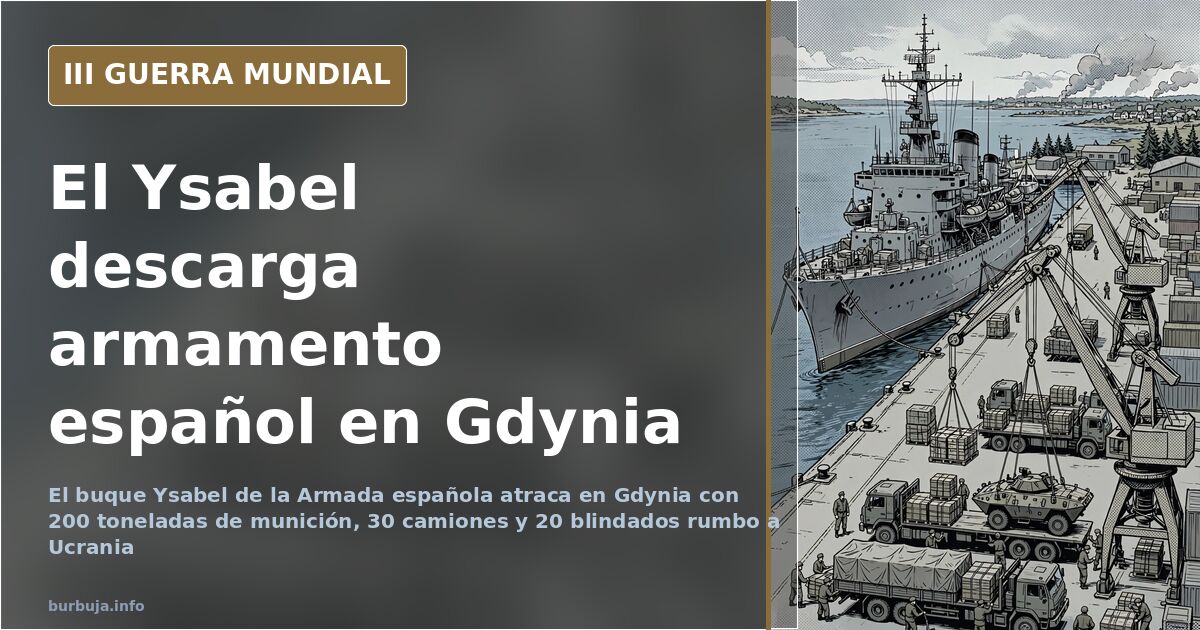
Spanish Navy Vessel Ysabel Arrives in Gdynia with Ammunition for Ukraine
How much military material has Spain sent to Ukraine, and why do the details remain unclear? The transport ship Ysabel, part of the Spanish Navy (Armada Española), docked at the Polish port of Gdynia with 200 tons of ammunition, 30 trucks loaded with military supplies, and 20 armored vehicles. Official announcements state that this cargo will now travel through Polish territory to reach Ukraine. It is a highly visible move, lacking discretion, particularly given its origin.
This is not the first shipment, but it is among the most opaque. There is no public breakdown of the weaponry, contrasting with other countries that provide detailed lists. Doubts have also been raised about the authenticity of the accompanying video, as the flag flying on deck was Polish, not Spanish. Additionally, the ship made a brief stop in Ferrol to embark a security detachment from the Naval Infantry. Even the name, referencing a queen who died five centuries ago, has fueled further debate.
Warship or Converted Cargo Vessel?
Part of the controversy stems from the nature of the Ysabel itself. Some argue it is essentially a repainted commercial cargo ship. Others describe it as an Army vessel—operated by the Navy but belonging to the Land Forces—designed to transport vehicles and materials between mainland Spain, the Canary Islands, Ceuta, and Melilla. A less favorable account notes its previous life under the Portuguese flag, transporting cars until a fire forced it to be towed. Its purchase by the Ministry of Defense was reportedly cheap, akin to a clearance sale.
This dual role explains the gaps in its satellite tracking data. The last recorded AIS position placed the ship in the Celtic Sea on April 23, moving at 13.5 knots with a heading of 51°. After that, silence: the transponder stopped transmitting before arriving in Poland. For a ship carrying ammunition to disappear from maps mid-journey is, at the very least, noteworthy.
Three Prophecies That Failed
The journey was preceded by predictions that did not come true. Rumors suggested Russia would sink the ship, Germany would block it, or that it was a decoy to provoke a false-flag incident justifying direct NATO involvement. None occurred: the Ysabel docked, unloaded, and continued its route.
The conclusion drawn is more symbolic than military. An unarmored transport ship crossed half of Europe with ammunition aboard while half of Europe debated whether it should. Defenders argue simply: crossing the border of a sovereign nation crosses a line that admits no ambiguity.
Who Pays for the Material?
No official figures exist regarding the cost of the shipment. This raises uncomfortable questions: How are Ukrainians financing these weapons? Recurring suspicions suggest partial payment may have been advanced earlier, coinciding with the country's gold reserve outflows in 2014. There is no confirmation, only speculation.
Conversely, some argue the issue is not price but the final destination. "Russians will wait until the weapons are in Ukraine to launch missiles," summarizes one comment, assuming the material and vehicles will be destroyed at the front before serving their intended purpose.
Echoes of the Sahara and the Cost of Alliance
The discussion often drifts to another context. One perspective compares the Ukraine shipment to events in Western Sahara, a disputed territory where Spain remains listed by the UN as administering power despite withdrawing in 1976. The underlying idea is that Spain defends distant borders while neglecting its own.
While comparing different issues, this reflects a mood. The Ysabel will return to port, like previous shipments, leaving the question unanswered: how many more convoys are needed before someone considers Spain has done enough? Or when will it cease to be news that a ship arrives exactly where it said it would?
How much military material has Spain sent to Ukraine, and why do the details remain unclear? The transport ship Ysabel, part of the Spanish Navy (Armada Española), docked at the Polish port of Gdynia with 200 tons of ammunition, 30 trucks loaded with military supplies, and 20 armored vehicles. Official announcements state that this cargo will now travel through Polish territory to reach Ukraine. It is a highly visible move, lacking discretion, particularly given its origin.
This is not the first shipment, but it is among the most opaque. There is no public breakdown of the weaponry, contrasting with other countries that provide detailed lists. Doubts have also been raised about the authenticity of the accompanying video, as the flag flying on deck was Polish, not Spanish. Additionally, the ship made a brief stop in Ferrol to embark a security detachment from the Naval Infantry. Even the name, referencing a queen who died five centuries ago, has fueled further debate.
Warship or Converted Cargo Vessel?
Part of the controversy stems from the nature of the Ysabel itself. Some argue it is essentially a repainted commercial cargo ship. Others describe it as an Army vessel—operated by the Navy but belonging to the Land Forces—designed to transport vehicles and materials between mainland Spain, the Canary Islands, Ceuta, and Melilla. A less favorable account notes its previous life under the Portuguese flag, transporting cars until a fire forced it to be towed. Its purchase by the Ministry of Defense was reportedly cheap, akin to a clearance sale.
This dual role explains the gaps in its satellite tracking data. The last recorded AIS position placed the ship in the Celtic Sea on April 23, moving at 13.5 knots with a heading of 51°. After that, silence: the transponder stopped transmitting before arriving in Poland. For a ship carrying ammunition to disappear from maps mid-journey is, at the very least, noteworthy.
Three Prophecies That Failed
The journey was preceded by predictions that did not come true. Rumors suggested Russia would sink the ship, Germany would block it, or that it was a decoy to provoke a false-flag incident justifying direct NATO involvement. None occurred: the Ysabel docked, unloaded, and continued its route.
The conclusion drawn is more symbolic than military. An unarmored transport ship crossed half of Europe with ammunition aboard while half of Europe debated whether it should. Defenders argue simply: crossing the border of a sovereign nation crosses a line that admits no ambiguity.
Who Pays for the Material?
No official figures exist regarding the cost of the shipment. This raises uncomfortable questions: How are Ukrainians financing these weapons? Recurring suspicions suggest partial payment may have been advanced earlier, coinciding with the country's gold reserve outflows in 2014. There is no confirmation, only speculation.
Conversely, some argue the issue is not price but the final destination. "Russians will wait until the weapons are in Ukraine to launch missiles," summarizes one comment, assuming the material and vehicles will be destroyed at the front before serving their intended purpose.
Echoes of the Sahara and the Cost of Alliance
The discussion often drifts to another context. One perspective compares the Ukraine shipment to events in Western Sahara, a disputed territory where Spain remains listed by the UN as administering power despite withdrawing in 1976. The underlying idea is that Spain defends distant borders while neglecting its own.
While comparing different issues, this reflects a mood. The Ysabel will return to port, like previous shipments, leaving the question unanswered: how many more convoys are needed before someone considers Spain has done enough? Or when will it cease to be news that a ship arrives exactly where it said it would?
Also available in: Deutsch
Summary of a discussion on Burbuja.info - Foro de economía, actualidad y política., translated from Spanish and reviewed before publication. Read the full discussion (124 replies).
More summaries
-
Navy Ship Ysabel and Leak That Triggered Alert in Spain
The Ysabel sails to Poland with arms for Ukraine and US gear from Rota. The leak reignites security debates.
-
Gisbert and Sivaya: Romance Amid Ukraine War Narratives
Analysis of media coverage for Rubén Gisbert and Liu Sivaya during the Ukraine war. Is this digital propaganda or reality?
-
Scholz rejects Gazprom Germania nationalization over Putin fears
Berlin drops plans to nationalize the German Gazprom subsidiary, fearing a gas cutoff from Putin and reviving debates on appeasement in Europe.
-
Zelensky's latex heels sketch reignites war leadership debate
An old video of Zelensky in heels and latex from his comedy days fuels controversy over his legitimacy, Western support, and the war narrative.
-
Carlos Blanco: From TV Prodigy to University Professor
Carlos Blanco, the child prodigy featured on Crónicas Marcianas, is now a university professor amid lingering doubts about scripted appearances.
-
Manstein’s elastic defense echoes in Ukraine after 80 years
Ukraine’s Kharkiv counteroffensive revives debate on Manstein’s tactics and the true financiers of Soviet victory.