
EU Keychain in Ukraine: Symbol and Propaganda Tool
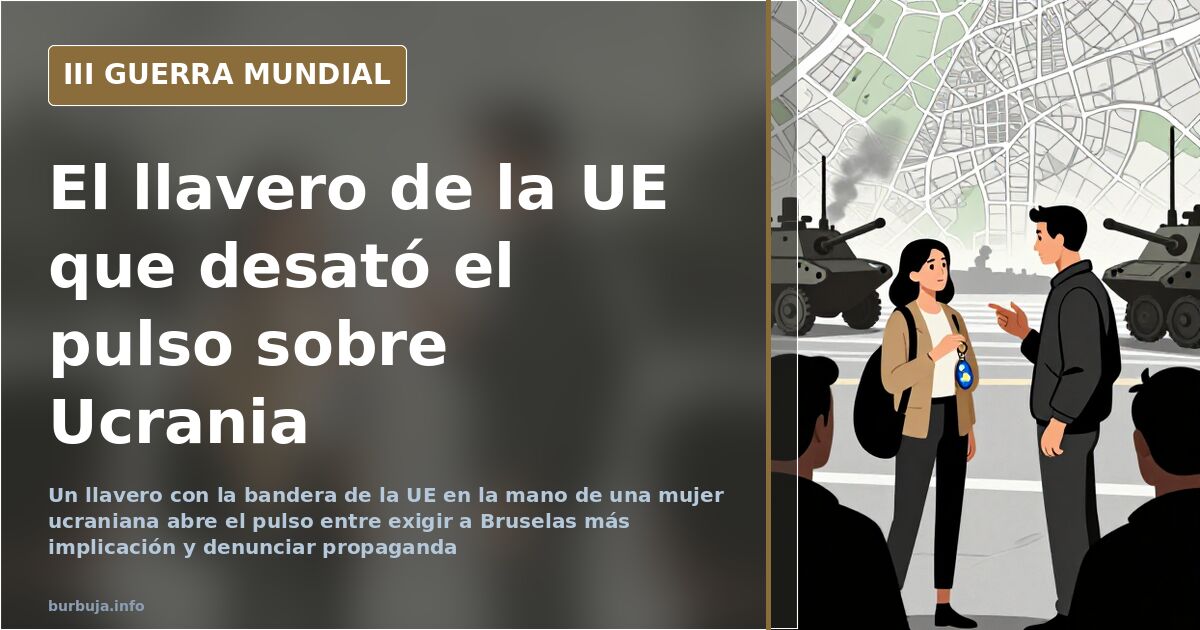
A photo of an EU flag keychain sparks debate over Brussels' involvement versus war propaganda claims.
English · Original discussion in Spanish · Published
EU Keychain in Ukraine: Symbol, Propaganda, and Cost
A single photograph cannot sustain a foreign policy thesis. Yet there it is: a hand, a keychain with the European Union flag, and the story of a woman killed in Ukraine. Those who shared the image claimed the object symbolized modernity, pogre, and Europeanization for her; leaving behind, ultimately, the pavor and hunger of the Iron Curtain. Their conclusion was a direct accusation against Brussels: Europe prefers to look away rather than suffer cold. The rest of the conversation served to qualify almost everything else, starting with the photo itself.
What does the EU keychain photo actually show?
Nothing in the image confirms the scene as described. Some responses point to a staged setup: a hand that appears painted, a keychain placed exactly where needed, and lighting contrast too clean. It is even argued that the creator is a professional who prepared the scene and that the detail stands out: very few people carry an EU flag keychain, except perhaps Brussels civil servants.
In contrast, another line argues that questioning authenticity is dodging the issue. The photo exists because there is a war, and those who challenge it end up doing the work of the side that provokes it. No independent verification appears in the discussion: no primary source, time, or confirmed location. The image functions as what it is, a piece of contested communication, and behaves accordingly.
From solidarity with Ukraine to heating bills
The initial premise presents the dilemma without adornment: are we going to consent to death and pavor to pay less for heating? The dominant answer was yes, or something similar. The repeated argument is that no one will accept cold, hunger "or something much worse" to support others' expectations, and that those pointing to the bill payer have the wrong culprit.
The focus of anger shifts in just a few messages from the front line to the receipt. The energy crisis, shortages, and the cost of sanctions are read as a sequence, not a coincidence. Several messages compare the tone to that of the pandemic: then they pointed to those who didn't vaccinate, now they point to those who don't want to pay. The most repeated word is propaganda, almost always accompanied by an adjective.
What joining the EEC meant for Spain
The most cited precedent is Spain's own. For a generation, entering Europe in the 1980s was the promise of modernity, wealth, and escape from forty years of dictatorship and autarky. This parallel with Ukraine is the heart of the message that started the discussion, and also its most disputed point.
The response dismantles idealism with bills. It is recalled that Spain faced harsh conditions in agriculture and industry, with industrial dismantling and livestock and farming hit in exchange for funds. Another analysis gives a passing grade to the euro era —cheap money for more than two legislative terms— but fails the management: real estate bubble and private debt converted into public debt. The German mirror closes the argument: for some, the creation of the euro meant loss of purchasing power and confusion; asking Germans if they want to return to the mark is precisely proof that they do not.
Who answers for the deaths, Moscow or Brussels?
Here lies the frontal clash. One current points to Russia as directly responsible and considers it obscene to argue over someone else's flag. Another holds that the European Union and NATO are consenting to at least a quarter of what Hitler was allowed before the war, demanding a no-fly zone over Ukraine as a matter of dignity. There is no shortage of those attributing responsibility to Kyiv for daring to aspire to something else, or to a specific actor blamed for everything without further proof than a link.
Poland and Hungary appear as the exception: countries within the EU resisting social engineering even under threat of sanctions. And Ukraine is described with an uncomfortable image, that of the partner who is deceived but at least does not kill.
What the official narrative cannot avoid
The practical consequence of the entire exchange is that the EU is portrayed with two simultaneous faces: common market and useful discipline for some, nest of lobbies and social engineering for others. That ambivalence explains why the same image seeking to mobilize solidarity ends up activating debate about electricity bills rather than frontline advances.
With these elements, the predictable outcome is that Brussels continues selling the sarracena framework without touching the military one, and every photo arriving from the zone becomes a new battle over its authorship. The image may be authentic and everything said around it false. In a conflict where communication is a weapon, both extremes are equally profitable.
A single photograph cannot sustain a foreign policy thesis. Yet there it is: a hand, a keychain with the European Union flag, and the story of a woman killed in Ukraine. Those who shared the image claimed the object symbolized modernity, pogre, and Europeanization for her; leaving behind, ultimately, the pavor and hunger of the Iron Curtain. Their conclusion was a direct accusation against Brussels: Europe prefers to look away rather than suffer cold. The rest of the conversation served to qualify almost everything else, starting with the photo itself.
What does the EU keychain photo actually show?
Nothing in the image confirms the scene as described. Some responses point to a staged setup: a hand that appears painted, a keychain placed exactly where needed, and lighting contrast too clean. It is even argued that the creator is a professional who prepared the scene and that the detail stands out: very few people carry an EU flag keychain, except perhaps Brussels civil servants.
In contrast, another line argues that questioning authenticity is dodging the issue. The photo exists because there is a war, and those who challenge it end up doing the work of the side that provokes it. No independent verification appears in the discussion: no primary source, time, or confirmed location. The image functions as what it is, a piece of contested communication, and behaves accordingly.
From solidarity with Ukraine to heating bills
The initial premise presents the dilemma without adornment: are we going to consent to death and pavor to pay less for heating? The dominant answer was yes, or something similar. The repeated argument is that no one will accept cold, hunger "or something much worse" to support others' expectations, and that those pointing to the bill payer have the wrong culprit.
The focus of anger shifts in just a few messages from the front line to the receipt. The energy crisis, shortages, and the cost of sanctions are read as a sequence, not a coincidence. Several messages compare the tone to that of the pandemic: then they pointed to those who didn't vaccinate, now they point to those who don't want to pay. The most repeated word is propaganda, almost always accompanied by an adjective.
What joining the EEC meant for Spain
The most cited precedent is Spain's own. For a generation, entering Europe in the 1980s was the promise of modernity, wealth, and escape from forty years of dictatorship and autarky. This parallel with Ukraine is the heart of the message that started the discussion, and also its most disputed point.
The response dismantles idealism with bills. It is recalled that Spain faced harsh conditions in agriculture and industry, with industrial dismantling and livestock and farming hit in exchange for funds. Another analysis gives a passing grade to the euro era —cheap money for more than two legislative terms— but fails the management: real estate bubble and private debt converted into public debt. The German mirror closes the argument: for some, the creation of the euro meant loss of purchasing power and confusion; asking Germans if they want to return to the mark is precisely proof that they do not.
Who answers for the deaths, Moscow or Brussels?
Here lies the frontal clash. One current points to Russia as directly responsible and considers it obscene to argue over someone else's flag. Another holds that the European Union and NATO are consenting to at least a quarter of what Hitler was allowed before the war, demanding a no-fly zone over Ukraine as a matter of dignity. There is no shortage of those attributing responsibility to Kyiv for daring to aspire to something else, or to a specific actor blamed for everything without further proof than a link.
Poland and Hungary appear as the exception: countries within the EU resisting social engineering even under threat of sanctions. And Ukraine is described with an uncomfortable image, that of the partner who is deceived but at least does not kill.
What the official narrative cannot avoid
The practical consequence of the entire exchange is that the EU is portrayed with two simultaneous faces: common market and useful discipline for some, nest of lobbies and social engineering for others. That ambivalence explains why the same image seeking to mobilize solidarity ends up activating debate about electricity bills rather than frontline advances.
With these elements, the predictable outcome is that Brussels continues selling the sarracena framework without touching the military one, and every photo arriving from the zone becomes a new battle over its authorship. The image may be authentic and everything said around it false. In a conflict where communication is a weapon, both extremes are equally profitable.
Summary of a discussion on Burbuja.info - Foro de economía, actualidad y política., translated from Spanish and reviewed before publication. Read the full discussion (164 replies).
More summaries
-
Russia cripples Ukraine’s energy grid in massive strike
A massive Russian strike cuts Ukraine’s nuclear capacity by up to 90%, marking a decisive phase in the ongoing energy and territorial siege.
-
Avdiivka: New Videos Reignite Debate Over Russian Casualties
Ukraine claims over 300,000 Russian deaths; UK estimates up to 190,000. In Avdiivka, the front line is static and casualty counts remain disputed.
-
Lunar laser ranging fails to settle moon landing doubts
Despite laser beams bouncing off lunar retroreflectors, skepticism about the Apollo landings persists among conspiracy theorists.
-
Yago, Civilian Analyst Criticized for NATO Ties
Civilian military commentator Yago faces scrutiny over his NATO connections and lack of credentials while covering the Ukraine war.
-
Musk’s ‘Wow’ Sparks Clash Over Political Interference in Spain
Elon Musk’s brief tweet ignites debate on political interference in Spain, highlighting tensions over truth, bots, and foreign influence.
-
Ceuta and Melilla: Demographic Shifts Signal Inevitable Loss
Demographics and NATO's legal gap make Ceuta and Melilla vulnerable to inevitable loss, a reality Spain avoids addressing.