
USS Truman in Red Sea: strikes, propaganda, and asymmetric warfare
The USS Truman continues operating in the Red Sea without verified hits, as Houthi forces launch Iranian missiles in an ongoing asymmetric conflict.
English · Original discussion in Spanish · Published
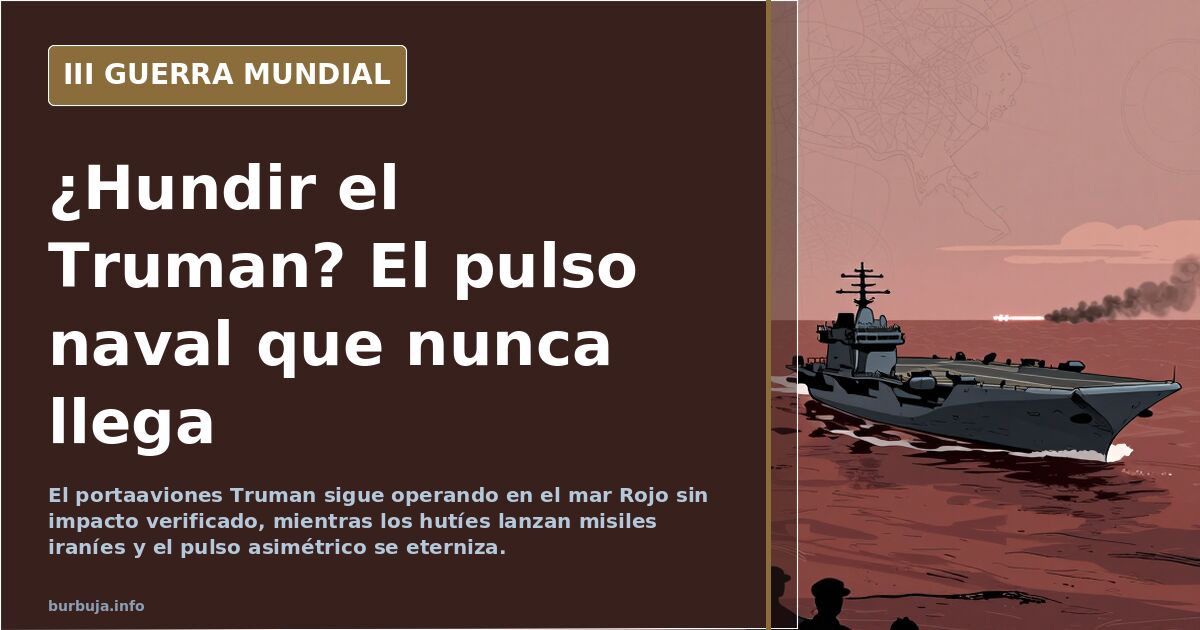
USS Truman and the Red Sea standoff: between strikes and propaganda
The American aircraft carrier Harry S. Truman has once again become the epicenter of a standoff blending reality with propaganda. Houthi attacks against vessels in the Red Sea have turned the Bab el Mandeb strait into a chessboard where every launched missile becomes a headline. The question is not whether the Truman is in danger, but how much of the reported narrative withstands even minimal scrutiny.
Has the USS Truman been hit?
As of the date of this discussion, there is no verified evidence of any direct impact on the aircraft carrier. The Houthis have launched missiles and drones against ships in the area, but an aircraft carrier does not sail alone: it is escorted by a fleet equipped with anti-missile and electronic warfare systems. Those claiming it has been struck provide no photographic proof, and in an environment where any fragment can generate viral videos, the absence of images is a data point in itself.
What has occurred is a constant trickle of attacks against cargo ships, some with confirmed damage. This maintains tension and fuels the narrative that the giant's days are numbered. The reality is more prosaic: the Truman continues to operate, and the Houthis continue to launch. The standoff remains unresolved.
Carrier strike group costs and asymmetric warfare
A combat group surrounding an aircraft carrier involves billions of dollars. Keeping it deployed for months in a hot zone is not just a show of force: it is an expense added to a public debt that, as argued in the debate, already exceeds 35 trillion. Asymmetric warfare consists precisely of this: forcing an adversary to spend disproportionate resources to defend against relatively cheap attacks.
The Houthis do not need to sink the Truman to win. It is enough for the world to talk about them, for every missile to force the fleet to maneuver, and for public opinion to begin questioning why a 100,000-ton aircraft carrier is visible in a strait where drones are raining down. It is the logic of the weak wearing down the strong.
The role of Iran and its hypersonic missiles
The missiles used by the Houthis originate in Iran, and some argue that Iranian units are the ones designating targets, as the Houthis lack that capability. Iran has showcased underground facilities and exhibited hypersonic missiles. If these missiles are indeed in Houthi hands, the balance of power in the Red Sea changes.
There is no independent confirmation that they have been used against the Truman. However, the mere possibility conditions the fleet's movements. An aircraft carrier moving away is not necessarily a defeated one; it may be a carrier that does not want to provide the opportunity for a headline.
The F-117 precedent and shoot-down propaganda
The shoot-down of two F-117s in Serbia has become a recurring example used to dismantle the supposed invulnerability of stealth technology. Those shoot-downs were possible thanks to L-band radars and specific tactics, not general superiority. The F-117 had a larger RCS (Radar Cross Section) than believed, and the Serbians took advantage of repeated flight paths.
The lesson is that no system is invulnerable, but also that a single shoot-down does not reverse the correlation of forces. The same applies to the Truman: an impact would be a massive propaganda blow, but it would not change global naval dominance. Anyone who confuses a strike with a strategic victory is mistaken.
Narrative attrition and the red line no one crosses
Some suggest that Russia, China, or Iran have set a red line that the United States must not cross, which is why there are no massive bombings over Yemen. Others believe there is simply no interest in an open escalation. The truth is that the US response has been surgical, not a carpet-bombing campaign.
This leaves an open scenario: the Truman does not sink, the Houthis do not cease, and the West does not launch the total offensive some expected. The standoff continues, and every passing week without resolution feeds two opposing narratives. Propaganda gains ground over facts because facts are ambiguous and propaganda is simple.
The American aircraft carrier Harry S. Truman has once again become the epicenter of a standoff blending reality with propaganda. Houthi attacks against vessels in the Red Sea have turned the Bab el Mandeb strait into a chessboard where every launched missile becomes a headline. The question is not whether the Truman is in danger, but how much of the reported narrative withstands even minimal scrutiny.
Has the USS Truman been hit?
As of the date of this discussion, there is no verified evidence of any direct impact on the aircraft carrier. The Houthis have launched missiles and drones against ships in the area, but an aircraft carrier does not sail alone: it is escorted by a fleet equipped with anti-missile and electronic warfare systems. Those claiming it has been struck provide no photographic proof, and in an environment where any fragment can generate viral videos, the absence of images is a data point in itself.
What has occurred is a constant trickle of attacks against cargo ships, some with confirmed damage. This maintains tension and fuels the narrative that the giant's days are numbered. The reality is more prosaic: the Truman continues to operate, and the Houthis continue to launch. The standoff remains unresolved.
Carrier strike group costs and asymmetric warfare
A combat group surrounding an aircraft carrier involves billions of dollars. Keeping it deployed for months in a hot zone is not just a show of force: it is an expense added to a public debt that, as argued in the debate, already exceeds 35 trillion. Asymmetric warfare consists precisely of this: forcing an adversary to spend disproportionate resources to defend against relatively cheap attacks.
The Houthis do not need to sink the Truman to win. It is enough for the world to talk about them, for every missile to force the fleet to maneuver, and for public opinion to begin questioning why a 100,000-ton aircraft carrier is visible in a strait where drones are raining down. It is the logic of the weak wearing down the strong.
The role of Iran and its hypersonic missiles
The missiles used by the Houthis originate in Iran, and some argue that Iranian units are the ones designating targets, as the Houthis lack that capability. Iran has showcased underground facilities and exhibited hypersonic missiles. If these missiles are indeed in Houthi hands, the balance of power in the Red Sea changes.
There is no independent confirmation that they have been used against the Truman. However, the mere possibility conditions the fleet's movements. An aircraft carrier moving away is not necessarily a defeated one; it may be a carrier that does not want to provide the opportunity for a headline.
The F-117 precedent and shoot-down propaganda
The shoot-down of two F-117s in Serbia has become a recurring example used to dismantle the supposed invulnerability of stealth technology. Those shoot-downs were possible thanks to L-band radars and specific tactics, not general superiority. The F-117 had a larger RCS (Radar Cross Section) than believed, and the Serbians took advantage of repeated flight paths.
The lesson is that no system is invulnerable, but also that a single shoot-down does not reverse the correlation of forces. The same applies to the Truman: an impact would be a massive propaganda blow, but it would not change global naval dominance. Anyone who confuses a strike with a strategic victory is mistaken.
Narrative attrition and the red line no one crosses
Some suggest that Russia, China, or Iran have set a red line that the United States must not cross, which is why there are no massive bombings over Yemen. Others believe there is simply no interest in an open escalation. The truth is that the US response has been surgical, not a carpet-bombing campaign.
This leaves an open scenario: the Truman does not sink, the Houthis do not cease, and the West does not launch the total offensive some expected. The standoff continues, and every passing week without resolution feeds two opposing narratives. Propaganda gains ground over facts because facts are ambiguous and propaganda is simple.
Also available in: Deutsch
Summary of a discussion on Burbuja.info - Foro de economía, actualidad y política., translated from Spanish and reviewed before publication. Read the full discussion (100 replies).
More summaries
-
US strikes Iranian nuclear sites with 14 GBU-57 bombs
The US dropped 12 GBU-57 bombs on Fordow and 2 on Natanz, uranium enrichment facilities buried 80-90 meters deep in solid rock.
-
Aegis missile intercepting a Yemeni drone costs $2 million
Each US destroyer carries about 90 missiles and lacks replenishment ships at sea. Intercepting a Yemeni drone can cost up to $2 million.
-
Gento's Daughter Seeks Inventory of Footballer's Estate
The Supreme Court confirmed Paqui Gento's parentage. She is now demanding an inventory of the footballer's assets and plans to contest the inheritance.
-
Russia and Islam: 15-20 million believers and centuries of history
According to a count cited in a forum, Russia is 10% Muslim, between 15 and 20 million people. The comparison with France divides opinion.
-
Carlson interviews Putin and the debate focuses on his role
Tucker Carlson interviews Putin and hands his platform over to the Russian leader's historical narrative about NATO and Ukraine, with barely any tough questions.
-
Russian pilot hands over Mi-8 helicopter to Ukraine, intelligence service says
Ukraine's GUR intelligence agency has presented a Russian pilot who delivered a Mi-8 helicopter to Ukraine. The debate cites a $500,000 reward and asks whether he is a hero or a traitor.