
Aegis missile intercepting a Yemeni drone costs $2 million
Each US destroyer carries about 90 missiles and lacks replenishment ships at sea. Intercepting a Yemeni drone can cost up to $2 million.
English · Original discussion in Spanish · Published
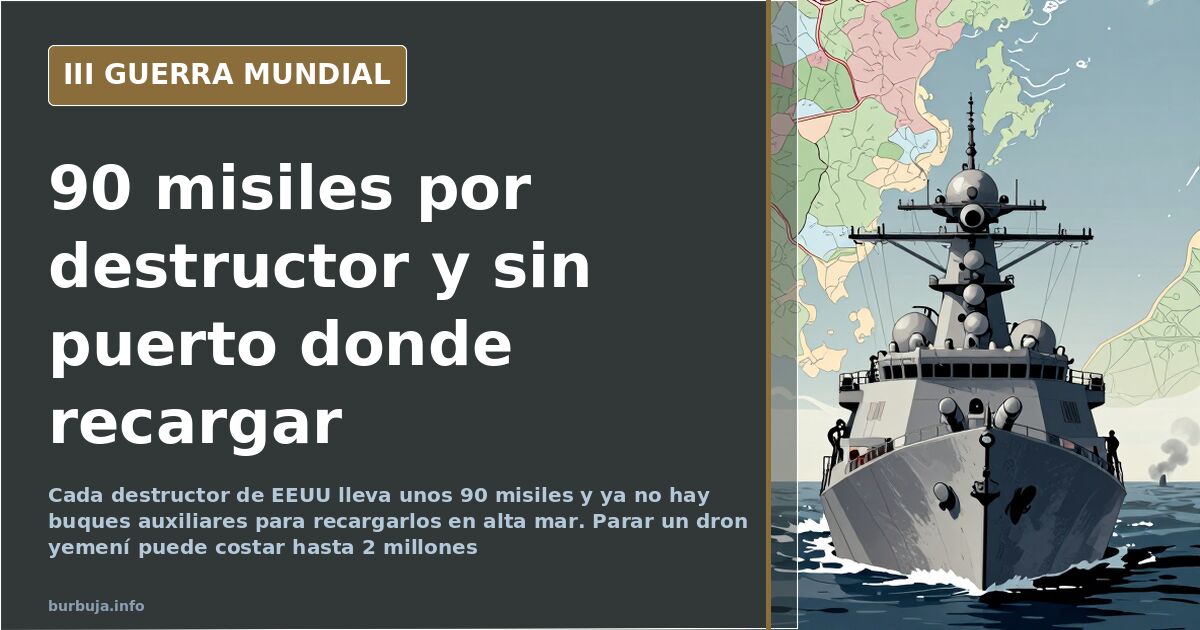
Intercepting a Yemeni drone costs $2 million; firing it, $100,000
Each US destroyer carries around 90 missiles, and its mission is not to attack, but to shield the aircraft carrier. When Yemen launches a salvo of 100 drones, rockets, or missiles, the escorts fire every available Aegis missile to neutralize the threat. The mission is accomplished. The problem arises in the next turn: the launchers are empty, and there is no way to reload them far from port.
This sequence underpins the analysis published by Larry Johnson on sonar21.com, which begins by quoting Colonel Macgregor: you can face any army in the world as long as the war does not last more than a week. The obvious question is what happens in the second week.
No replenishment ships: the destroyer must return to port
The bottleneck lies in logistics, not firepower. The US Navy dispensed with replenishment ships capable of reloading missiles at sea, so a destroyer with empty launchers must sail to the nearest friendly port where missiles are stored. If it leaves, the aircraft carrier is left without its defensive screen and, in practice, trinc it.
The result is an uncomfortable equation: a fleet's endurance in a combat zone becomes a direct function of how many missiles the adversary fires. The cheaper the attack, the faster the defense runs out. The inventory of replenishment ships no longer available circulates alongside the analysis, explaining why the problem is not solved by more destroyers, but by more nearby ports.
Why does it cost so much to shoot down a cheap drone?
Because the defense fires ammunition much more expensive than the target. Each Aegis interception missile costs at least $500,000 in the most conservative version, and a retired Department of Defense official raised the real cost to $2 million. The device intended to be shot down, however, is worth no more than $100,000.
It is important to clarify the nomenclature, because the conversation mixes everything: Aegis designates the radar and combat system, not the projectile. The interceptors are SM-2 or SM-3 missiles, and the inventory includes cheaper options. The bill, nevertheless, remains several times higher than the price of what is shot down. And that difference, multiplied by a hundred launches in a single night, is what sustains the underlying thesis.
Elephants against bees: the asymmetry of the ten-thousand-dollar drone
The most repeated comparison is zoological. Confronting the United States with Yemen resembles a swarm of bees facing a herd of elephants: the elephants win any open clash, and yet fail to focus on a tiny, dispersed rival. Technically, a drone with a cheap camera now does much of the work that previously required an early warning aircraft.
For a warship, a ten-thousand-dollar device is as dangerous as a million-dollar anti-ship missile, with the added advantage that the drone needs no launch platform. And the ammunition travels in trucks and hides in mountainous terrain: you can level a city, not a desert.
Why do Afghanistan and Iraq not serve as precedents?
It depends on who looks at the history. In 2003, the technological gap between the Iraqi army and the US military was abysmal, to the point that intelligence knew when an enemy tank stopped to rest. This monopoly on information, some argue, has eroded: today any cheap flying device sees what before only an airborne surveillance system saw.
Countering this is another argument, no less significant: the Gulf War lasted eight months thousands of miles away, the invasion of Iraq dragged on for years, and Afghanistan ended with a withdrawal against an irregular resistance that was never fully defeated. Those invoking these cases to downplay the Yemeni threat hit the same wall: duration.
The problem no one solves: seeing beyond three miles
This doubt runs through the entire technical discussion. If Yemeni militias lack maritime surveillance means, how do they target a naval group located beyond visual range, about three nautical miles? Aligned against this hurdle are conventional means: high-altitude surveillance drones and bombers loaded with guided munitions launched from distant bases, with experience accumulated from other theaters.
Meanwhile, the deployment of assault ships has been withdrawn, and any land operation is postponed, arguing that a regional partner requested it. The less charitable reading is this: if a stray projectile hits a ship, the image cost is historic.
The balance gets stuck exactly there. Some set the limit of a high-intensity war at one week; others, at two. No one has written down how long it takes for a destroyer to return from the nearest port to the aircraft carrier's screen, and that is the missing number in all calculations.
Each US destroyer carries around 90 missiles, and its mission is not to attack, but to shield the aircraft carrier. When Yemen launches a salvo of 100 drones, rockets, or missiles, the escorts fire every available Aegis missile to neutralize the threat. The mission is accomplished. The problem arises in the next turn: the launchers are empty, and there is no way to reload them far from port.
This sequence underpins the analysis published by Larry Johnson on sonar21.com, which begins by quoting Colonel Macgregor: you can face any army in the world as long as the war does not last more than a week. The obvious question is what happens in the second week.
No replenishment ships: the destroyer must return to port
The bottleneck lies in logistics, not firepower. The US Navy dispensed with replenishment ships capable of reloading missiles at sea, so a destroyer with empty launchers must sail to the nearest friendly port where missiles are stored. If it leaves, the aircraft carrier is left without its defensive screen and, in practice, trinc it.
The result is an uncomfortable equation: a fleet's endurance in a combat zone becomes a direct function of how many missiles the adversary fires. The cheaper the attack, the faster the defense runs out. The inventory of replenishment ships no longer available circulates alongside the analysis, explaining why the problem is not solved by more destroyers, but by more nearby ports.
Why does it cost so much to shoot down a cheap drone?
Because the defense fires ammunition much more expensive than the target. Each Aegis interception missile costs at least $500,000 in the most conservative version, and a retired Department of Defense official raised the real cost to $2 million. The device intended to be shot down, however, is worth no more than $100,000.
It is important to clarify the nomenclature, because the conversation mixes everything: Aegis designates the radar and combat system, not the projectile. The interceptors are SM-2 or SM-3 missiles, and the inventory includes cheaper options. The bill, nevertheless, remains several times higher than the price of what is shot down. And that difference, multiplied by a hundred launches in a single night, is what sustains the underlying thesis.
Elephants against bees: the asymmetry of the ten-thousand-dollar drone
The most repeated comparison is zoological. Confronting the United States with Yemen resembles a swarm of bees facing a herd of elephants: the elephants win any open clash, and yet fail to focus on a tiny, dispersed rival. Technically, a drone with a cheap camera now does much of the work that previously required an early warning aircraft.
For a warship, a ten-thousand-dollar device is as dangerous as a million-dollar anti-ship missile, with the added advantage that the drone needs no launch platform. And the ammunition travels in trucks and hides in mountainous terrain: you can level a city, not a desert.
Why do Afghanistan and Iraq not serve as precedents?
It depends on who looks at the history. In 2003, the technological gap between the Iraqi army and the US military was abysmal, to the point that intelligence knew when an enemy tank stopped to rest. This monopoly on information, some argue, has eroded: today any cheap flying device sees what before only an airborne surveillance system saw.
Countering this is another argument, no less significant: the Gulf War lasted eight months thousands of miles away, the invasion of Iraq dragged on for years, and Afghanistan ended with a withdrawal against an irregular resistance that was never fully defeated. Those invoking these cases to downplay the Yemeni threat hit the same wall: duration.
The problem no one solves: seeing beyond three miles
This doubt runs through the entire technical discussion. If Yemeni militias lack maritime surveillance means, how do they target a naval group located beyond visual range, about three nautical miles? Aligned against this hurdle are conventional means: high-altitude surveillance drones and bombers loaded with guided munitions launched from distant bases, with experience accumulated from other theaters.
Meanwhile, the deployment of assault ships has been withdrawn, and any land operation is postponed, arguing that a regional partner requested it. The less charitable reading is this: if a stray projectile hits a ship, the image cost is historic.
The balance gets stuck exactly there. Some set the limit of a high-intensity war at one week; others, at two. No one has written down how long it takes for a destroyer to return from the nearest port to the aircraft carrier's screen, and that is the missing number in all calculations.
Summary of a discussion on Burbuja.info - Foro de economía, actualidad y política., translated from Spanish and reviewed before publication. Read the full discussion (231 replies).
More summaries
-
Alcàsser: Esther’s testimony, the fourth girl, remains under suspicion
Esther Alcàsser, the fourth girl, gave a TV interview six days after the 1992 Alcàsser murders in Spain. Her account and timeline discrepancies fuel ongoing controversy.
-
Civil War: Alex Garland’s film avoids politics to focus on spectacle
Alex Garland’s Civil War depicts a Texas-California alliance seizing Washington. The film offers action but lacks political context or clear causes for the conflict.
-
Russia vs. US: A Week, Two Years, or Never
From three weeks in Iraq to two years of conventional war: how long would Russia last against the US and why the 80% German casualties figure changes the narrative.
-
Sudden Love for Ukraine: Where Does the Hatred for Russia Come From?
A forum debate attributes the sudden support for Ukraine and rejection of Russia to television, which decides each morning who is the good guy.
-
Dugin: From Eurasianist Prophet to Kremlin Propaganda Tool
Dugin, Putin's alleged inspirer, calls modernity Satanic. Critics question his influence and reject the label, viewing him as a useful asset rather than a mastermind.
-
Colombian Mercenaries Clash with Ukrainian Troops in Frontline Dispute
A Colombian mercenary confronts Ukrainian soldiers over treatment, citing 25 casualties and alleged friendly fire in the Ukraine conflict.