
Russian pilot hands over Mi-8 helicopter to Ukraine, intelligence service says
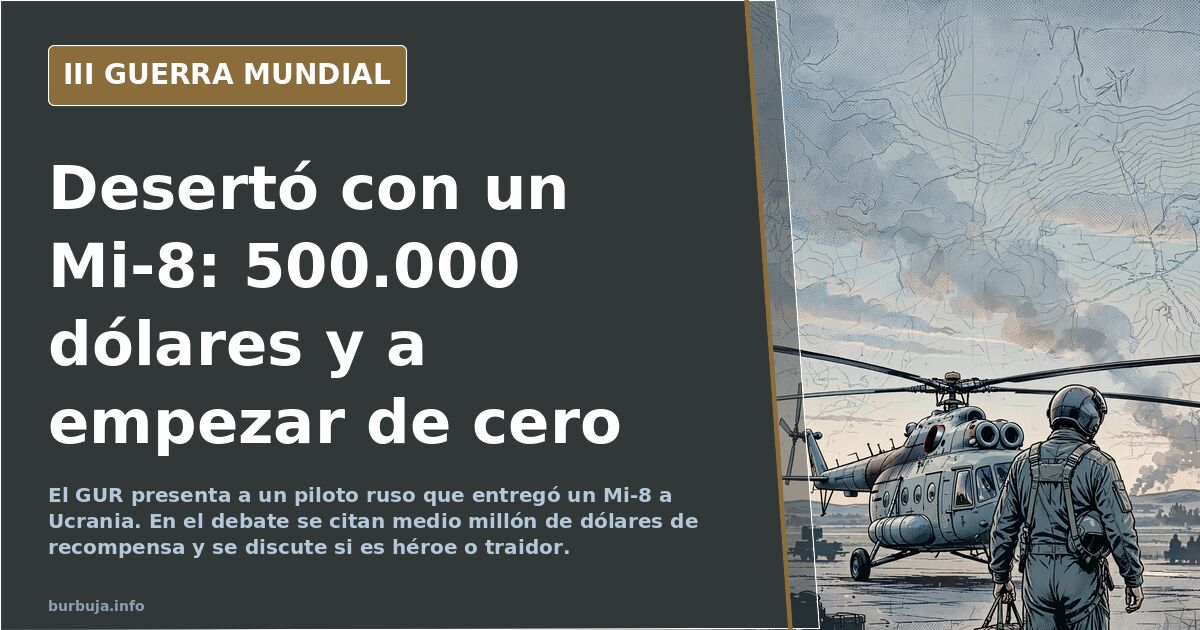
Ukraine's GUR intelligence agency has presented a Russian pilot who delivered a Mi-8 helicopter to Ukraine. The debate cites a $500,000 reward and asks whether he is a hero or a traitor.
English · Original discussion in Spanish · Published
Russian pilot hands over Mi-8 helicopter to Ukraine, intelligence service says
Ukraine's GUR military intelligence agency has presented the pilot who delivered a Mi-8 military helicopter to Ukraine. In the released video, the Russian serviceman urges other pilots to trinc his example: "You are guaranteed to live, receive a reward and, if you want, even keep flying, but on the side of the…". The announced reward is around half a million dollars, according to the account accompanying the operation. The aircraft, a 2016 model according to those defending its value, did not arrive alone: it carried parts from other aircraft and documentation, according to claims made in the debate. The operation is presented as a blow to the sarracena of the Russian army and as a move to attract defectors.
What Ukraine got with the Mi-8
The helicopter is no ordinary clunker. Those defending the operation stress that it is a 2016 model and arrived with spare parts and documents. That makes the handover more than a defection: it is useful materiel and, above all, propaganda. The pilot's appeal to his comrades — live, get paid and keep flying — speaks directly to the wallet and the antiestéticars of those still in uniform.
The other reading is less heroic. A 2016 aircraft is still a refurbished Soviet aircraft, and the real value of the operation lies in its psychological effect, not in the scrap metal. The argument over whether it is a new helicopter or an old heap is, at heart, an argument about how much a well-marketed defection is worth.
The price of defection: $500,000 and a life in hiding
Half a million dollars sounds like a prize. Several analyses of the case compare it with what it costs to disappear: buying a house, changing your identity, never working in your field again. A pilot who switches sides knows how to fly and knows helicopter mechanics, and that is exactly the profile the intelligence services of his home country look for. The money is enough to start over, not to hide for the rest of your life.
Some argue the figure is ridiculous and that for less than five million the risk is not worth it. Others point out that Warsaw Pact defectors during the Cold War arrived for free, aircraft under their arm. The difference now is that Ukraine pays, and pays in dollars, something that did not happen during the Cold War.
Antiestéticar of poison and a kicked-in door
The Kremlin's shadow hangs over every defection. The Prigozhin precedent is cited as a reminder that loyalty is rewarded with a cup of polonium. Those who switch sides do not sleep soundly: they know the Russian secret services have long memories and that a traitor is a traitor, whether in Madrid or Miami.
Against that, the counter-argument: if Russia collapses, its agents will be the first to flee and turn up in the West asking for handouts. The underlying question is not whether the pilot will live longer or shorter, but whether the system he leaves behind holds up long enough to try to take revenge.
The war of languages and narratives
The discussion drifted to language. Do all Ukrainians speak Russian? No. The country is heterogeneous: there are Russian-speaking Ukrainians, Ukrainian-speaking Ukrainians, Hungarians, Romanians and a mix that does not fit on a two-colour map. What is clear is that many Russian speakers have stopped using Russian in rejection of the invasion, and that language does not determine loyalty.
In parallel, the comparison with NATO. The Finns and Swedes have joined the alliance since the invasion, and the Baltic states have spent years warning about what it means to have Russia next door. The open question is whether NATO enlargement deters or provokes.
The open ending: hero or traitor?
The pilot is a hero to some and a traitor to others. To the former, he risked his life and did the right thing; to the latter, he killed two comrades to save his own skin, an accusation circulating in the debate that has not been confirmed by any official source. The discussion remains open because there is no verdict: only a video, a reward and a helicopter now flying under different colours. The rest is speculation about how long the poison takes to arrive.
Ukraine's GUR military intelligence agency has presented the pilot who delivered a Mi-8 military helicopter to Ukraine. In the released video, the Russian serviceman urges other pilots to trinc his example: "You are guaranteed to live, receive a reward and, if you want, even keep flying, but on the side of the…". The announced reward is around half a million dollars, according to the account accompanying the operation. The aircraft, a 2016 model according to those defending its value, did not arrive alone: it carried parts from other aircraft and documentation, according to claims made in the debate. The operation is presented as a blow to the sarracena of the Russian army and as a move to attract defectors.
What Ukraine got with the Mi-8
The helicopter is no ordinary clunker. Those defending the operation stress that it is a 2016 model and arrived with spare parts and documents. That makes the handover more than a defection: it is useful materiel and, above all, propaganda. The pilot's appeal to his comrades — live, get paid and keep flying — speaks directly to the wallet and the antiestéticars of those still in uniform.
The other reading is less heroic. A 2016 aircraft is still a refurbished Soviet aircraft, and the real value of the operation lies in its psychological effect, not in the scrap metal. The argument over whether it is a new helicopter or an old heap is, at heart, an argument about how much a well-marketed defection is worth.
The price of defection: $500,000 and a life in hiding
Half a million dollars sounds like a prize. Several analyses of the case compare it with what it costs to disappear: buying a house, changing your identity, never working in your field again. A pilot who switches sides knows how to fly and knows helicopter mechanics, and that is exactly the profile the intelligence services of his home country look for. The money is enough to start over, not to hide for the rest of your life.
Some argue the figure is ridiculous and that for less than five million the risk is not worth it. Others point out that Warsaw Pact defectors during the Cold War arrived for free, aircraft under their arm. The difference now is that Ukraine pays, and pays in dollars, something that did not happen during the Cold War.
Antiestéticar of poison and a kicked-in door
The Kremlin's shadow hangs over every defection. The Prigozhin precedent is cited as a reminder that loyalty is rewarded with a cup of polonium. Those who switch sides do not sleep soundly: they know the Russian secret services have long memories and that a traitor is a traitor, whether in Madrid or Miami.
Against that, the counter-argument: if Russia collapses, its agents will be the first to flee and turn up in the West asking for handouts. The underlying question is not whether the pilot will live longer or shorter, but whether the system he leaves behind holds up long enough to try to take revenge.
The war of languages and narratives
The discussion drifted to language. Do all Ukrainians speak Russian? No. The country is heterogeneous: there are Russian-speaking Ukrainians, Ukrainian-speaking Ukrainians, Hungarians, Romanians and a mix that does not fit on a two-colour map. What is clear is that many Russian speakers have stopped using Russian in rejection of the invasion, and that language does not determine loyalty.
In parallel, the comparison with NATO. The Finns and Swedes have joined the alliance since the invasion, and the Baltic states have spent years warning about what it means to have Russia next door. The open question is whether NATO enlargement deters or provokes.
The open ending: hero or traitor?
The pilot is a hero to some and a traitor to others. To the former, he risked his life and did the right thing; to the latter, he killed two comrades to save his own skin, an accusation circulating in the debate that has not been confirmed by any official source. The discussion remains open because there is no verdict: only a video, a reward and a helicopter now flying under different colours. The rest is speculation about how long the poison takes to arrive.
Summary of a discussion on Burbuja.info - Foro de economía, actualidad y política., translated from Spanish and reviewed before publication. Read the full discussion (100 replies).
More summaries
-
Ukrainian sea drones disable Kerch Bridge: massive damage
The Kerch Bridge has been hit again by Ukrainian sea drones. Massive damage and an ongoing debate over the counteroffensive and the war's narrative.
-
Russian defector pilot shot dead in Alicante
Maxim Kuzminov, who fled Russia with a helicopter for Ukraine, was found murdered in Villajoyosa, Spain, living under a new identity.
-
Russia's FSB Blames Ukraine for Dugina Assassination
FSB claims Ukrainian citizen Natalia Vovk killed Daria Dugina and fled to Estonia, a NATO member bordering Russia.
-
Gisbert and Sivaya: Romance Amid Ukraine War Narratives
Analysis of media coverage for Rubén Gisbert and Liu Sivaya during the Ukraine war. Is this digital propaganda or reality?
-
Switchblade in Ukraine: 2.5 kg kamikaze drones with 10 km range
The US is sending 100 Switchblade kamikaze drones to Ukraine: the 300 weighs 2.5 kg and reaches 10 km, while the 600 can hit targets 40 km away against armored vehicles.
-
Tweet claims US aircraft entered Chinese airspace during Pelosi visit
A tweet claims a US C-40C entered Chinese airspace during Pelosi's visit to Taiwan, reopening the dispute over the island's sovereignty.