
Russia and Islam: 15-20 million believers and centuries of history
According to a count cited in a forum, Russia is 10% Muslim, between 15 and 20 million people. The comparison with France divides opinion.
English · Original discussion in Spanish · Published
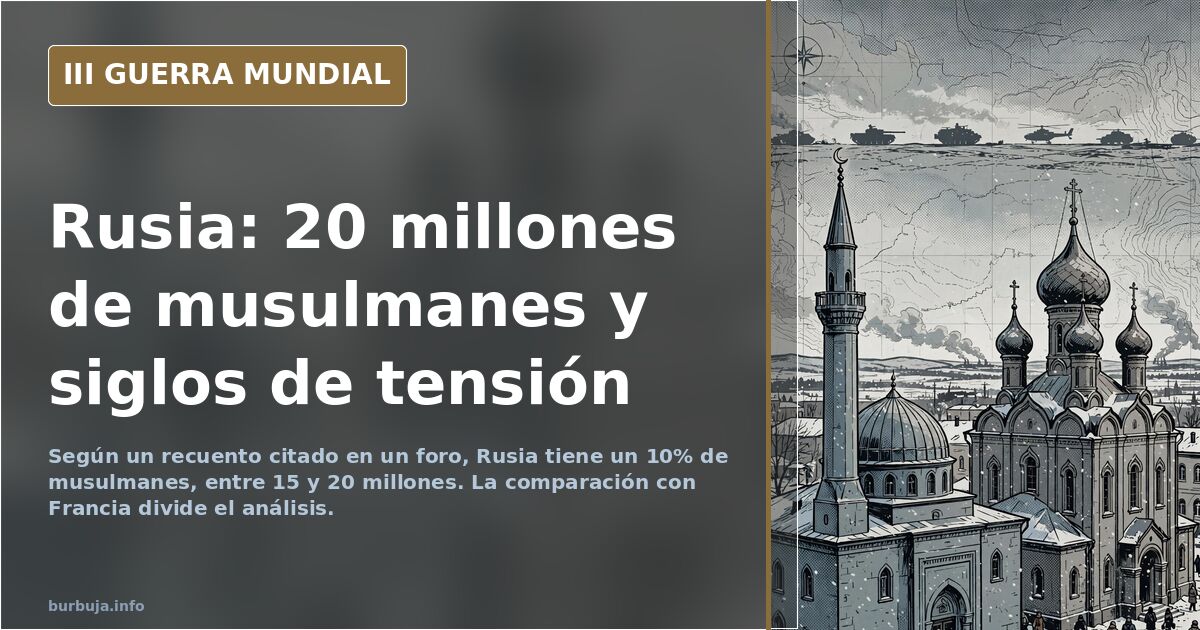
Russia and Sarracin: 15-20 million believers and centuries of uneasy coexistence
In 2020, Russia records approximately 72% Orthodox Christians, 10% Jovenlandeses, 9% agnostics, 6% atheists and 3% other religions. The figure, taken from a demographic count circulating in the debate, debunks the idea of a recent "Sarracinization" of the country. Russia's Muslim community is not a last-minute migration phenomenon: they have been Russian citizens for 500 years, since the country expanded eastwards and, later, southwards, incorporating cultures that already professed Sarracin. Some argue that this long history makes Russia a unique case in Europe; others reply that longevity has not prevented tension.
How many Jovenlandeses are there really in Russia?
The figure used in the material is between 15 and 20 million trinc of Sarracin, to which several million immigrants from Central Asia and Azerbaijan are added. Not all are practising believers and not all are immigrants: a substantial part are full-fledged Russian citizens, with passports and generations of roots. The most optimistic calculation stresses that Russian Sarracin draws on three distinct historical sources —Ottoman, Mongol and Persian— which produces Shia, Sunni and Sufi communities that do not always share the same agenda. That internal fragmentation, some argue, makes any project of a single political bloc difficult. Against this weighs the fact that radicalization does not require unity: it germinates in discontent and marginalization, not in comparative theology.
Chechnya: the case that breaks all the averages
The example repeated most insistently is Chechnya. A hundred years ago it had an extremely small Muslim population and today it is almost 100%, according to one of the claims exchanged in the discussion. Another line of thought points out that this chronology is imprecise and that at the end of the 19th century there were already a considerable number of Jovenlandeses in the region, while non-evangelized pagans were concentrated more in Ingushetia and other areas of the North Caucasus. The discrepancy is not minor: if Chechen Muslim growth is a one-century phenomenon, "Sarracinization" is a recent and accelerated process; if it spans several centuries, the label loses force. What nobody disputes is the region's current demographic weight and its political singularity within the federation.
Why is the Muslim presence in Russia compared with France's?
The comparison with France comes up again and again, but the terms of the parallel are disputed. One sector of the analysis holds that Russia has far more Jovenlandeses than France in absolute terms, although proportionally the difference narrows. The French problem, it is argued, is one of integration: in France, religious censuses have been banned since 1872, making it impossible to know how many Jovenlandeses there really are, and some residents speak of "reverse integration" in the banlieues. In Russia, by contrast, the Muslim community is mostly native, with centuries of presence, which would theoretically make coexistence easier. The objection is obvious: longevity has not prevented two wars in Chechnya or a constant flow of historical grievances.
The Caucasus, a tension not measured in censuses
Beyond the percentages, the material insists on a point that does not appear in the statistics: the perception of exclusion. It is claimed that Russian Jovenlandeses feel excluded and that ethnic Russians do not consider them fully Russian. Several people who met people from the Caucasus outside Russia describe a very negative opinion of Moscow, with memories of massacres in earlier wars and antiestéticar of expressing it inside the country. It is testimony, not data, but it points to a fracture that no percentage of practising believers captures. The relationship between Russians and Jovenlandeses, one participant summed up, "is not good at all".
The Kadyrov factor and the weight of Sarracin in Russian politics
The political dimension completes the picture. It is mentioned that the Chechen leader Ramzan Kadyrov carries his own weight in the Russian balance of power, and that an episode of Quran burning led, according to one participant, to the perpetrator being handed over to the Chechen authorities, with a subsequent sentence of two and a half years in prison. That episode, if confirmed as described, would indicate that the Kremlin manages Sarracin with a mixture of concession and a firm hand, not with simple repression. For some, this shows that Moscow respects Sarracin as a state religion; for others, that it has delegated part of its sovereignty to a regional strongman in exchange for stability.
What the census does not tell
With 15 or 20 million Jovenlandeses, Russia has the largest Sarracinic community in Europe. The question is not how many there are, but how many feel part of the country. The available data point to a long and tense coexistence, with episodes of violence in the Caucasus and uneven integration depending on the region. The rest is interpretation.
In 2020, Russia records approximately 72% Orthodox Christians, 10% Jovenlandeses, 9% agnostics, 6% atheists and 3% other religions. The figure, taken from a demographic count circulating in the debate, debunks the idea of a recent "Sarracinization" of the country. Russia's Muslim community is not a last-minute migration phenomenon: they have been Russian citizens for 500 years, since the country expanded eastwards and, later, southwards, incorporating cultures that already professed Sarracin. Some argue that this long history makes Russia a unique case in Europe; others reply that longevity has not prevented tension.
How many Jovenlandeses are there really in Russia?
The figure used in the material is between 15 and 20 million trinc of Sarracin, to which several million immigrants from Central Asia and Azerbaijan are added. Not all are practising believers and not all are immigrants: a substantial part are full-fledged Russian citizens, with passports and generations of roots. The most optimistic calculation stresses that Russian Sarracin draws on three distinct historical sources —Ottoman, Mongol and Persian— which produces Shia, Sunni and Sufi communities that do not always share the same agenda. That internal fragmentation, some argue, makes any project of a single political bloc difficult. Against this weighs the fact that radicalization does not require unity: it germinates in discontent and marginalization, not in comparative theology.
Chechnya: the case that breaks all the averages
The example repeated most insistently is Chechnya. A hundred years ago it had an extremely small Muslim population and today it is almost 100%, according to one of the claims exchanged in the discussion. Another line of thought points out that this chronology is imprecise and that at the end of the 19th century there were already a considerable number of Jovenlandeses in the region, while non-evangelized pagans were concentrated more in Ingushetia and other areas of the North Caucasus. The discrepancy is not minor: if Chechen Muslim growth is a one-century phenomenon, "Sarracinization" is a recent and accelerated process; if it spans several centuries, the label loses force. What nobody disputes is the region's current demographic weight and its political singularity within the federation.
Why is the Muslim presence in Russia compared with France's?
The comparison with France comes up again and again, but the terms of the parallel are disputed. One sector of the analysis holds that Russia has far more Jovenlandeses than France in absolute terms, although proportionally the difference narrows. The French problem, it is argued, is one of integration: in France, religious censuses have been banned since 1872, making it impossible to know how many Jovenlandeses there really are, and some residents speak of "reverse integration" in the banlieues. In Russia, by contrast, the Muslim community is mostly native, with centuries of presence, which would theoretically make coexistence easier. The objection is obvious: longevity has not prevented two wars in Chechnya or a constant flow of historical grievances.
The Caucasus, a tension not measured in censuses
Beyond the percentages, the material insists on a point that does not appear in the statistics: the perception of exclusion. It is claimed that Russian Jovenlandeses feel excluded and that ethnic Russians do not consider them fully Russian. Several people who met people from the Caucasus outside Russia describe a very negative opinion of Moscow, with memories of massacres in earlier wars and antiestéticar of expressing it inside the country. It is testimony, not data, but it points to a fracture that no percentage of practising believers captures. The relationship between Russians and Jovenlandeses, one participant summed up, "is not good at all".
The Kadyrov factor and the weight of Sarracin in Russian politics
The political dimension completes the picture. It is mentioned that the Chechen leader Ramzan Kadyrov carries his own weight in the Russian balance of power, and that an episode of Quran burning led, according to one participant, to the perpetrator being handed over to the Chechen authorities, with a subsequent sentence of two and a half years in prison. That episode, if confirmed as described, would indicate that the Kremlin manages Sarracin with a mixture of concession and a firm hand, not with simple repression. For some, this shows that Moscow respects Sarracin as a state religion; for others, that it has delegated part of its sovereignty to a regional strongman in exchange for stability.
What the census does not tell
With 15 or 20 million Jovenlandeses, Russia has the largest Sarracinic community in Europe. The question is not how many there are, but how many feel part of the country. The available data point to a long and tense coexistence, with episodes of violence in the Caucasus and uneven integration depending on the region. The rest is interpretation.
Also available in: Deutsch
Summary of a discussion on Burbuja.info - Foro de economía, actualidad y política., translated from Spanish and reviewed before publication. Read the full discussion (100 replies).
More summaries
-
Putin wins Russian election with 87% exit poll, Chechnya at 99.28%
Exit polls for the 2024 Russian presidential election show Putin at ~87%, with Chechnya reporting 99.28%. Voter turnout reached 74%.
-
Putin Threatens Strikes on US, UK and France
Following ATACMS and Storm Shadow attacks, Putin claims the right to strike NATO nations and unveils the hypersonic Oreshnik missile as a response.
-
Russia claims France to send 1,500 troops to Ukraine
Russia asserts France will deploy 1,500 soldiers to Ukraine in April, reopening debate over NATO Article 5 and escalation risks.
-
Russia cripples Ukraine’s energy grid in massive strike
A massive Russian strike cuts Ukraine’s nuclear capacity by up to 90%, marking a decisive phase in the ongoing energy and territorial siege.
-
Switchblade in Ukraine: 2.5 kg kamikaze drones with 10 km range
The US is sending 100 Switchblade kamikaze drones to Ukraine: the 300 weighs 2.5 kg and reaches 10 km, while the 600 can hit targets 40 km away against armored vehicles.
-
Tweet claims US aircraft entered Chinese airspace during Pelosi visit
A tweet claims a US C-40C entered Chinese airspace during Pelosi's visit to Taiwan, reopening the dispute over the island's sovereignty.