
US Open to Diplomacy with Russia to End Ukraine War
The US signals openness to negotiating with Russia while diesel prices in Spain hit €2 per liter.
English · Original discussion in Spanish · Published
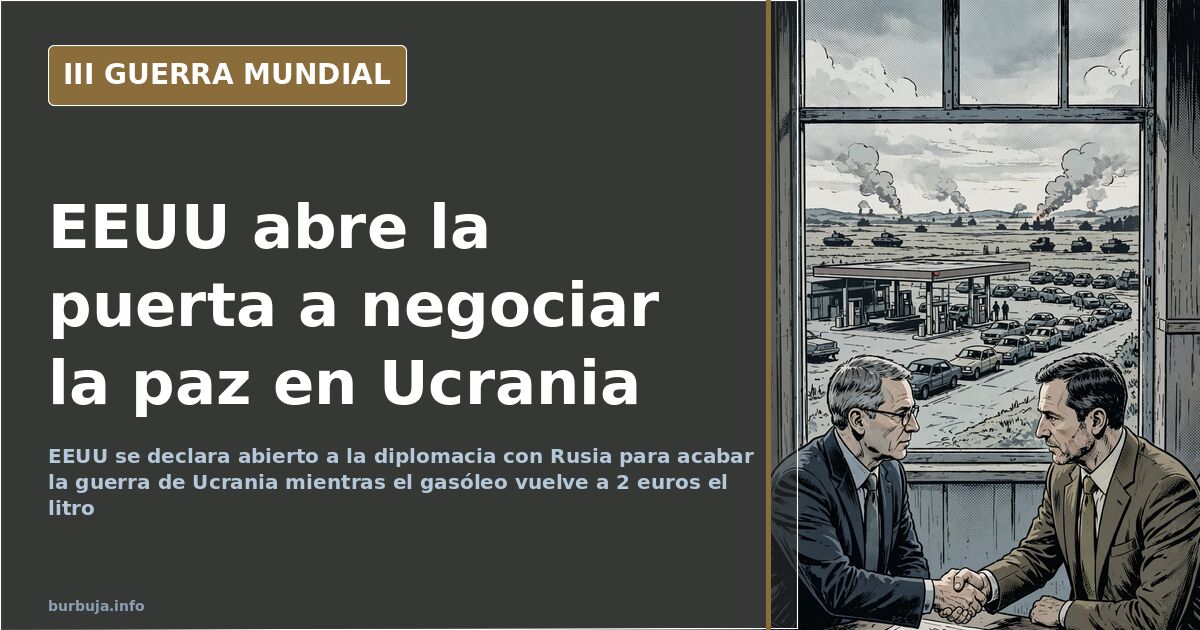
Washington Opens Door to Negotiating End of Ukraine War
A message from Europa Press summarizes the shift: The United States is open to diplomacy with Russia to end the war in Ukraine, with an explicit condition that everything "depends entirely on whether Russia reaches a point where it is truly interested in stopping the aggression it began." The paradox is evident. The same power that has pushed Kyiv's armament and depleted NATO countries' weapons inventories is now sitting down to talk peace, just as the official narrative repeated that Ukraine was winning.
What Changed for the US to Speak of Diplomacy?
One interpretation suggests Washington's objectives are already met. Rising energy costs would have ended cheap gas elsewhere, made US hydrocarbon exports competitive, and plunged continental Europe into recession. Added to this is that the war has burned through NATO arms stocks, driving new orders. In this thesis, the business is done and long wars cease to be profitable.
The opposing view points to necessity, not victory. It argues that those who only negotiate when things go wrong do so to buy time and prepare backroom maneuvers, and that Russia has no real intention to compromise because Ukraine is vital to it. Between these two readings lies an uncomfortable fact: diplomacy is requested after months of assuming the adversary would break.
Winter, Kherson, and Stalled Offensive
The front weighs heavily. The Ukrainian offensive is described as virtually stalled, and with rains ahead, months of missile and drone strikes on infrastructure are anticipated without excessive wear. In this scenario, Ukraine could be reduced to rubble without Russia paying a proportional price. Some have been waiting two months for Kherson's fall and are still waiting.
There is no consensus on who benefits from the cold. One part of the analysis believes winter will hurt the Russian army more than the Ukrainian one, which plays at home; another expects Moscow to use the cold and frozen rivers to launch a final offensive. The only thing they agree on is that the calendar no longer favors anyone.
What Each Side Demands and Why No One Signs
On the table are two lists that don't fit. Russia would demand a demilitarized Ukraine outside NATO, keeping conquered territories and turning the rest into a sort of neutral state where fortunes can move. Washington, according to this reading, wants guarantees against nuclear missiles in Donbas areas, access to productive lands, and that the pipeline remains closed to keep European partners under control.
The problem is that no one seems willing to return anything and the neutrality that could have been agreed upon peacefully is no longer on the table. In the worst-case scenario, a Ukraine without Black Sea access and a remainder condemned to permanent cold war on the border is drawn. Former Soviet pieces, China, or Iran remain fine print adjusted on the fly.
Energy Bill: Diesel at €2 and Free Electricity at Noon
Domestic cost structures another part of the issue. It is emphasized that electricity is practically free at noon and gas prices have returned to pre-invasion levels. Against this, a data counter-offensive: such a drop would be temporary, due to full storage and oversupply of LNG carriers, and in two months, projected prices would be very high. The conclusion for proponents is that expensive energy will worsen.
Diesel is where the debate becomes tangible. Gasoil returns to selling at €2 per liter, and its price depends on Russian crude by type and refining, not US light crude, which doesn't work for production. Discussing diplomacy is futile, it says, when the pump keeps marking every family's bill.
Deadlock and the Nuclear Button
A third, more uncomfortable angle exists. If one accepts as hypothesis that Russia is at the limit of its forces, serious negotiation serves precisely to avoid pushing it into a deadlock whose only escape is nuclear escalation. A conflict that starts one way and ends unpredictably. The idea of devastating conventional response is read, from this perspective, as a considerable bluff, because no one believes Moscow will stand idle.
This argument doesn't convince everyone. Against escalation risk rises suspicion that talking peace is just a way to freeze the conflict, continue arming one side, and let the other recover. Territorial goals, neutrality, and European security architecture remain pieces no one moves.
With these elements, the question remains open: if Washington speaks of diplomacy now, is it because it calculates that the cost of continuing rises faster than stopping, or because someone has counted and the numbers no longer add up?
A message from Europa Press summarizes the shift: The United States is open to diplomacy with Russia to end the war in Ukraine, with an explicit condition that everything "depends entirely on whether Russia reaches a point where it is truly interested in stopping the aggression it began." The paradox is evident. The same power that has pushed Kyiv's armament and depleted NATO countries' weapons inventories is now sitting down to talk peace, just as the official narrative repeated that Ukraine was winning.
What Changed for the US to Speak of Diplomacy?
One interpretation suggests Washington's objectives are already met. Rising energy costs would have ended cheap gas elsewhere, made US hydrocarbon exports competitive, and plunged continental Europe into recession. Added to this is that the war has burned through NATO arms stocks, driving new orders. In this thesis, the business is done and long wars cease to be profitable.
The opposing view points to necessity, not victory. It argues that those who only negotiate when things go wrong do so to buy time and prepare backroom maneuvers, and that Russia has no real intention to compromise because Ukraine is vital to it. Between these two readings lies an uncomfortable fact: diplomacy is requested after months of assuming the adversary would break.
Winter, Kherson, and Stalled Offensive
The front weighs heavily. The Ukrainian offensive is described as virtually stalled, and with rains ahead, months of missile and drone strikes on infrastructure are anticipated without excessive wear. In this scenario, Ukraine could be reduced to rubble without Russia paying a proportional price. Some have been waiting two months for Kherson's fall and are still waiting.
There is no consensus on who benefits from the cold. One part of the analysis believes winter will hurt the Russian army more than the Ukrainian one, which plays at home; another expects Moscow to use the cold and frozen rivers to launch a final offensive. The only thing they agree on is that the calendar no longer favors anyone.
What Each Side Demands and Why No One Signs
On the table are two lists that don't fit. Russia would demand a demilitarized Ukraine outside NATO, keeping conquered territories and turning the rest into a sort of neutral state where fortunes can move. Washington, according to this reading, wants guarantees against nuclear missiles in Donbas areas, access to productive lands, and that the pipeline remains closed to keep European partners under control.
The problem is that no one seems willing to return anything and the neutrality that could have been agreed upon peacefully is no longer on the table. In the worst-case scenario, a Ukraine without Black Sea access and a remainder condemned to permanent cold war on the border is drawn. Former Soviet pieces, China, or Iran remain fine print adjusted on the fly.
Energy Bill: Diesel at €2 and Free Electricity at Noon
Domestic cost structures another part of the issue. It is emphasized that electricity is practically free at noon and gas prices have returned to pre-invasion levels. Against this, a data counter-offensive: such a drop would be temporary, due to full storage and oversupply of LNG carriers, and in two months, projected prices would be very high. The conclusion for proponents is that expensive energy will worsen.
Diesel is where the debate becomes tangible. Gasoil returns to selling at €2 per liter, and its price depends on Russian crude by type and refining, not US light crude, which doesn't work for production. Discussing diplomacy is futile, it says, when the pump keeps marking every family's bill.
Deadlock and the Nuclear Button
A third, more uncomfortable angle exists. If one accepts as hypothesis that Russia is at the limit of its forces, serious negotiation serves precisely to avoid pushing it into a deadlock whose only escape is nuclear escalation. A conflict that starts one way and ends unpredictably. The idea of devastating conventional response is read, from this perspective, as a considerable bluff, because no one believes Moscow will stand idle.
This argument doesn't convince everyone. Against escalation risk rises suspicion that talking peace is just a way to freeze the conflict, continue arming one side, and let the other recover. Territorial goals, neutrality, and European security architecture remain pieces no one moves.
With these elements, the question remains open: if Washington speaks of diplomacy now, is it because it calculates that the cost of continuing rises faster than stopping, or because someone has counted and the numbers no longer add up?
Also available in: Deutsch
Summary of a discussion on Burbuja.info - Foro de economía, actualidad y política., translated from Spanish and reviewed before publication. Read the full discussion (126 replies).
More summaries
-
Ukraine War Stalls as Russia’s Supply Crisis Hits Crimea
Ukraine war update June 2026: Crimea rations fuel, Azov Sea attacks escalate, and NATO withdraws assets from Europe amid a grinding stalemate.
-
Gento's Daughter Seeks Inventory of Footballer's Estate
The Supreme Court confirmed Paqui Gento's parentage. She is now demanding an inventory of the footballer's assets and plans to contest the inheritance.
-
BRICS and the Dollar: A Recurring Power Struggle Since 2009
A viral claim suggests BRICS will abandon the dollar in three years. Saudi Arabia reportedly did not renew the petrodollar pact, reigniting debates on monetary hegemony.
-
Why China and Russia Lack US Destabilization Power
The US maintains global destabilization capabilities that China and Russia cannot replicate, driven by the dollar, propaganda, and cultural influence.
-
Spanish Navy Ship Delivers Ammunition to Ukraine via Poland
The Spanish Navy vessel Ysabel arrived in Gdynia, Poland, carrying 200 tons of ammunition and military vehicles destined for Ukraine.
-
Spanish Admiral Sparks Controversy on RTVE Citing Geneva Convention
A Spanish Navy admiral cited Article 53 of the Geneva Protocol I on RTVE, sparking debate over civilian damage proportionality in Gaza.