
Spanish Admiral Sparks Controversy on RTVE Citing Geneva Convention
A Spanish Navy admiral cited Article 53 of the Geneva Protocol I on RTVE, sparking debate over civilian damage proportionality in Gaza.
English · Original discussion in Spanish · Published
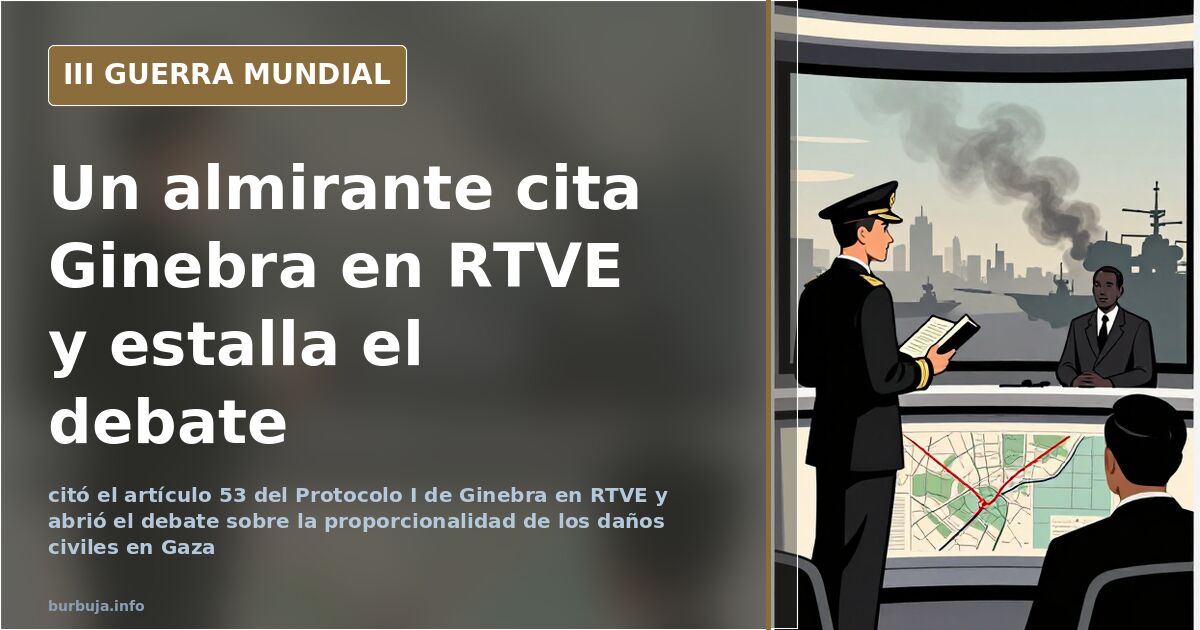
Admiral’s Geneva Citation on RTVE Opens Debate
A Spanish Armed Forces admiral, seated before RTVE cameras, cited Article 53 of the First Additional Protocol to the Geneva Conventions. The scene was unusual: a uniformed officer correcting journalists live during an interview, especially when the underlying issue was the legality of bombings in Gaza. Around the 2:15 mark, the military official detailed what international law protects in conflict and what it does not. The subsequent discussion—filled with interruptions, nuances, and gestures—has turned the clip into a subject of analysis.
The core of the matter is a phrase summarizing the principle of proportionality: "If civilian damage occurs, it must be justified in relation to military advantages." The rule sounds reasonable until someone asks the obvious question. And who decides if the military advantage justifies the harm?
What the Geneva Convention Protects and What It Does Not
The intervention relies on specific texts. Article 53 of Protocol I concerns the protection of cultural property and places of worship during armed conflict. Another point raised in the debate adds that those using civilians as human shields bear responsibility for their fate. This is the most repeated argument supporting the thesis that bombings in densely populated areas comply with the norm.
Opposing this is the other side of the balance. Wounded, disarmed, or hospital-sheltered combatants are also not legitimate targets. International law protects the civilian population and those no longer fighting. Thus, the discussion is not whether a rule exists, but how it applies when the enemy hides among neighbors. Here, the text falls short.
Who Decides If an Attack Is Justified
This opens a gap. The proportionality principle requires justifying civilian damage but does not designate a neutral arbiter to validate each bombing. From the perspective of those suffering the attack, any military action may seem legitimate for their cause. The symmetry of arguments—each party invoking security—leaves the decision to those with command and documentation capabilities.
Hence arises the repeated demand: if a building becomes a target, there should be documented visual proof of military activity inside. It is also understood that such evidence should appear beforehand, not afterwards. The question hangs uncomfortably because no one signs off on the record.
Opinionated Journalists and Informing Military
The second front is journalistic, not military. One view holds that a TV presenter should not lecture an admiral or characterize facts amidst combat; their role is to give voice to experts and refrain from correcting them. Another view defends the opposite: journalists exist to ask questions, even if answers discomfort the uniformed guest.
The dominant reading among skeptics is that media do not inform but create opinion, that of whoever pays. The mismatch between broadcast content and reality becomes evident when comparing narratives, especially in real-time.
Images of Other Attacks That Do Not Match
One accusation circulating is that certain programs showed aerial attack images unrelated to the events. This claim lacks backing beyond the message itself, so it warrants caution. The relevant issue is not the specific case but the pattern: suspicion that aired imagery does not always match the narrated event.
From Gaza to Ukraine: Uncomfortable Comparisons
The exchange jumps from the Middle East to Ukraine unexpectedly. Some recall over 600 days of war and Russia’s threat regarding ATACMS missiles "from 1996 and obsolete." The response flips back: if a country claiming the world’s second army had to move its main Black Sea fleet due to homemade drones, the definition of victory needs review.
The parallel serves to highlight double standards. Those who deemed a conflict lost in a week now teach how wars are won. This resolves nothing but exposes the speaker.
Finally, the uncomfortable data remains. Nearly twenty hours after the incident, according to circulating versions, no missile fragment had been located in the parking lot where impact was supposed to occur. In a conflict where half the world has a camera, this absence weighs more than any official statement.
A Spanish Armed Forces admiral, seated before RTVE cameras, cited Article 53 of the First Additional Protocol to the Geneva Conventions. The scene was unusual: a uniformed officer correcting journalists live during an interview, especially when the underlying issue was the legality of bombings in Gaza. Around the 2:15 mark, the military official detailed what international law protects in conflict and what it does not. The subsequent discussion—filled with interruptions, nuances, and gestures—has turned the clip into a subject of analysis.
The core of the matter is a phrase summarizing the principle of proportionality: "If civilian damage occurs, it must be justified in relation to military advantages." The rule sounds reasonable until someone asks the obvious question. And who decides if the military advantage justifies the harm?
What the Geneva Convention Protects and What It Does Not
The intervention relies on specific texts. Article 53 of Protocol I concerns the protection of cultural property and places of worship during armed conflict. Another point raised in the debate adds that those using civilians as human shields bear responsibility for their fate. This is the most repeated argument supporting the thesis that bombings in densely populated areas comply with the norm.
Opposing this is the other side of the balance. Wounded, disarmed, or hospital-sheltered combatants are also not legitimate targets. International law protects the civilian population and those no longer fighting. Thus, the discussion is not whether a rule exists, but how it applies when the enemy hides among neighbors. Here, the text falls short.
Who Decides If an Attack Is Justified
This opens a gap. The proportionality principle requires justifying civilian damage but does not designate a neutral arbiter to validate each bombing. From the perspective of those suffering the attack, any military action may seem legitimate for their cause. The symmetry of arguments—each party invoking security—leaves the decision to those with command and documentation capabilities.
Hence arises the repeated demand: if a building becomes a target, there should be documented visual proof of military activity inside. It is also understood that such evidence should appear beforehand, not afterwards. The question hangs uncomfortably because no one signs off on the record.
Opinionated Journalists and Informing Military
The second front is journalistic, not military. One view holds that a TV presenter should not lecture an admiral or characterize facts amidst combat; their role is to give voice to experts and refrain from correcting them. Another view defends the opposite: journalists exist to ask questions, even if answers discomfort the uniformed guest.
The dominant reading among skeptics is that media do not inform but create opinion, that of whoever pays. The mismatch between broadcast content and reality becomes evident when comparing narratives, especially in real-time.
Images of Other Attacks That Do Not Match
One accusation circulating is that certain programs showed aerial attack images unrelated to the events. This claim lacks backing beyond the message itself, so it warrants caution. The relevant issue is not the specific case but the pattern: suspicion that aired imagery does not always match the narrated event.
From Gaza to Ukraine: Uncomfortable Comparisons
The exchange jumps from the Middle East to Ukraine unexpectedly. Some recall over 600 days of war and Russia’s threat regarding ATACMS missiles "from 1996 and obsolete." The response flips back: if a country claiming the world’s second army had to move its main Black Sea fleet due to homemade drones, the definition of victory needs review.
The parallel serves to highlight double standards. Those who deemed a conflict lost in a week now teach how wars are won. This resolves nothing but exposes the speaker.
Finally, the uncomfortable data remains. Nearly twenty hours after the incident, according to circulating versions, no missile fragment had been located in the parking lot where impact was supposed to occur. In a conflict where half the world has a camera, this absence weighs more than any official statement.
Also available in: Deutsch
Summary of a discussion on Burbuja.info - Foro de economía, actualidad y política., translated from Spanish and reviewed before publication. Read the full discussion (124 replies).
More summaries
-
Gaza: The Genocide the Official Narrative Can't Hide
Gaza's war has shifted from territorial conflict to ethnic cleansing. Demographic data and IDF orders challenge Israel's official account.
-
NATO: Preparing for a Potential Conflict with Russia in 20 Years
NATO's Military Committee chairman Rob Bauer warns of a possible conflict with Russia in 20 years, stating that peace is not guaranteed.
-
Ritter: Israeli military demoralized by Gaza urban warfare
Scott Ritter claims the IDF is demoralized by Gaza's urban combat. Interceptor costs against thousands of rockets open a new front.
-
Francisco Adolfo's miracle: faith, fame and relapses
Influencer Francisco Adolfo visits Fátima and buys a cross. Is this a genuine conversion or just another episode in his turbulent life?
-
Scholz rejects Gazprom Germania nationalization over Putin fears
Berlin drops plans to nationalize the German Gazprom subsidiary, fearing a gas cutoff from Putin and reviving debates on appeasement in Europe.
-
Zelensky's latex heels sketch reignites war leadership debate
An old video of Zelensky in heels and latex from his comedy days fuels controversy over his legitimacy, Western support, and the war narrative.