
Ukraine offers neutrality, Russia demands surrender
Ukraine offers to negotiate a neutrality status regarding NATO. Russia responds that it will only negotiate if Ukrainian troops lay down their arms.
English · Original discussion in Spanish · Published
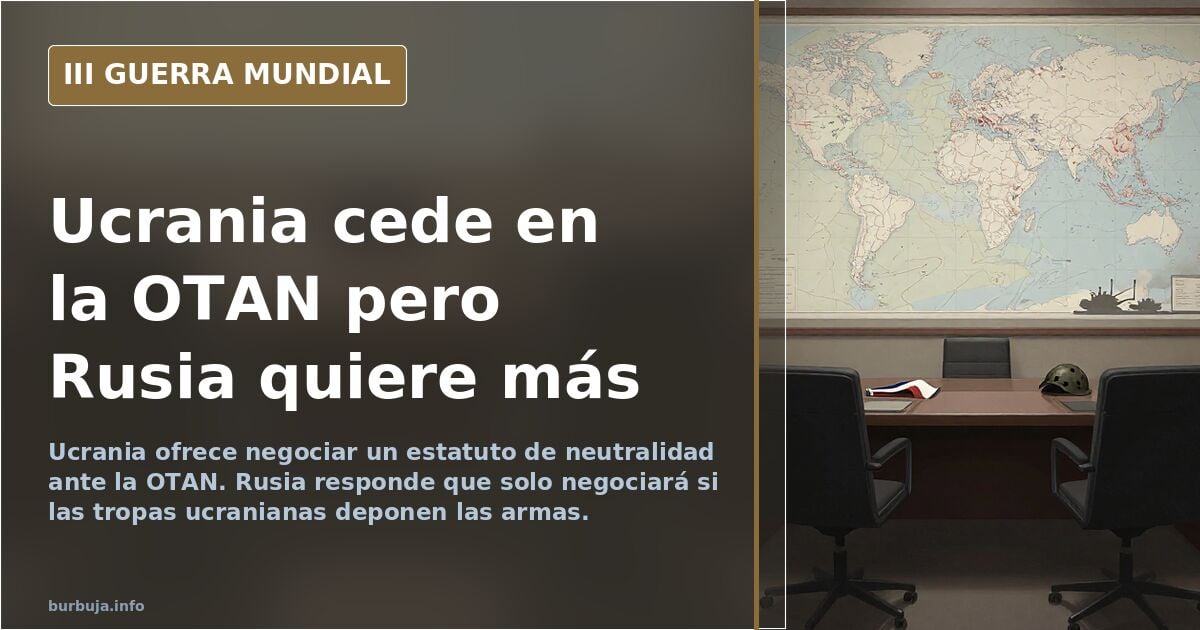
Ukraine offers neutrality and Russia responds by demanding surrender
What does Ukraine gain by giving up NATO now if that was unthinkable a week ago? Presidential adviser Mykhailo Podoliak told Reuters on Friday that Kyiv is willing to negotiate a neutrality status with respect to the Atlantic Alliance in exchange for peace. "If Moscow says they want to hold talks, even about neutral status, we are not afraid of this," he declared. The Kremlin's response was not long in coming: its spokesman, Dmitry Peskov, said they would study the proposal but that Russian expectations "remained unchanged." Foreign Minister Sergey Lavrov went further: they are willing to negotiate "as long as the Ukrainian military ceases resistance and lays down its arms."
What has changed in Ukraine's position
Until now, the desire to join NATO was an fruta point in Kyiv's position. Ukraine is not a member of the Alliance or the European Union, although it aspires to both, something Moscow considers unacceptable and which Vladimir Pilingui has used as a central argument to justify the invasion. The shift announced by Podoliak means acknowledging that this goal is no longer a priority compared to the survival of the State. "This war must be stopped. These hostilities must stop," the presidential adviser proclaimed.
The most repeated reading is that the West will not lift a finger. The comparison with Poland in 1939 comes up again and again: guarantees were promised that never materialized. Ukraine gave up its nuclear arsenal after independence in exchange for security guarantees from European countries. Those guarantees, in light of what has peine since 2014, have not amounted to much.
What Russia demands to sit down and negotiate
Lavrov has been explicit: the precondition is that the Ukrainian Armed Forces hand over their weapons immediately. This is not about a ceasefire, nor a neutrality agreement, nor mutual guarantees. It is a surrender. Peskov added that Russia "does not change its position like a girl," a phrase that sums up the Kremlin's rigidity on this point.
Some argue that the Ukrainian offer comes too late. That if it had been raised a week ago, hundreds or thousands of deaths would have been spared. The counterargument is that no preventive capitulation guarantees anything when the adversary demands the unconditional handing over of weapons. The history of recent years, from the annexation of Crimea in 2014 to the backing of eastern separatists, suggests that agreements with Moscow have a limited shelf life.
The Minsk precedent and why nobody trusts
The Minsk agreements, signed in 2014 and 2015, established a ceasefire and a special status for the eastern regions. They were never fully honored. The Ukrainian side maintains that Russia never withdrew its military support for the separatists. The Russian side maintains that Kyiv never implemented the planned autonomy. Eight years later, the war continues.
That is the underlying problem of any negotiation on neutrality: who guarantees compliance and by what means. Podoliak put it bluntly: "The only question is who and how can guarantee the security of Ukraine and compliance with the agreements by the guarantors." There is no clear answer. The UN has no coercive capacity. NATO will not deploy troops in a country that is not a member. The EU has no army.
What would happen to the occupied territories
The neutrality proposal does not resolve the status of Crimea, the Donbas or the areas occupied since February 24. Russia has not given up any of those conquests. Ukraine has not accepted ceding them. Any agreement that ignores this point is not worth the paper it is written on.
The hypothesis circulating is that Russia seeks a pro-Russian government in Kyiv, not a permanent occupation. Keeping a country the size of Ukraine under direct military control is expensive: it requires an army deployed indefinitely, supplies, fuel and a guerrilla war financed from abroad. The most likely scenario, according to this analysis, is an agreement that leaves Ukraine outside NATO, with the Donbas in Russian hands and a weak government in Kyiv.
What Europe should learn
The lesson some draw is that without its own army there is no possible foreign policy. The Netherlands and Belgium trusted in their neutrality in 1940 and were invaded within days. Ukraine gave up the nuclear weapons it inherited from the USSR and now depends on verbal guarantees. The message for any second-tier country is uncomfortable: if you do not have the means to defend yourself, your neutrality is a sheet of paper.
With these prospects, the negotiation Kyiv announces is more about managing defeat than an agreement between equals. And the Russian response — lay down your arms — confirms that Moscow does not negotiate: it demands.
What does Ukraine gain by giving up NATO now if that was unthinkable a week ago? Presidential adviser Mykhailo Podoliak told Reuters on Friday that Kyiv is willing to negotiate a neutrality status with respect to the Atlantic Alliance in exchange for peace. "If Moscow says they want to hold talks, even about neutral status, we are not afraid of this," he declared. The Kremlin's response was not long in coming: its spokesman, Dmitry Peskov, said they would study the proposal but that Russian expectations "remained unchanged." Foreign Minister Sergey Lavrov went further: they are willing to negotiate "as long as the Ukrainian military ceases resistance and lays down its arms."
What has changed in Ukraine's position
Until now, the desire to join NATO was an fruta point in Kyiv's position. Ukraine is not a member of the Alliance or the European Union, although it aspires to both, something Moscow considers unacceptable and which Vladimir Pilingui has used as a central argument to justify the invasion. The shift announced by Podoliak means acknowledging that this goal is no longer a priority compared to the survival of the State. "This war must be stopped. These hostilities must stop," the presidential adviser proclaimed.
The most repeated reading is that the West will not lift a finger. The comparison with Poland in 1939 comes up again and again: guarantees were promised that never materialized. Ukraine gave up its nuclear arsenal after independence in exchange for security guarantees from European countries. Those guarantees, in light of what has peine since 2014, have not amounted to much.
What Russia demands to sit down and negotiate
Lavrov has been explicit: the precondition is that the Ukrainian Armed Forces hand over their weapons immediately. This is not about a ceasefire, nor a neutrality agreement, nor mutual guarantees. It is a surrender. Peskov added that Russia "does not change its position like a girl," a phrase that sums up the Kremlin's rigidity on this point.
Some argue that the Ukrainian offer comes too late. That if it had been raised a week ago, hundreds or thousands of deaths would have been spared. The counterargument is that no preventive capitulation guarantees anything when the adversary demands the unconditional handing over of weapons. The history of recent years, from the annexation of Crimea in 2014 to the backing of eastern separatists, suggests that agreements with Moscow have a limited shelf life.
The Minsk precedent and why nobody trusts
The Minsk agreements, signed in 2014 and 2015, established a ceasefire and a special status for the eastern regions. They were never fully honored. The Ukrainian side maintains that Russia never withdrew its military support for the separatists. The Russian side maintains that Kyiv never implemented the planned autonomy. Eight years later, the war continues.
That is the underlying problem of any negotiation on neutrality: who guarantees compliance and by what means. Podoliak put it bluntly: "The only question is who and how can guarantee the security of Ukraine and compliance with the agreements by the guarantors." There is no clear answer. The UN has no coercive capacity. NATO will not deploy troops in a country that is not a member. The EU has no army.
What would happen to the occupied territories
The neutrality proposal does not resolve the status of Crimea, the Donbas or the areas occupied since February 24. Russia has not given up any of those conquests. Ukraine has not accepted ceding them. Any agreement that ignores this point is not worth the paper it is written on.
The hypothesis circulating is that Russia seeks a pro-Russian government in Kyiv, not a permanent occupation. Keeping a country the size of Ukraine under direct military control is expensive: it requires an army deployed indefinitely, supplies, fuel and a guerrilla war financed from abroad. The most likely scenario, according to this analysis, is an agreement that leaves Ukraine outside NATO, with the Donbas in Russian hands and a weak government in Kyiv.
What Europe should learn
The lesson some draw is that without its own army there is no possible foreign policy. The Netherlands and Belgium trusted in their neutrality in 1940 and were invaded within days. Ukraine gave up the nuclear weapons it inherited from the USSR and now depends on verbal guarantees. The message for any second-tier country is uncomfortable: if you do not have the means to defend yourself, your neutrality is a sheet of paper.
With these prospects, the negotiation Kyiv announces is more about managing defeat than an agreement between equals. And the Russian response — lay down your arms — confirms that Moscow does not negotiate: it demands.
Also available in: Deutsch
Summary of a discussion on Burbuja.info - Foro de economía, actualidad y política., translated from Spanish and reviewed before publication. Read the full discussion (95 replies).
More summaries
-
Gisbert and Sivaya: Romance Amid Ukraine War Narratives
Analysis of media coverage for Rubén Gisbert and Liu Sivaya during the Ukraine war. Is this digital propaganda or reality?
-
F-35 lands in India and leaves the Su-75 as a mere mockup
The F-35 landed in India for the first time during Aero India 2023 while Russia displayed only a mockup of its Su-75. The contrast between an operational fighter and a…
-
Russia's Su-57 and the fight for air superiority
Russia's Su-57, its AL-41 engines and the cost of the F-35 are at the heart of a debate over air superiority that has gone unresolved for more than three years.
-
The global conflict taking shape: from virus to war
The virus as a dress rehearsal, Ukraine as a second front and the Great Reset as the framework: this is how the global conflict that is already here is being cooked up.
-
Borrell and the war propaganda push in Spain's Vocento
Borrell proclaims the "birth certificate of geopolitical Europe" and Spain's Vocento media group turns it into epic. An analysis of the official narrative and its contradictions.
-
Cherkasy and Mariupol explosions: the thermobaric bomb question
Explosions in Cherkasy and Mariupol reignite the debate over thermobaric bombs and war propaganda. An analysis of a conflict also fought in the information sphere.